Petrotympanic fissure (Latin: fissura petrotympanica)
Also called Glaserian fissure
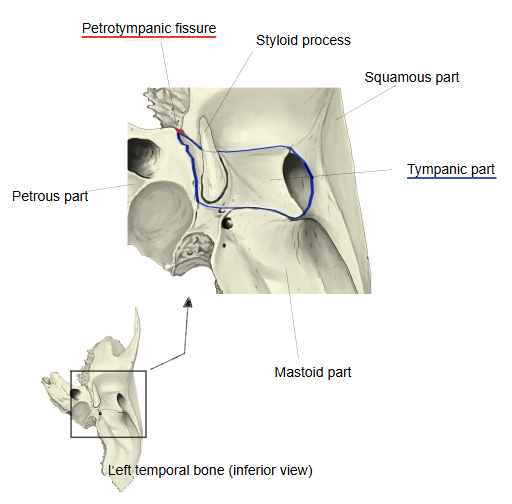
- Squamous part : the part that takes up the middle and the whole upper part of the bone; it has a temporal surface and a cerebral surface.
- Petrous part
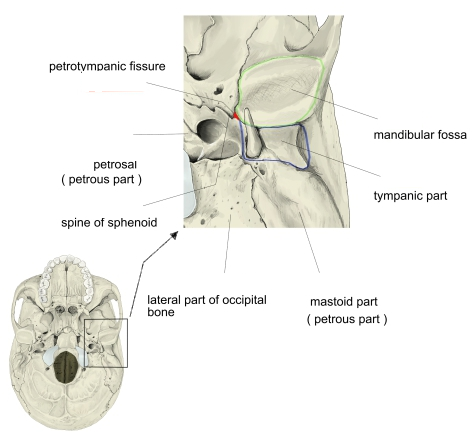
- Mastoid part : below the squamous part (from the mastoid process to the parietal notch). Features: mastoid process, mastoid notch, groove for the occipital artery, groove for the sigmoid sinus, mastoid foramen, occipital border, stylomastoid foramen. Related, but not part of the mastoid part: canaliculus for the chorda tympani and the petrotympanic fissure, which lies between the tympanic and petrous parts.
- Pyramid : a three-sided pyramid running forwards and medially from the boundary of the squamous and mastoid parts, with three surfaces and three borders: the petrous part in the narrow sense.
- Tympanic part : the smallest part: a thin, half-tube-shaped plate of bone that forms the front and lower walls of the external acoustic meatus.
On the underside of the skull the fissure crosses the mandibular fossa, separating its front (articular) part from the back part formed by the tympanic plate; medially it ends near the spine of the sphenoid. It opens into the tympanic cavity just above and in front of the ring that holds the tympanic membrane, as a slit about 2 mm long.
It holds the anterior process and the anterior ligament of the malleus, and transmits the anterior tympanic artery and tympanic veins. The chorda tympani leaves the tympanic cavity through it or through a small canal at its medial end (sources differ) and then joins the lingual nerve.
It is also called the Glaserian fissure, after the Swiss anatomist Johann Heinrich Glaser. Some sources use the names squamotympanic or tympanosquamous fissure for the same line seen from below; strictly, the tegmen tympani splits that line into a petrosquamous part in front and the petrotympanic part behind. Compare the petro-occipital fissure, between the petrous part and the occipital bone.
 Left temporal bone (inferior view)
 External cranial base
Reference websites
[Wikipedia]
· Petrotympanic fissure, Wikipedia.
· Chorda tympani, Wikipedia.
[Websites with illustrations]
· The temporal bone (TeachMeAnatomy)
· Temporal bone: anatomy, parts, sutures and foramina (Kenhub)
· Chorda tympani (Kenhub)
Related terms
- Petro-occipital fissure
- Tympanic part
- Petrous part
- Tympanosquamous fissure
- Articular tubercle
- Chorda tympani
- Anterior tympanic artery
- Anterior process of malleus
References and sources
- Further reading: Petrotympanic fissure, Wikipedia.
- Federative International Programme for Anatomical Terminology (FIPAT). Terminologia Anatomica, 2nd ed. (TA2), 2019.