Horizontal plate (Latin: lamina horizontalis ossis palatini)
Also called: horizontal plate of palatine bone
· Some sources also call it the palatine plate.
· Its anterior border is serrated and joins the palatine process of the maxilla (transverse palatine suture).
· Its medial border is the thickest and is serrated; it joins the horizontal plate of the opposite palatine bone and completes the median palatine suture, which continues from the maxillae in front.
· The back end of the medial border (the back end of the median palatine suture) unites with that of the other side to form a backward-pointing process, the posterior nasal spine.
- Perpendicular plate : the upright plate; it has two surfaces (nasal surface and maxillary surface) and three processes.
- Orbital process : projects upwards and laterally from the top of the perpendicular plate and forms a very small part of the orbit.
- Sphenoidal process : projects upwards and medially from the top of the perpendicular plate and joins the sphenoid bone.
- Pyramidal process : projects backwards and laterally from the lower end of the back of the perpendicular plate.
- Horizontal plate : the horizontal plate; it has two surfaces (nasal surface = superior surface, palatine surface = inferior surface).
Surfaces: the horizontal plate has two surfaces, the superior (or nasal) surface and the inferior (or palatine) surface.
| Surfaces of the horizontal plate | 1 | Superior / nasal surface | · A smooth surface that forms the back part of the floor of the nasal cavity. · Concave from side to side. · The medial border, where it meets the plate of the opposite palatine bone, is raised, because it continues the nasal crest of the maxilla. |
| 2 | Inferior / palatine surface | · A rough surface that forms the back part of the hard palate. · Slightly concave. · Near its posterior margin there is often a transverse ridge, the palatine crest; the greater palatine foramen lies at the back of its lateral border. |
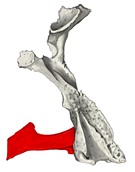 Palatine bone (posterior)
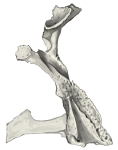 Surfaces of the horizontal plate
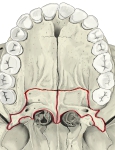 Hard palate (inferior)
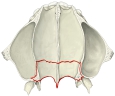 Floor of the nasal cavity
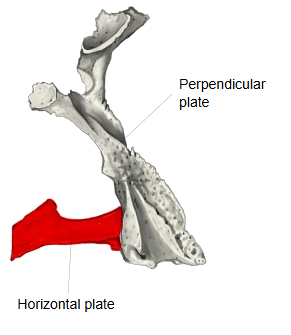
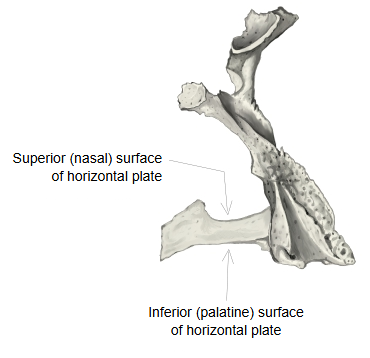
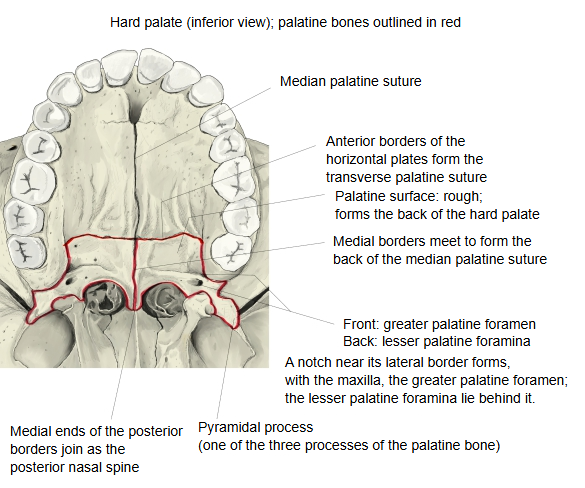
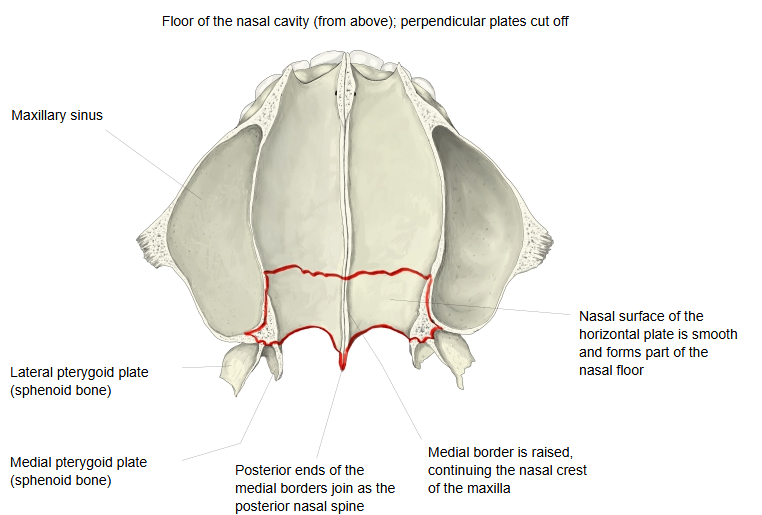
The horizontal plate continues the palatine process of the maxilla backwards and so completes the bony palate. Its superior (nasal) surface is smooth; the border where it meets the opposite plate is raised as on the maxilla (the nasal crest) and projects backwards as the posterior nasal spine. Its inferior (palatine) surface is rough and slightly hollowed, often with a ridge (the palatine crest) near its posterior margin; the greater palatine foramen lies at the back of its lateral border.
The horizontal plate is the flat, roughly four-sided part of the palatine bone. It has two surfaces (superior and inferior) and four borders (anterior, posterior, medial and lateral). Together, the right and left plates make up the back part of the hard palate (the posterior fourth in Gray's Anatomy; some sources say about a third).
Surfaces
Superior (nasal) surface: smooth and concave from side to side; it forms the back part of the floor of the nasal cavity. Inferior (palatine) surface: rough and slightly concave; with the matching surface of the opposite bone it forms the back part of the hard palate. Near its posterior margin there is often a transverse ridge, the palatine crest, for part of the aponeurosis of tensor veli palatini.
Borders
Anterior border: serrated; it joins the palatine process of the maxilla at the transverse palatine suture. Posterior border: concave and free; the soft palate is attached to it. Its medial end is sharp and, united with that of the opposite bone, forms the posterior nasal spine, which gives attachment to the musculus uvulae. Lateral border: joins the lower edge of the perpendicular plate; near its back end it is grooved by the lower end of the greater palatine canal and, with the maxilla, forms the greater palatine foramen; the lesser palatine foramina lie just behind, in the pyramidal process. Medial border: the thickest; serrated for the plate of the opposite side. Its upper edge rises into a ridge which, with that of the opposite bone, forms the back part of the nasal crest, holding the lower edge of the vomer.
Reference websites
[Wikipedia]
· Horizontal plate of palatine bone, Wikipedia.
· Palatine bone, Wikipedia.
[Websites with illustrations]
· Palatine bone: plates, borders, processes, articulations (Kenhub)
· Left palatine bone, posterior aspect (Gray's Anatomy, fig. 169) (Wikimedia Commons)

· Articulation of the left palatine bone with the maxilla (Gray's Anatomy, fig. 167) (Wikimedia Commons)

Where it is found
Related terms
- Perpendicular plate
- Palatine process
- Hard palate
- Transverse palatine suture
- Greater palatine canal
- Pyramidal process
- Palatine bone
References and sources
- Further reading: Horizontal plate of palatine bone, Wikipedia.
- Further reading: Palatine bone, Wikipedia.
- Federative International Programme for Anatomical Terminology (FIPAT). Terminologia Anatomica, 2nd ed. (TA2), 2019.