Gastrocolic ligament (Latin: ligamentum gastrocolicum)
- Overview
- Formation
- Structures passing through it
- Reference websites
- (Wikipedia)
- Where it is found
- Related terms
Overview
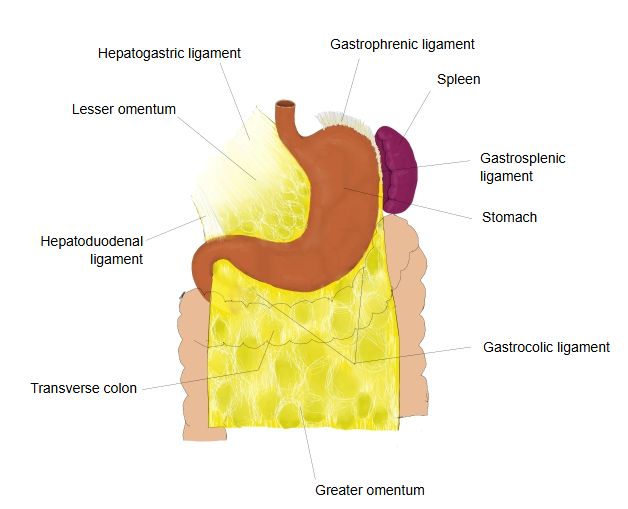
The greater omentum is divided into three or four parts, as below, but "greater omentum" often means this gastrocolic ligament alone, by far its largest part.
It forms part of the anterior wall of the omental bursa (lesser sac). Dividing it is a standard surgical route to the front of the pancreas and the back of the stomach. To the left it is continuous with the gastrosplenic ligament.
omentum
- Gastrocolic ligament : the curtain-like fold that hangs down and forms most of the greater omentum; rich in fat.
- Gastrosplenic ligament : between the upper part of the greater curvature (especially from the fundus to the upper greater curvature) and the spleen (hilum).
- Gastrophrenic ligament : from near the uppermost part of the greater curvature to the underside of the left part of the diaphragm.
- Splenorenal ligament : between the spleen (medial side, near the hilum) and the front of the left kidney. Some sources count it as part of the greater omentum, because it develops from the same structure; others call it one of the peritoneal ligaments.
Note: in the strict sense, the gastrocolic ligament is only the part of the greater omentum between the stomach and the transverse colon (not the apron that hangs down and folds back up), as in the drawing below. In that case the grouping above no longer fits exactly.
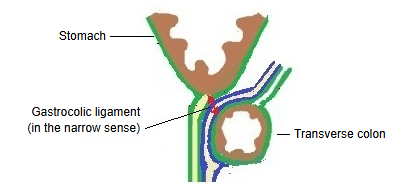
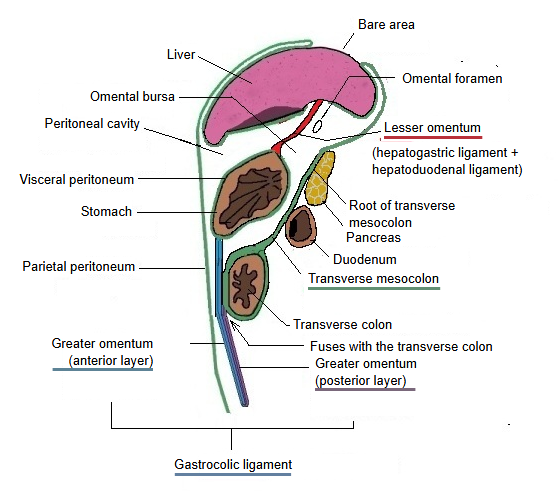
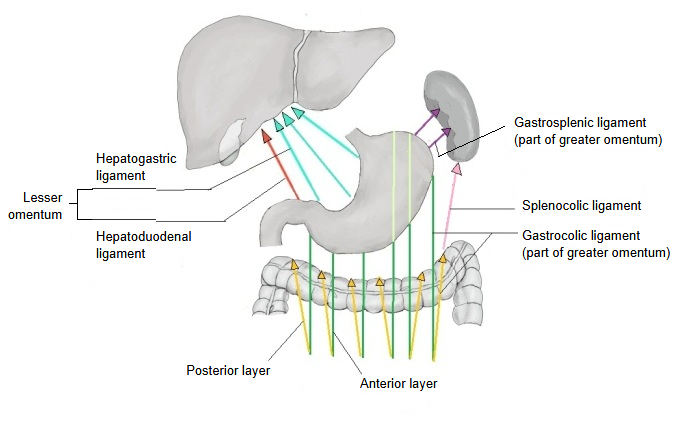
 Lesser and greater omenta (anterior)
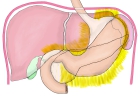 Peritoneal folds around the stomach
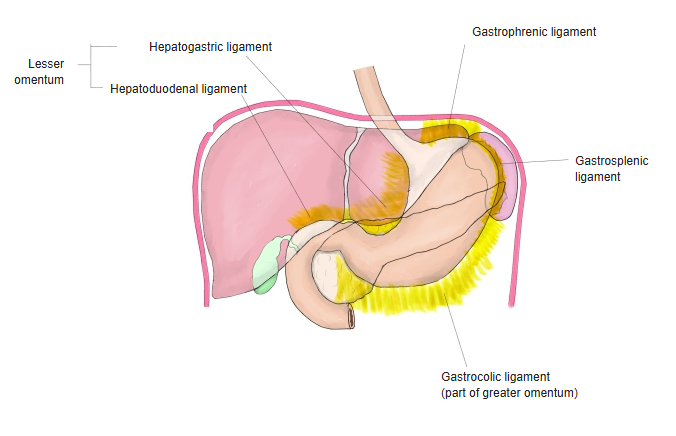
Formation
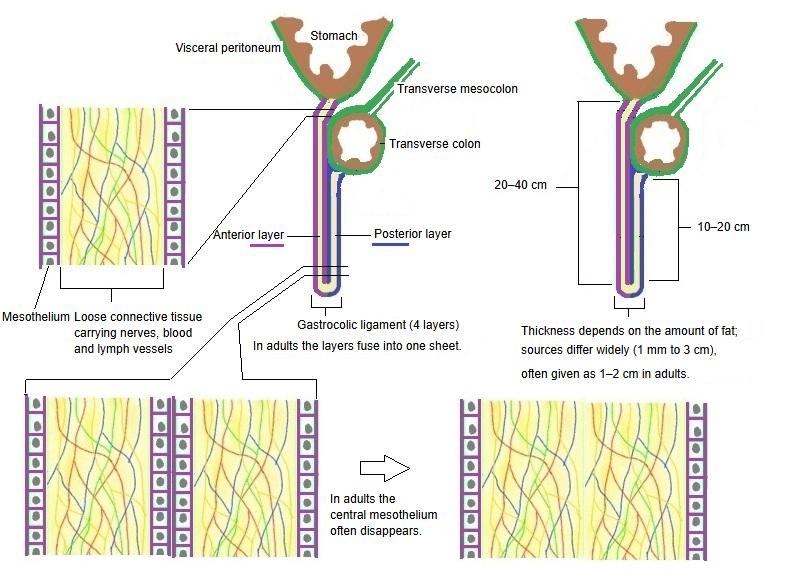
The formation of the greater omentum, in simple steps:
1. 1. The visceral peritoneum covering the front and back of the stomach meets at the greater curvature and hangs down as a double sheet, carrying adipose tissue, nerves, blood vessels and lymphatic vessels.
(The length of the hanging part varies greatly between people and with body fat.)
2. 2. At its lower edge it turns back on itself and rises again, lying close against the sheet that came down.
(The descending double sheet is called the anterior layer and the ascending one the posterior layer, so the apron has four layers of peritoneum; in adults they usually fuse into a single sheet, and the mesothelium between them often disappears.)
3. 3. Still lying against the anterior layer, the posterior layer rises to the transverse colon and ends by fusing with its visceral peritoneum and with the transverse mesocolon. Sources differ on whether the name covers only the short stretch between the stomach and the colon or the whole apron.
Structures passing through it
Arteries
1. 1. Right gastro-omental (gastroepiploic) artery; 2. left gastro-omental (gastroepiploic) artery. They run along the greater curvature between the layers and join each other there; their omental branches descend into the apron.
Veins
The veins accompanying these arteries: the right gastro-omental vein drains into the superior mesenteric vein, the left gastro-omental vein into the splenic vein.
Nerves
Mainly autonomic nerve fibres from the coeliac plexus.
1. 1. Gastric branches from the coeliac plexus; 2. branches from the splenic plexus. They run with the gastro-omental arteries to the stomach.
Lymphatic vessels and lymph nodes
The lymphatic vessels of the greater curvature of the stomach run in the greater omentum.
Main lymph nodes: the right and left gastro-omental lymph nodes, which drain towards the subpyloric and splenic nodes.
Reference websites
[Wikipedia]
· Gastrocolic ligament, Wikipedia.
· Greater omentum, Wikipedia.
Where it is found
Related terms
- Greater omentum
- Gastrosplenic ligament
- Gastrophrenic ligament
- Transverse mesocolon
- Lesser omentum
- Stomach
- Colon
References and sources
- Further reading: Gastrocolic ligament, Wikipedia.
- Further reading: Greater omentum, Wikipedia.
- Federative International Programme for Anatomical Terminology (FIPAT). Terminologia Anatomica, 2nd ed. (TA2), 2019.