Mesothelium (Latin: mesothelium)
Overview
· A single layer of very thin, flat cells resting on a basement membrane; the cells carry short microvilli on their free surface.
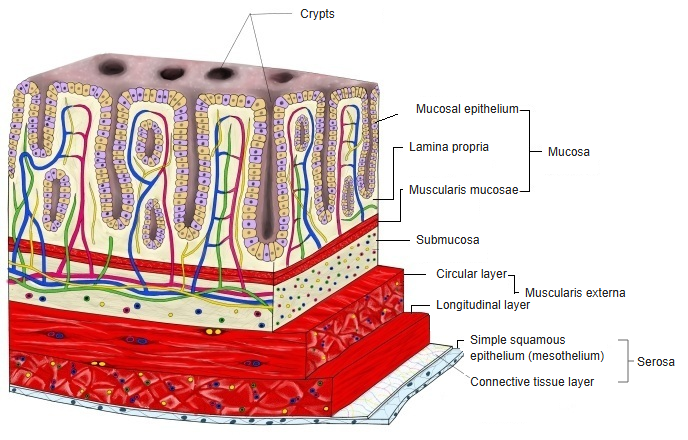
· With the connective tissue beneath it, it forms the pleura, the serous pericardium and the peritoneum. It covers both the parietal layer (on the body wall) and the visceral layer (on the organ surface) of each serous membrane.
· It produces a thin film of serous fluid that lubricates the surfaces, so organs such as the lungs, heart and intestines can slide against their neighbours with little friction.
· Develops from the mesoderm. A malignant tumour arising from it is called mesothelioma, which is strongly linked to asbestos exposure.
Epithelium, endothelium and mesothelium
| Feature | Epithelium | Endothelium | Mesothelium | |
|---|---|---|---|---|
| 1 | Place in classification | General name for epithelial tissue | A kind of epithelium | A kind of epithelium |
| 2 | Basic structure | Simple or stratified; flat, cuboidal or columnar (varied) | Simple squamous epithelium only | Simple squamous epithelium only |
| 3 | What it covers | Body surface, cavities, tubes and organ surfaces | Inner surface of the heart, blood vessels and lymph vessels | Inner surface of the body cavities (the serous membranes) |
| 4 | Main sites | Skin, gastrointestinal tract, respiratory tract, glands, etc. | Arteries, veins, capillaries, lymph vessels | Peritoneum, pleura, serous pericardium |
| 5 | Functions | Protection, absorption, secretion, sensation | Exchange between blood and tissues, control of blood flow, prevention of clotting | Lubrication, less friction, protection of the cavities |
| 6 | Germ-layer origin | Ectoderm, endoderm and mesoderm | Mesoderm | Mesoderm |
| 7 | Relation to connective tissue | Rests on it across a basement membrane | Rests on it across a basement membrane | Lies on the subserous connective tissue |
| 8 | Appearance in sections | Varied (layered, columnar, etc.) | Very thin and flat | Very thin and flat |
| 9 | In the large intestine | Mucosal epithelium (absorption and secretion) | Lines the vessels in the wall | Covers the serosa (parts inside the peritoneal cavity) |
Sources differ on classification: many texts treat endothelium and mesothelium as special kinds of simple squamous epithelium, while others describe them as separate tissue types because they come from the mesoderm.
Where it is found
Related terms
- Peritoneum
- Pleura
- Serous pericardium
- Peritoneal cavity
- Pleural cavity
- Pericardial cavity
- Visceral peritoneum
References and sources
- Further reading: Mesothelium, Wikipedia.
- Further reading: Serous membrane, Wikipedia.
- Federative International Programme for Anatomical Terminology (FIPAT). Terminologia Anatomica, 2nd ed. (TA2), 2019.