Helicotrema (Latin: helicotrema)
How the two scalae meet at the apex of the cochlea:
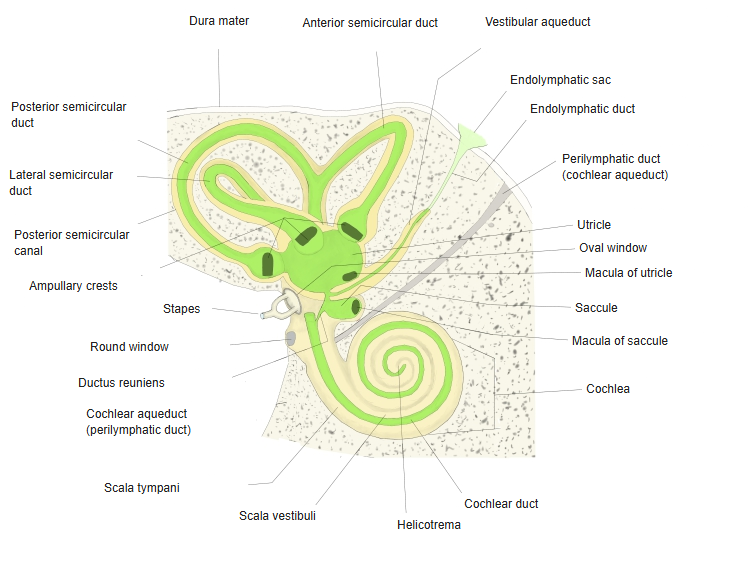
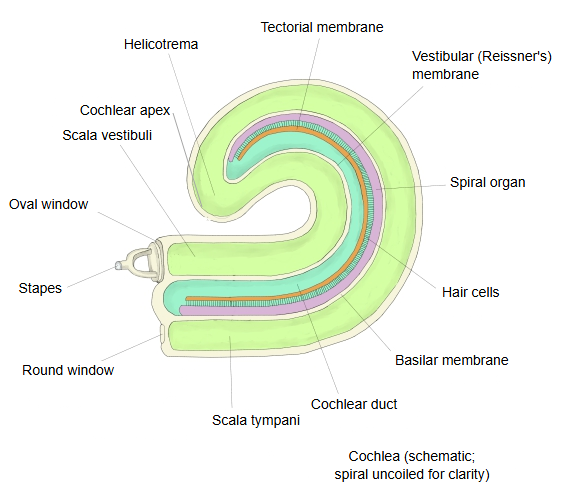
Along the spiral of the cochlea the scala vestibuli and the scala tympani are separated by the cochlear duct, but at the cochlear cupula the cochlear duct ends blindly.
Beyond its blind end the two scalae unite, so their lumens are continuous. This communicating opening is crescent-shaped and is called the helicotrema.
- Spiral canal of cochlea
- Upper level
- Scala vestibuli : filled with perilymph; passes the sound vibrations on to the cochlear duct; part of the bony labyrinth
- Vestibular (Reissner's) membrane
- Cochlear duct : filled with endolymph; contains the spiral organ; both ends are blindContents: tectorial membrane, organ of Corti, internal and external spiral sulci, spiral prominence, stria vascularis
- Osseous spiral lamina + basilar membrane : (+ secondary spiral lamina)
- Lower level
- Scala tympani : part of the bony labyrinth, filled with perilymph; the travelling wave passes on into the scala tympani
- Whole length : about 3 cm, 2.5–2.75 turns
- Upper level
- Modiolus : the cone of spongy bone at the centre of the cochlea, with the longitudinal canals and the spiral canal of the modiolus
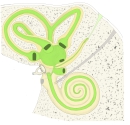 Bony and membranous labyrinth
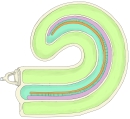 Cochlea (schematic)
Reference websites
[Wikipedia]
· Helicotrema, Wikipedia.
· Cochlea, Wikipedia.
[Websites with illustrations]
· Diagrammatic section of the cochlea (Gray's Anatomy) (Wikimedia Commons)

· Helicotrema (Wikimedia Commons)

Structure
The helicotrema lies at the apex of the cochlea, the cochlear cupula. Here the cochlear duct ends blindly just short of the apex, and beyond its tip the scala vestibuli and the scala tympani are continuous. Its outline is a small crescent, bounded by the hooked free end of the osseous spiral lamina (the hamulus) and the top of the modiolus.
Function
Perilymph can pass through the helicotrema from one scala to the other, so the two scalae form one continuous part of the perilymphatic space. The hair cells in the apical turn of the cochlea, near the helicotrema, respond best to low-frequency sounds.
Related terms
References and sources
- Further reading: Helicotrema, Wikipedia.
- Further reading: Cochlea, Wikipedia.
- Federative International Programme for Anatomical Terminology (FIPAT). Terminologia Anatomica, 2nd ed. (TA2), 2019.