Thoracolumbar fascia (Latin: fascia thoracolumbalis)
Also called the lumbodorsal fascia
It is a strong sheet of deep fascia and aponeuroses on the back of the trunk that encloses the erector spinae and the other deep (intrinsic) back muscles from the thorax down to the sacrum and separates them from the muscles that join the trunk to the upper limb. The latissimus dorsi and serratus posterior inferior arise from it, and the internal oblique and transversus abdominis attach to it at the side. It helps to transfer load between the trunk, the pelvis and the limbs, and it is often discussed as a possible source of low back pain.
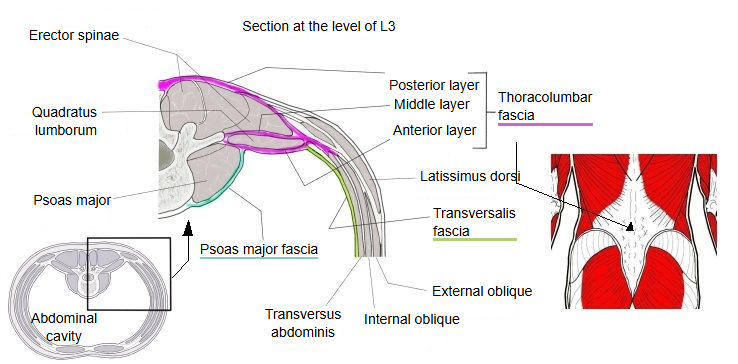
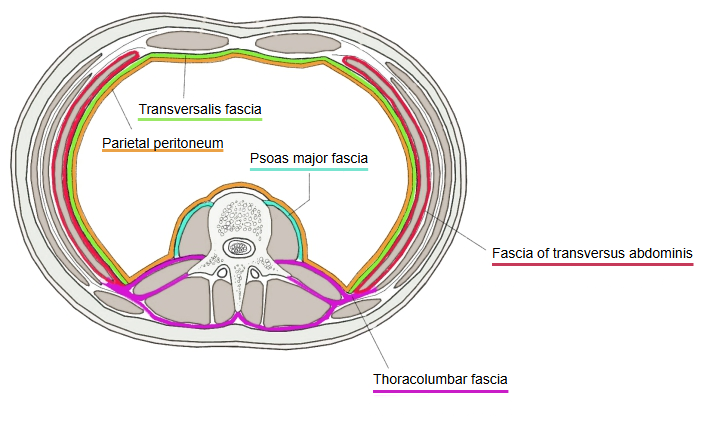
In the lumbar region it is thickest and has three layers. The posterior layer covers the back of the erector spinae and is attached to the lumbar and sacral spinous processes and the supraspinous ligament. The middle layer lies between the erector spinae and the quadratus lumborum and is attached to the tips of the lumbar transverse processes, the 12th rib and the iliac crest. The anterior layer covers the front of the quadratus lumborum, is attached to the front of the transverse processes and blends with the transversalis fascia and the psoas fascia. At the lateral border of the erector spinae the posterior and middle layers fuse, and the anterior layer joins them at the side of the quadratus lumborum, giving origin to the transversus abdominis. Some books count only two layers and treat the anterior layer as the fascia of quadratus lumborum; sources differ.
In the thorax only a thin single layer remains, covering the deep back muscles; it is attached to the thoracic spinous processes and the angles of the ribs and lies deep to the serratus posterior superior. Above, it becomes continuous with the deep fascia of the back of the neck. Below, the layers fuse into a thick sheet attached to the posterior superior iliac spine, the iliac crest, the sacrum and the sacrotuberous ligament.
Reference websites
[Wikipedia]
· Thoracolumbar fascia, Wikipedia.
[Websites with illustrations]
· Thoracolumbar fascia (posterior view) (Kenhub)

· Layers of the thoracolumbar fascia (TeachMeAnatomy)

· Anterior, middle and posterior layers in a transverse section of the lumbar region (X (Twitter))

Related terms
- Muscles of the back
- Transversalis fascia
- Latissimus dorsi
- Quadratus lumborum
- Transversus abdominis
- Internal oblique
- Serratus posterior inferior
References and sources
- Further reading: Thoracolumbar fascia, Wikipedia.
- Federative International Programme for Anatomical Terminology (FIPAT). Terminologia Anatomica, 2nd ed. (TA2), 2019.