Longissimus (Latin: musculus longissimus)
Also called the longissimus muscles
of the
back
(21)
- Superficial back muscles (5) : = spinohumeral muscles: first layer (2), second layer (3)
- Deep back muscles (16)
- First layer (2) : = spinocostal muscles
- Second layer (14) : = intrinsic back muscles
- Muscles of the vertebral column (10)
- Splenius (2)
- Erector spinae (3) : iliocostalis, longissimus, spinalis
- Transversospinalis (3)
- Others (2)
- Suboccipital muscles (4)
- Muscles of the vertebral column (10)
ssimus
- Longissimus capitis : joins the transverse and articular processes of the lower cervical and upper thoracic vertebrae to the mastoid process of the temporal bone.
- Longissimus cervicis : joins the transverse processes of the upper thoracic vertebrae to those of the cervical vertebrae.
- Longissimus thoracis : arises together with the iliocostalis and inserts into the lumbar and thoracic vertebrae and the ribs.
· For the origin and insertion of each part, see the page of that muscle.
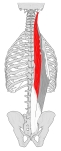 Longissimus (posterior view)
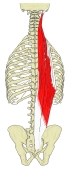 Erector spinae (lateral columns)
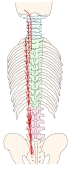 Three parts of the longissimus
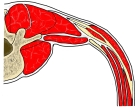 Back muscles at L3 (section)
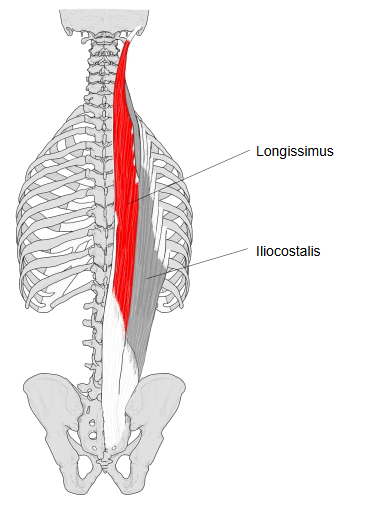
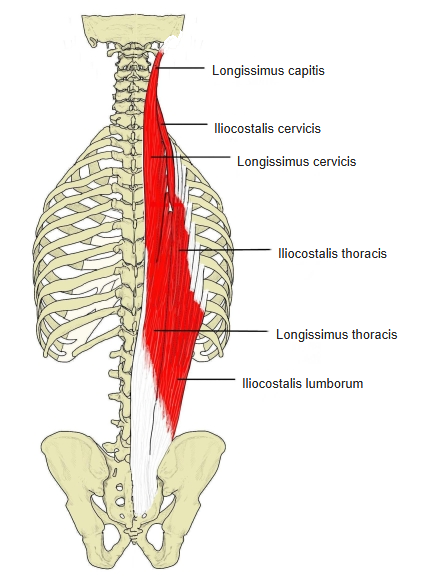
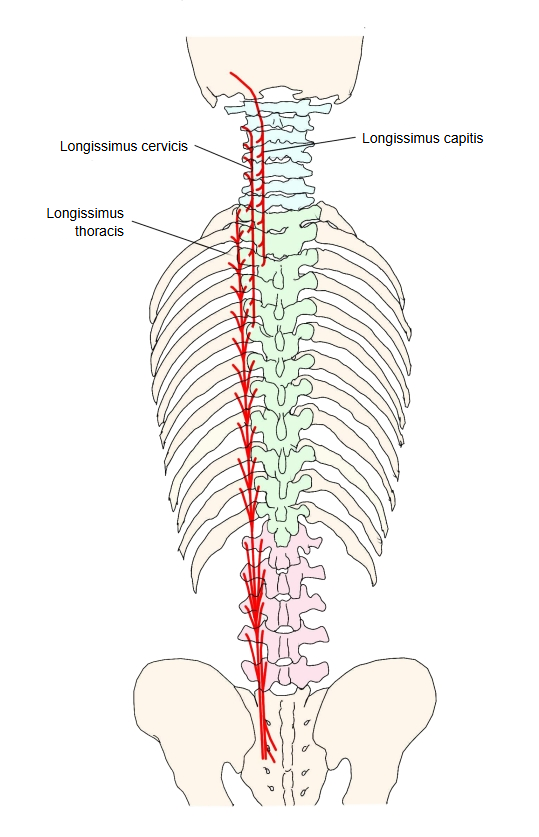
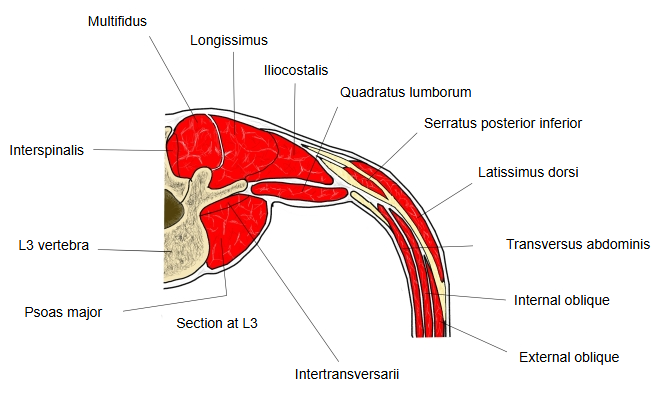
The longissimus is the middle column of the erector spinae: it lies medial to the iliocostalis and lateral to the spinalis; in the neck the longissimus capitis lies lateral to the deeper semispinalis capitis. Like the iliocostalis, its bundles arise medially and insert laterally, but its build is more complex. In the thoracic and lumbar region it has medial insertions on the transverse processes of the thoracic vertebrae and the accessory processes of the lumbar vertebrae, and lateral insertions on the ribs, so its fascicles are fixed both to the ribs and to the vertebral column. Its highest part ends far laterally on the mastoid process, which helps it turn the head to the same side. Acting on both sides it extends the vertebral column and the head. It is supplied by the posterior rami of the spinal nerves.
Reference websites
[Wikipedia]
· Longissimus, Wikipedia.
· Erector spinae muscles, Wikipedia.
[Websites with illustrations]
· Erector spinae: attachments, innervation and function (Kenhub)
· The intrinsic back muscles (TeachMeAnatomy)
· Deep muscles of the back (Gray's Anatomy, fig. 389) (Wikimedia Commons)

Related terms
- Erector spinae
- Iliocostalis
- Spinalis
- Intrinsic back muscles
- Deep back muscles
- Transversospinalis muscles
- Mastoid process
References and sources
- Further reading: Longissimus, Wikipedia.
- Further reading: Erector spinae muscles, Wikipedia.
- Federative International Programme for Anatomical Terminology (FIPAT). Terminologia Anatomica, 2nd ed. (TA2), 2019.