Spinalis (Latin: musculus spinalis)
Also called the spinalis muscles
- Superficial back muscles : first layer, second layer
- Deep back muscles
- First layer
- Second layer
- Muscles of the vertebral column : = intrinsic back muscles
- Splenius
- Erector spinae : iliocostalis, longissimus, spinalis
- Transversospinalis
- Others
- Suboccipital muscles
- Muscles of the vertebral column : = intrinsic back muscles
- Spinalis capitis : runs up to the occipital bone near the external occipital protuberance. It is usually inseparable from the semispinalis capitis, and many books treat it as part of that muscle.
- Spinalis cervicis : from the lower cervical and upper thoracic spinous processes to the spinous process of the axis and the vertebrae below it. It is often poorly developed or absent.
- Spinalis thoracis : from the spinous processes of the upper lumbar and lowest thoracic vertebrae to those of the upper thoracic vertebrae. It blends with the longissimus thoracis.
 Spinalis and interspinales
 Spinalis cervicis and thoracis (lines)
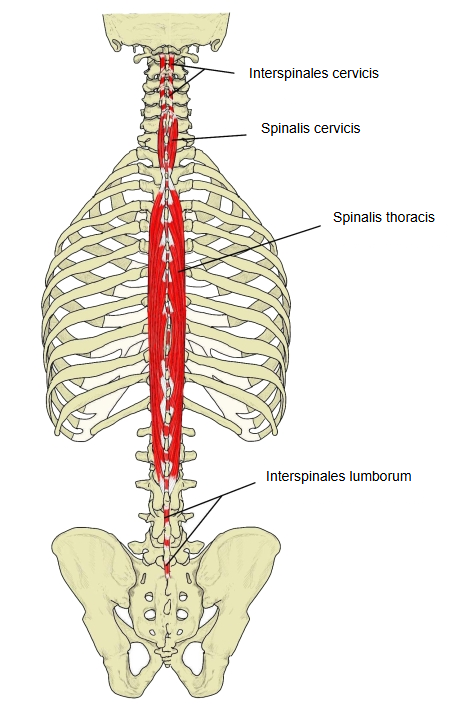
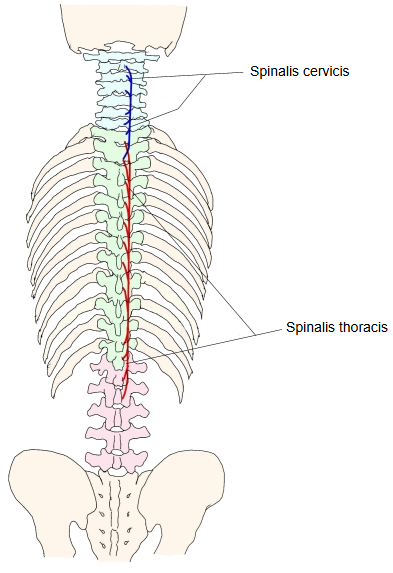
· The erector spinae has three columns: iliocostalis (lateral), longissimus (intermediate) and spinalis (medial). The spinalis lies between the spinous processes and the longissimus.
· Its fibres arise from lower spinous processes and insert into spinous processes a few segments higher, arching over the segments in between.
· It is divided into the spinalis thoracis, spinalis cervicis and spinalis capitis. The thoracic part is the most constant and the best developed; the other two (spinalis cervicis and spinalis capitis) are small and often poorly developed or missing. In rare cases fibres run from the spinous processes of the cervical and upper thoracic vertebrae to the external occipital protuberance (spinalis capitis).
· Action: it extends the vertebral column. Nerve supply: posterior rami of the spinal nerves.
Reference websites
[Wikipedia]
· Spinalis, Wikipedia.
· Erector spinae muscles, Wikipedia.
[Websites with illustrations]
· Erector spinae: attachments, innervation and function (Kenhub)
· The intrinsic back muscles (TeachMeAnatomy)
· Deep muscles of the back (Gray's Anatomy, fig. 389) (Wikimedia Commons)

Related terms
- Spinalis thoracis
- Spinalis cervicis
- Muscles of the back
- Longissimus thoracis
- Iliocostalis thoracis
- Semispinalis capitis
- Spinous process
References and sources
- Further reading: Spinalis, Wikipedia.
- Further reading: Erector spinae muscles, Wikipedia.
- Federative International Programme for Anatomical Terminology (FIPAT). Terminologia Anatomica, 2nd ed. (TA2), 2019.