Bile (Latin: bilis)
Also called the gall
Overview
juices
- Saliva : where: oral cavity (salivary glands); contents: amylase, lipase and others; action: digestion of carbohydrates.
- Gastric juice : where: stomach; contents: hydrochloric acid, pepsin; action: digestion of protein, killing microbes.
- Pancreatic juice : where: pancreas; contents: amylase, lipase and others; action: digestion of all three main nutrients (carbohydrates, proteins and fats).
- Bile : where: liver; contents: bile acids, bilirubin and others; action: helps the digestion of fat. Unlike the other juices it contains no digestive enzymes.
- Intestinal juice : where: small intestine; contents: peptidases, maltase and others; action: last stage of digestion, helps absorption.
A more detailed diagram
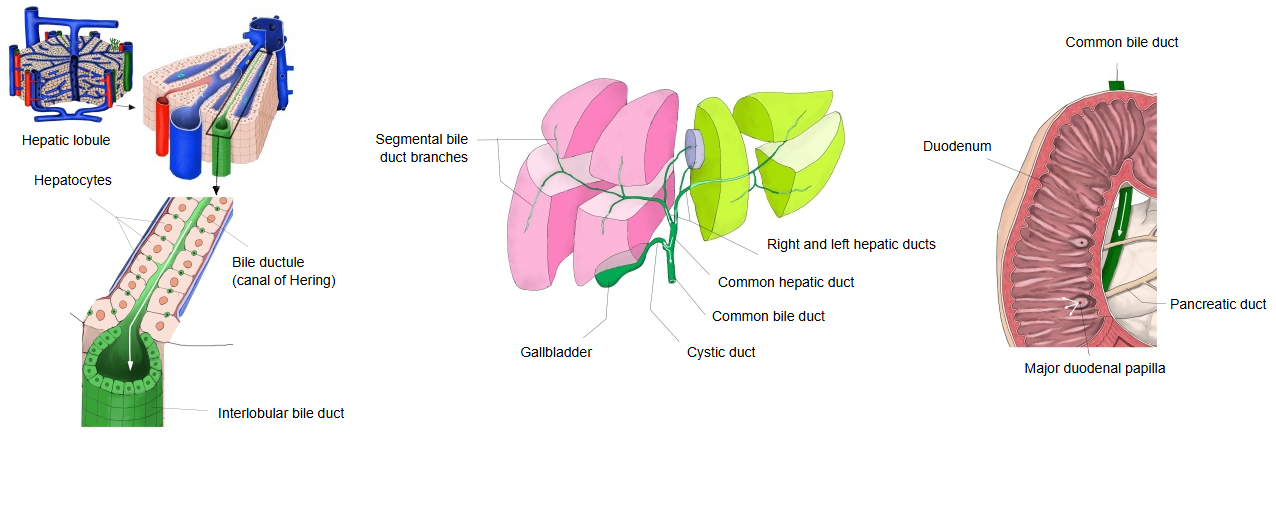
The diagram below shows simply how bile travels from where it is made to where it is released. For the ducts themselves see bile duct.
From the hepatocytes to the duodenum
In the hepatic lobule bile flows in the opposite direction to the blood: from the centre outward.
Bile acids: emulsify fat and so help the digestive enzymes to work.
Bile pigments: mainly bilirubin, a breakdown product of the haem of haemoglobin from red blood cells.
· Bile contains no digestive enzymes, unlike the other digestive juices.
Functions of bile
1. 1. Helping the digestion of fat
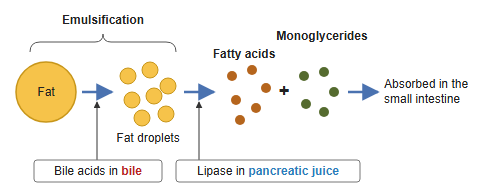
· The bile salts in bile break masses of fat up into small droplets (emulsification) and form micelles around them.
· The fat in these droplets has a much larger surface for the enzyme lipase of the pancreatic juice, which splits it into fatty acids and monoglycerides; these are absorbed in the small intestine. This also helps the absorption of the fat-soluble vitamins A, D, E and K.
2. 2. Removing waste products
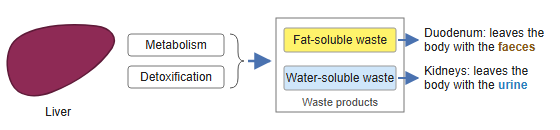
Bile carries the fat-soluble waste made by the metabolism and detoxification work of the liver (such as bilirubin and many drug metabolites) into the duodenum, from where it leaves the body with the faeces.
Note: water-soluble waste (such as urea and creatinine) is carried by the blood to the kidneys and leaves the body in the urine.
Other
Enterohepatic circulation: the circulation in which bile components (mainly bile acids) are reabsorbed in the small intestine (mainly the terminal ileum), return to the liver in the portal blood and are secreted into the bile again; most of the bile acids are reused in this way.
Being alkaline, bile also helps to neutralise the acid coming from the stomach into the duodenum.
Related terms
References and sources
- Further reading: Bile, Wikipedia.
- Further reading: Enterohepatic circulation, Wikipedia.
- Federative International Programme for Anatomical Terminology (FIPAT). Terminologia Anatomica, 2nd ed. (TA2), 2019.