Gland (Latin: glandula)
Also called the secretory gland
Overview
A gland is a group of cells in an organ of the body that carries out secretion.
· Also called a secretory gland.
Glands are divided broadly into exocrine glands, which secrete sweat, sebum and the like, and endocrine glands, which secrete hormones and the like.
Secrete through a ductHave no duct
(Secretory)
gland
gland
- Exocrine glands
- Onto the body surface : sweat glands (eccrine and apocrine), sebaceous glands, mammary gland = skin glands
- Into the digestive tract : salivary glands, pancreas, liver, gastric glands, duodenal glands
- Other : nasal glands
- Endocrine glands
- Brain : pituitary gland, pineal gland
- Neck : thyroid gland, parathyroid glands
- Viscera : suprarenal glands, pancreas (pancreatic islets)
- Reproductive organs : gonads (ovary with its corpus luteum, testis); in pregnancy also the placenta
Exocrine glands
The typical structural features of an exocrine gland are the secretory end piece (which makes the secretion) and the duct (which carries it away).
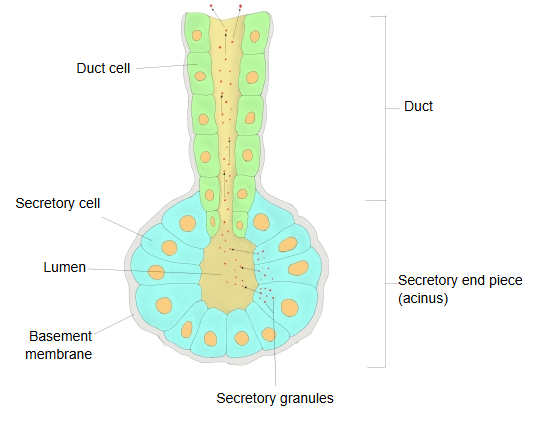
A short table of typical examples:
| Type | Secretion | Site | Function | |
|---|---|---|---|---|
| 1 | Sweat glands | Sweat | Skin of the whole body | Temperature control; keeps the skin moist |
| 2 | Salivary glands | Saliva | Mouth (oral cavity) | Digestion; kills germs |
| 3 | Lacrimal gland | Tears | Above and lateral to the eyeball, behind the upper eyelid | Keeps the eye moist; kills germs; protection |
| 4 | Sebaceous glands | Sebum | Skin with hair, all over the body | Protection; keeps the skin from drying |
| 5 | Gastric glands | Gastric juice | Mucosa of the stomach | Digestion; kills germs |
| 6 | Intestinal glands | Intestinal juice | Mucosa lining the intestinal wall | Digestion |
| 7 | Pancreas (exocrine part) | Pancreatic juice | Throughout the pancreas | Digestion (of carbohydrates, proteins and fats) |
| 8 | Mammary gland | Milk | Inside the breast | Nourishes the infant |
| 9 | Mucous glands | Mucus | Mucosa of the respiratory and digestive tracts | Keeps surfaces moist; protects against invaders |
Endocrine glands
The cells of endocrine glands are not arranged in one uniform pattern as in exocrine glands, but each site has its own typical arrangement.
| Arrangement | Notes | |
|---|---|---|
| 1 | Cords (the most common) | The cells line up in long strands (cords) that branch and join into a network; capillaries run closely in the narrow spaces between the cords. Examples: pituitary gland, suprarenal gland, pancreatic islets |
| 2 | Follicles | The cells form round, hollow balls (follicles). The hormone made is first stored in the central cavity of the follicle and released into the surrounding vessels when needed. Examples: thyroid gland, pituitary gland (intermediate part) |
| 3 | Layers | The cells are stacked in neat layers by type and role; each layer makes a different kind of hormone. Example: suprarenal cortex |
A short list follows.
| Name | Site | Main hormones | Action | |
|---|---|---|---|---|
| 1 | Hypothalamus | Centre of the brain | Releasing hormones and others | Gives orders to the pituitary gland just below it and controls how much hormone it releases |
| 2 | Pituitary gland | Base (underside) of the brain | Growth hormone Various stimulating hormones Antidiuretic hormone (vasopressin) | Promotes body growth. Tells other endocrine glands to release their hormones. Reduces the amount of urine and keeps water in the body. |
| 3 | Thyroid gland | Front of the neck (below the Adam's apple) | Thyroid hormones (thyroxine and others) | Raises the metabolism of the whole body and the energy it produces |
| 4 | Parathyroid glands | Back of the thyroid gland (usually four) | Parathyroid hormone (parathormone) | Raises the calcium in the blood, for example by releasing calcium from bone |
| 5 | Suprarenal glands | Just above the kidneys | Cortisol Aldosterone Adrenaline | Helps the body cope with stress; keeps the balance of salt and water. Raises the heart rate and readies the body for action |
| 6 | Pancreas (pancreatic islets) | Deep in the abdomen (behind the stomach) | Insulin Glucagon | Controls the blood sugar level |
| 7 | Testes (male) | In the scrotum | Testosterone (male sex hormone) | Builds the male body form, such as muscle and facial hair; supports sperm production |
| 8 | Ovaries (female) | In the pelvis (on each side of the uterus) | Oestrogen (follicular hormone) Progesterone (corpus luteum hormone) | Builds the female body form; controls the menstrual cycle and prepares the body for pregnancy |
| 9 | Pineal gland | Deep in the middle of the brain | Melatonin | Brings on sleepiness at night and sets the sleep-wake rhythm (body clock) |
Related terms
References and sources
- Further reading: Gland, Wikipedia.
- Further reading: Exocrine gland, Wikipedia.
- Further reading: Endocrine gland, Wikipedia.
- Federative International Programme for Anatomical Terminology (FIPAT). Terminologia Anatomica, 2nd ed. (TA2), 2019.