Duct (of an exocrine gland) (Latin: ductus)
Also called the excretory duct system of a gland
- Overview
- Exocrine glands without a duct
- Reference websites
- (Wikipedia, websites with illustrations)
- Related terms
Overview
exocrine
gland
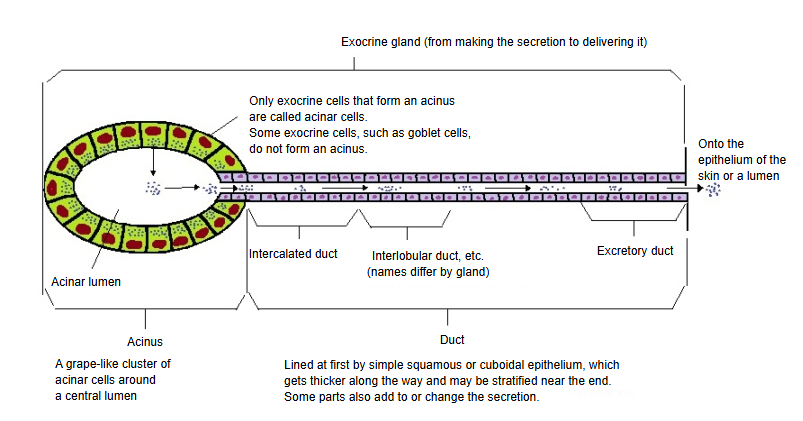
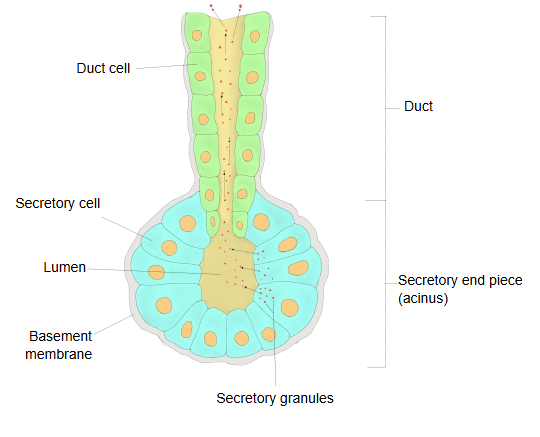
- Exocrine cells : the secretory cells. Most of them form a gland structure, usually an acinus; some do not, such as goblet cells.
- Glandular (acinar) lumen : the space inside the acinus into which the secretion is first released.
- Duct : the route that carries the secretion away from the lumen; some parts also take part in secretion.
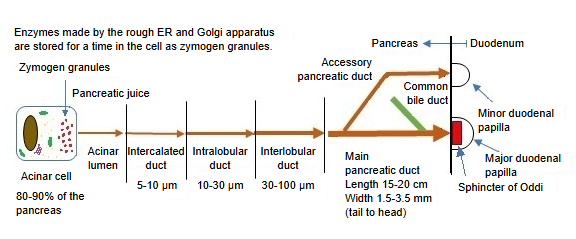
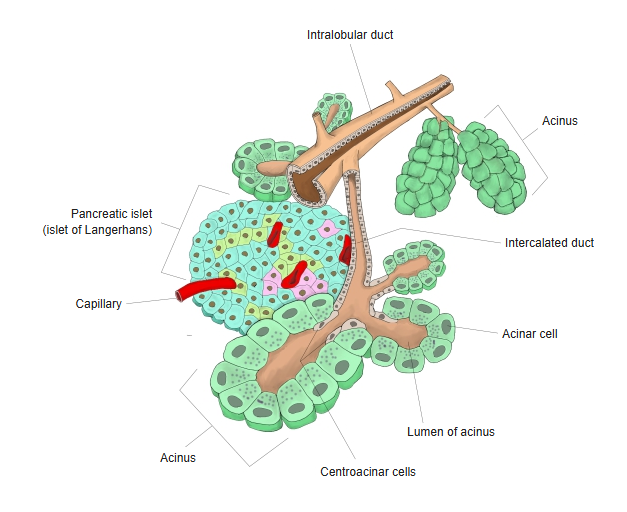
The diagram below shows the flow of pancreatic juice in the pancreas.
In the pancreas the duct runs from the intercalated ducts to the main pancreatic duct.
The parts of the duct and their functions, taking the salivary glands as the example:
| Part of the duct | Epithelium | Main function | Secretion | |
|---|---|---|---|---|
| 1 | Intercalated duct | Simple squamous to cuboidal | Receives the secretion and carries it on | Some secretion of bicarbonate (HCO₃⁻) |
| 2 | Striated duct | Simple columnar, with many mitochondria at the base | Takes back and secretes electrolytes; little water is taken back | Takes back Na⁺; secretes K⁺ and HCO₃⁻ |
| 3 | Excretory duct | Pseudostratified to stratified | Passage that carries the secretion | Normally none |
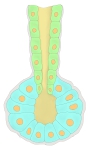 Exocrine gland
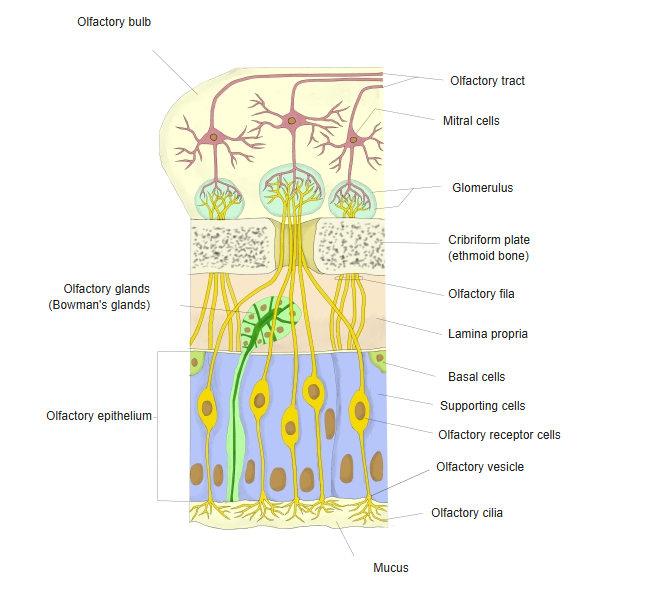
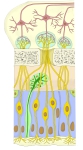 Olfactory glands (nasal mucosa)
 Acini of the pancreas
Exocrine glands without a duct
Which exocrine glands, apart from goblet cells, have no duct?
The best-known exocrine gland without a duct is the goblet cell, a single cell in an epithelium that releases its mucus straight onto the surface. A few multicellular exocrine glands are borderline cases.
Other examples (borderline cases)
Sebaceous glands of the skin: they release sebum into the hair follicle, which serves as the passage; they have no separate duct system, so some authors do not speak of a true duct.
Tarsal (meibomian) glands of the eyelid: sebaceous glands that secrete the oily layer of the tear film. Each has a single long central duct, running through the height of the tarsus with the acini opening into it along its length, and opens on the margin of the eyelid; there is no branched duct system.
Reference websites
[Wikipedia]
· Duct (anatomy), Wikipedia.
· Exocrine gland, Wikipedia.
[Websites with illustrations]
· Exocrine gland types (The Worlds of David Darling)
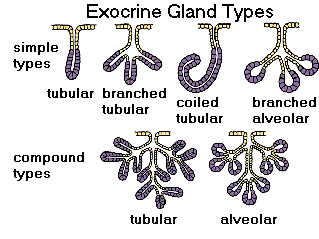
· Simple and compound glands (Pinterest (image))

· Classification of glands (jotscroll.com)

Related terms
- Exocrine gland
- Acinar lumen
- Intercalated duct
- Intralobular duct
- Interlobular duct
- Pancreatic duct
- Acinar cells
References and sources
- Further reading: Duct (anatomy), Wikipedia.
- Further reading: Exocrine gland, Wikipedia.
- Federative International Programme for Anatomical Terminology (FIPAT). Terminologia Anatomica, 2nd ed. (TA2), 2019.