Mucin
- Overview
- Types of mucin
- Main cells that secrete mucin
- Main sites where mucin is secreted
- Questions and answers
- Related terms
Overview
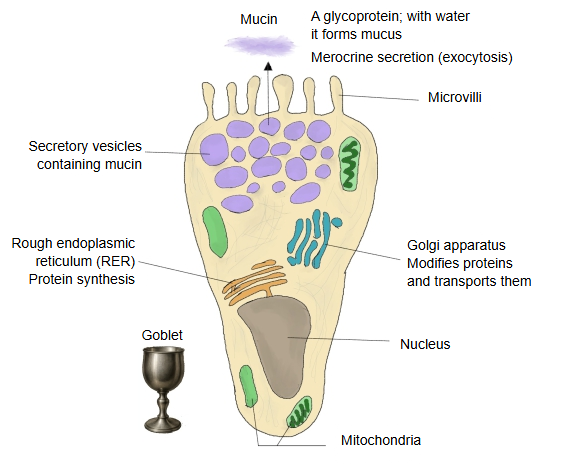
· Mucus is formed when mucin secreted by cells is joined by water (which makes up most of it) and other components, as shown below.
Types of mucin
The main human mucins are listed below (not a complete list; more than 20 mucin genes, MUC1, MUC2 and so on, are known).
| Name | Distribution and features | |
|---|---|---|
| 1 | MUC2 | Mainly in the intestine (especially the large intestine). Forms the barrier between the gut bacteria and the intestinal wall. |
| 2 | MUC5AC | Epithelium of the stomach and the airways. Forms gel-like mucus. |
| 3 | MUC5B | Salivary glands and airway glands. Highly viscous; forms a lasting barrier. |
| 4 | MUC6 | Secreted in the stomach, for example in the pyloric part. Protects the mucosa from acid. |
| 5 | MUC1, MUC4, MUC16 and others | Mucins bound to the cell membrane. Protect the cell surface and take part in signalling. |
Main cells that secrete mucin
A short list of the cells that secrete mucus:
| Cell | Main sites | Features and secretion | |
|---|---|---|---|
| 1 | Goblet cells | Epithelium of the gastrointestinal tract (especially the small and large intestine) and of the airways | Single cells that secrete mucin. PAS-positive. Scattered in the epithelium. |
| 2 | Mucous gland cells | Salivary glands (part of the submandibular gland, the sublingual gland and others), airway glands | Form multicellular glands. Pale, foamy cytoplasm; secrete mucin. The nucleus is flattened at the base of the cell. |
| 3 | Gland cells of the uterine cervix | Mucosa of the cervix of the uterus | Secrete cervical mucus, whose viscosity changes between the ovulatory and the luteal phase. |
| 4 | Cells of Brunner's glands (duodenal glands) | Submucosa of the duodenum | Secrete alkaline mucus that protects the intestinal wall from gastric acid. |
| 5 | Mucous cells of the paranasal sinuses and the nasal cavity | Nasal cavity, mucosa of the upper respiratory tract | Their mucus traps particles and microbes in the inhaled air. Work together with goblet cells and glands. |
Main sites where mucin is secreted
A short list of the places where mucus is secreted:
| Site | Main role | Secretory cells | |
|---|---|---|---|
| 1 | Respiratory system (nasal cavity to trachea and bronchi) | Traps and removes particles and pathogens (swept out by the movement of cilia) | Goblet cells, gland cells of the airways |
| 2 | Gastrointestinal tract (mouth to anus) | Lubrication; protects the mucosa from acid and digestive enzymes; eases mechanical irritation | Goblet cells, surface mucous cells, intestinal glands |
| 3 | Eye (conjunctiva, tear film) | Keeps the surface moist; removes particles | Goblet cells (conjunctiva), mucin-producing cells of the lacrimal glands |
| 4 | Ear (middle ear, auditory tube) | Protects the mucosa; prevents the entry of bacteria | Goblet cells, gland cells |
| 5 | Reproductive organs (vagina, cervical canal and others) | Lubrication, defence against infection, control of the passage of sperm | Cervical gland cells, vaginal epithelial cells |
| 6 | Urinary organs (urethra, urinary bladder) | Protection from irritation by urine and from infection | Goblet cells, urethral glands and others |
| 7 | Some duct systems, such as the bile ducts and the pancreatic duct | Mucus smooths the flow of the contents and protects the epithelium | Mucous cells (bile ducts, pancreatic duct) |
Questions and answers
Q: Most of the mass of mucin is sugar. Is it still a protein?
A: Yes. Mucin is a protein to which a very large number of sugar chains are attached, and it is classed as a glycoprotein. However much sugar it carries, the protein chain is the backbone and the sugar chains are added to it.
· The backbone (main structure) is a protein.
· Many sugar chains (O-glycans) are packed densely over its surface.
· The sugar chains make up most of the mass, but the basic structure is the protein.
· The sugar chains take part in interaction with the surroundings, protection and viscosity.
Q: In terms of molecular weight, does mucin contain more sugar than protein?
A: Yes. In the secreted mucins, sugar chains make up most of the molecular weight (more than 70%), and the protein part is the smaller share.
Structure of mucin in outline
· Backbone: the main protein chain (core protein).
· Modification: many O-linked sugar chains are attached to the serine (Ser) and threonine (Thr) residues of the main chain, which are concentrated in repeated stretches of the chain.
· Sugar chains: start from N-acetylgalactosamine (GalNAc), with branches made of galactose, fucose, sialic acid and other sugars.
Compared with an ordinary glycoprotein
| Item | Mucin | Ordinary glycoprotein (e.g. IgG) | |
|---|---|---|---|
| 1 | Size | Very large: secreted mucins join into molecules of about 1–10 million Da | Much smaller |
| 2 | Share of sugar | Most of the mass (more than 70% in secreted mucins) | Usually a small share |
| 3 | Role of the protein | Backbone (base for the sugar chains) | Main structure and function |
Why so much sugar?
· Mucin forms mucus, which must be viscous and slippery and act as a barrier; for this it needs a great many hydrophilic sugar chains.
· The O-linked sugar chains of mucin stand densely like the bristles of a brush, hold water and form a viscous gel.
Related terms
References and sources
- Further reading: Mucin, Wikipedia.
- Federative International Programme for Anatomical Terminology (FIPAT). Terminologia Anatomica, 2nd ed. (TA2), 2019.