Semispinalis (Latin: musculus semispinalis)
What is the semispinalis?
muscles
(21)
- Superficial back muscles (5) : = spinohumeral muscles
- 1st layer (2)
- 2nd layer (3)
- Deep back muscles (16)
- 1st layer (2) : = spinocostal muscles
- 2nd layer (14)
- Muscles of the vertebral column (10) : = intrinsic back muscles
- Splenius (2)
- Erector spinae (3)
- Transversospinalis (3) : semispinalis, multifidus, rotatores
- Others (2)
- Suboccipital muscles (4)
- Muscles of the vertebral column (10) : = intrinsic back muscles
Origin: the transverse processes and articular processes of the cervical and thoracic vertebrae.
Its fascicles are long: each spans at least five, usually six or seven, vertebrae (sources differ on the exact number).
The origins extend from T11 (sometimes T12) up to C3.
Insertion: the spinous processes of the cervical and thoracic vertebrae, and the occipital bone (the occipital squama between the superior and inferior nuchal lines).
The insertions extend from T3 (sometimes T4) up to C2, and to the occipital plane of the skull.
Action: acting on both sides it extends the vertebral column and the head; acting on one side it turns the column toward the opposite side.
Nerves: the medial branches of the posterior rami of the cervical and upper thoracic spinal nerves (about C1–T6 in all; the levels of each part are given below, and sources differ).
Arteries: muscular branches of the posterior intercostal arteries, the descending branch of the occipital artery and the deep cervical artery (see each part below).
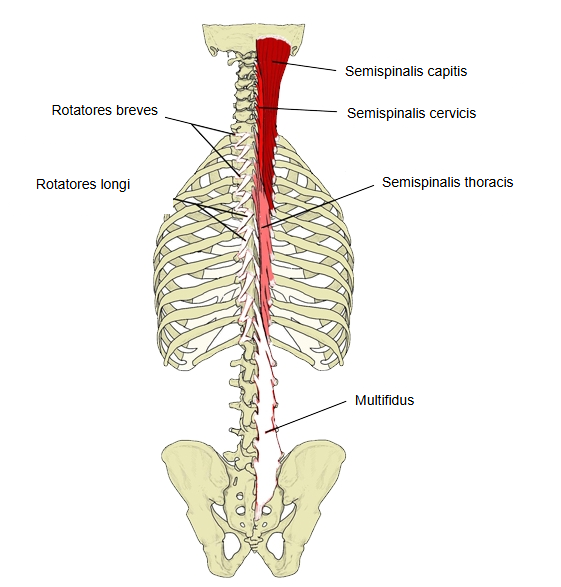
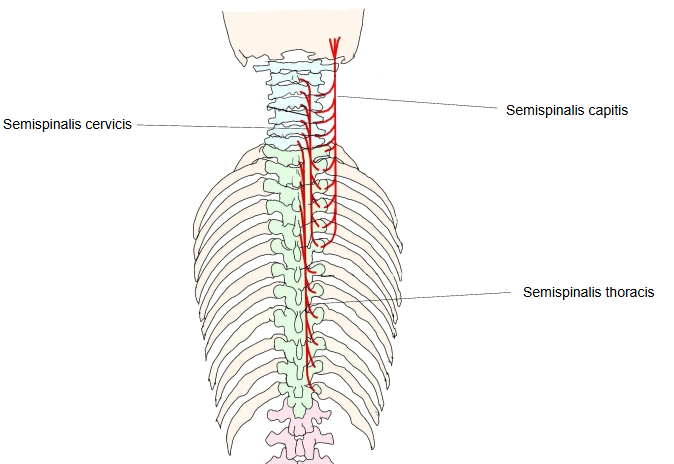
It is found only in the thoracic and cervical regions, and is divided into the semispinalis capitis, the semispinalis cervicis and the semispinalis thoracis.
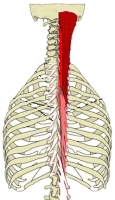 Transversospinalis muscles
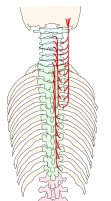 Parts of the semispinalis
Semispinalis capitis
Origin: the transverse processes of the upper six (or seven) thoracic vertebrae and of C7, and the articular processes of the lower three or four cervical vertebrae (about C4–C6). It runs upward over the semispinalis cervicis.
Insertion: the occipital bone between the superior and inferior nuchal lines. It is the largest and most superficial part of the semispinalis.
Action: extends the head and the cervical vertebral column; acting on one side it bends the head slightly to the same side and turns it toward the opposite side.
Nerves: the posterior rami of the upper cervical nerves (about C1–C6), including the greater occipital nerve.
Arteries: muscular branches of the posterior intercostal arteries, the descending branch of the occipital artery and the deep cervical branch of the costocervical trunk.
· Some illustrations show the upper part of the semispinalis capitis lying just under the skin, but in fact it is covered in the neck by the trapezius and the splenius.
In the neck it is completely covered by the splenius and lies medial to the longissimus cervicis and longissimus capitis. It belongs to the medial tract (transversospinalis group) of the intrinsic back muscles, but it is supplied not only by the medial but also by the lateral branches of the posterior rami of the spinal nerves, so some books place it between the medial and lateral tracts. It has a narrower medial part (biventer cervicis), often separate and interrupted by an intermediate tendon, and a broader lateral part. Lateral to the cervical spinous processes it can be felt through the trapezius as a firm, rounded mass. Details: Semispinalis capitis.
Semispinalis cervicis
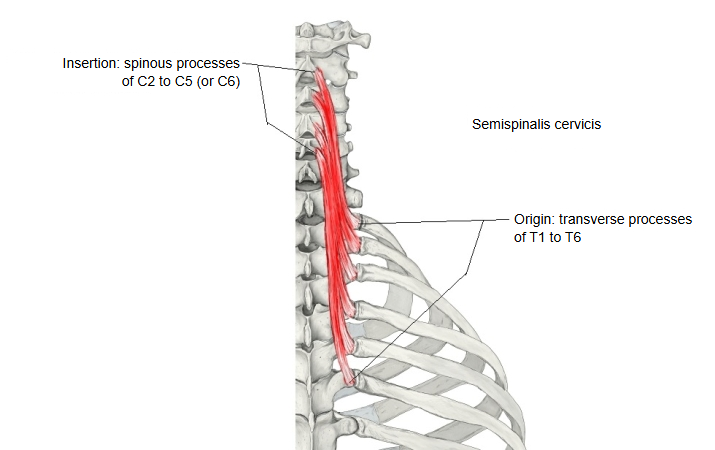
Origin: the transverse processes of the upper five or six thoracic vertebrae.
Insertion: the spinous processes of C2 to C5 (sometimes C6). The slip to the axis (C2) is the largest and mainly fleshy.
Nerves: the posterior rami of the lower three cervical nerves.
Arteries: muscular branches of the posterior intercostal arteries, the descending branch of the occipital artery and the deep cervical branch of the costocervical trunk.
· The semispinalis thoracis and cervicis often form a single unit. As in the multifidus, each bundle of origin divides into several bundles of insertion. The semispinalis cervicis is thicker than the semispinalis thoracis. Details: Semispinalis cervicis.
Semispinalis thoracis
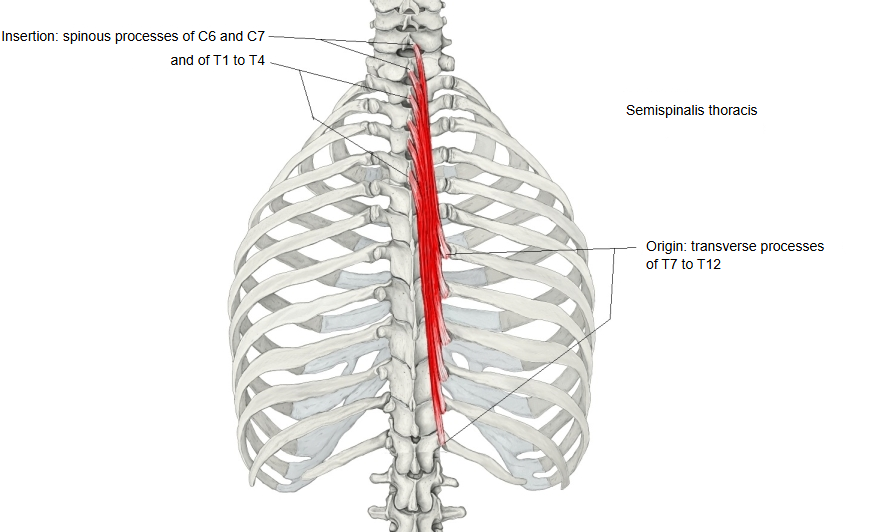
Origin: the transverse processes of the lower thoracic vertebrae: T7–T12 (lower six) in many texts, about T6–T10 in others.
Insertion: the spinous processes of the lower two cervical (C6–C7) and upper four thoracic (T1–T4) vertebrae.
Action: extends the thoracic vertebral column; acting on one side it turns it toward the opposite side.
Nerves: the medial branches of the posterior rami of the upper six thoracic nerves.
Arteries: muscular branches of the posterior intercostal arteries (and, at its upper end, of the deep cervical artery). It is made of thin, narrow fleshy fascicles joined by long tendons. Details: Semispinalis thoracis.
Reference websites
[Wikipedia]
· Semispinalis muscles, Wikipedia.
· Transversospinales, Wikipedia.
[Websites with illustrations]
· Semispinalis capitis (animation) (Wikimedia Commons)

· Semispinalis muscles (illustrations) (Wikimedia Commons)
Related terms
- Transversospinalis muscles
- Multifidus
- Rotatores
- Intrinsic back muscles
- Semispinalis capitis
- Semispinalis cervicis
- Semispinalis thoracis
References and sources
- Further reading: Semispinalis muscle, Wikipedia.
- Further reading: Transversospinales, Wikipedia.
- Federative International Programme for Anatomical Terminology (FIPAT). Terminologia Anatomica, 2nd ed. (TA2), 2019.