Rotatores (Latin: musculi rotatores)
Also called the rotatores muscles or the rotator muscles
Origin: the transverse processes of the vertebrae except the atlas (in the lumbar region the costal processes or the mammillary processes; sources differ). From there they run upwards and medially.
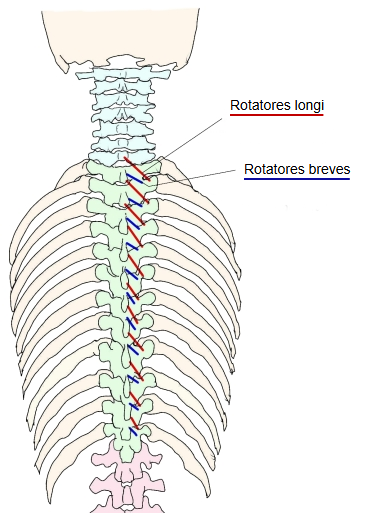
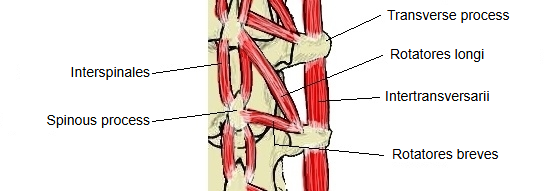
Insertion: the lamina and the base of the spinous process of the vertebra one or two levels above (one level above ⇒ rotatores breves, two levels above ⇒ rotatores longi).
Some sources give the insertion simply as the lamina of the vertebra directly above the vertebra of origin.
Action: acting on one side they help rotate the vertebral column towards the opposite side; they also steady individual vertebrae. Being rich in muscle spindles, they are thought to act largely as sensors of position.
Nerve supply: medial branches of the posterior rami of the spinal nerves.
Arteries: muscular branches of the posterior intercostal arteries (through their dorsal branches).
The diagram below shows where the rotatores sit among the muscles of the back.
the back (21)
- Superficial back muscles (5) : = spinohumeral muscles
- First layer (2)
- Second layer (3)
- Deep back muscles (16)
- First layer (2) : = spinocostal muscles
- Second layer (14)
- Muscles of the vertebral column (10) : = intrinsic back muscles, spinodorsal muscles
- Splenius muscles (2)
- Erector spinae (3)
- Transversospinalis muscles (3) : semispinalis, multifidus, rotatores
- Others (2)
- Suboccipital muscles (4)
- Muscles of the vertebral column (10) : = intrinsic back muscles, spinodorsal muscles
Each part has its own features.
| Region | Name | Features |
| Upper | Rotatores cervicis | Poorly developed. |
| Middle | Rotatores thoracis | The best developed of the three parts; usually eleven on each side. |
| Lower | Rotatores lumborum | Hard to separate from neighbouring short muscles such as the interspinales. |
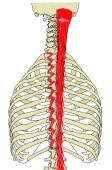 Rotatores and semispinalis
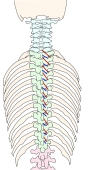 Rotatores longi and breves
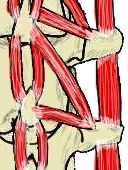 Short muscles between vertebrae
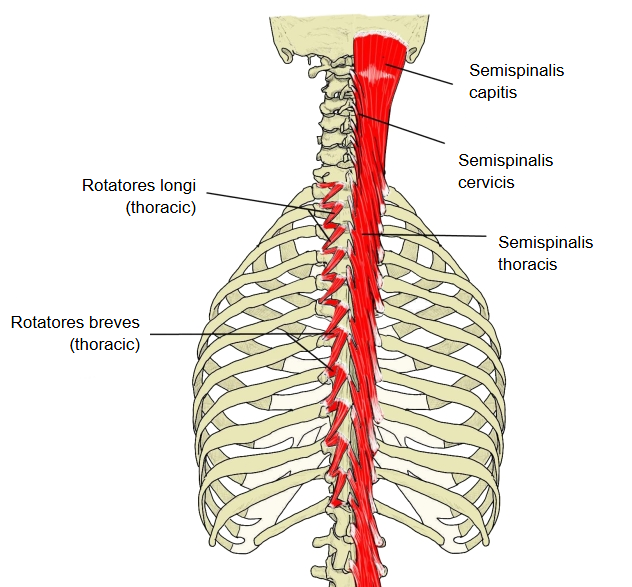
| Name | Description | 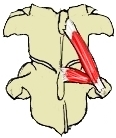 | |
| 1 | Rotatores longi | Skip one vertebra and insert on the vertebra two levels above (lamina and base of the spinous process). | |
| 2 | Rotatores breves | Insert on the vertebra directly above (lamina and base of the spinous process). |
Reference websites
[Wikipedia]
· Rotatores, Wikipedia.
Related terms
- Transversospinalis muscles
- Rotatores breves
- Semispinalis thoracis
- Transverse process
- Spinous process
- Thoracic vertebrae
- Vertebral column
References and sources
- Further reading: Rotatores, Wikipedia.
- Federative International Programme for Anatomical Terminology (FIPAT). Terminologia Anatomica, 2nd ed. (TA2), 2019.