Rotatores (Latin: musculi rotatores)
- Overview
- Illustrations
- Origin / insertion
- Action
- Nerve / blood supply
- Reference websites
- (Wikipedia, websites with illustrations)
- Related terms
Overview
- Back (21)
- Superficial back muscles (5)
- Deep back muscles (16)
- Layer 1 (2)
- Layer 2: muscles of the vertebral column (10)
- Splenius muscles (2)
- Erector spinae (3)
- Transversospinales (3) : semispinalis (thoracis, cervicis, capitis), multifidus, rotatores (breves, longi)
- Others (2) : interspinales, intertransversarii
- Suboccipital muscles (4)
- Thorax (11)
- Abdomen (6)
- Pelvis (4)
- Perineum
· They lie deep to the multifidus, directly on the laminae of the vertebrae; they are the deepest of the intrinsic back muscles.
· By region they are divided into three groups, each with its own features:
- Rotatores cervicis : poorly developed
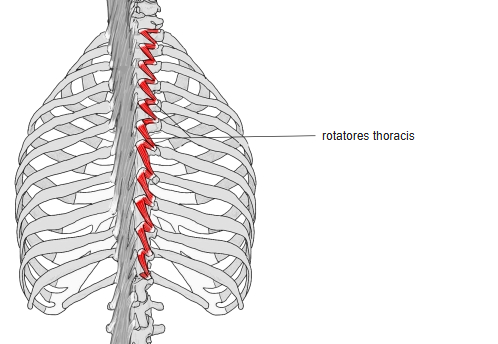
- Rotatores thoracis : the best developed; usually 11 on each side, from T1–T2 down to T11–T12
- Rotatores lumborum : hard to separate from the multifidus
· By length they are divided into two kinds:
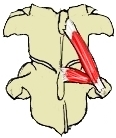 Short and long rotator
- Rotatores breves : to the vertebra directly above
- Rotatores longi : skip one vertebra and reach the vertebra two levels above
Illustrations
More figures: Back, deep layer (3) · Back, deep layer (1) · Multi-muscle illustrations: Back · Muscles of the trunk (list)
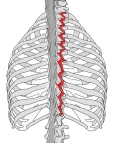 Rotatores thoracis
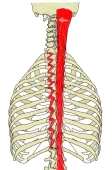 Rotatores and semispinalis
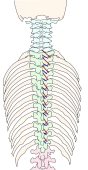 Short and long rotatores (schematic)
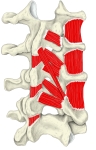 Short muscles of the vertebral column
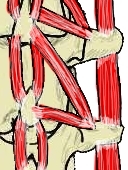 Short and long rotatores (close view)
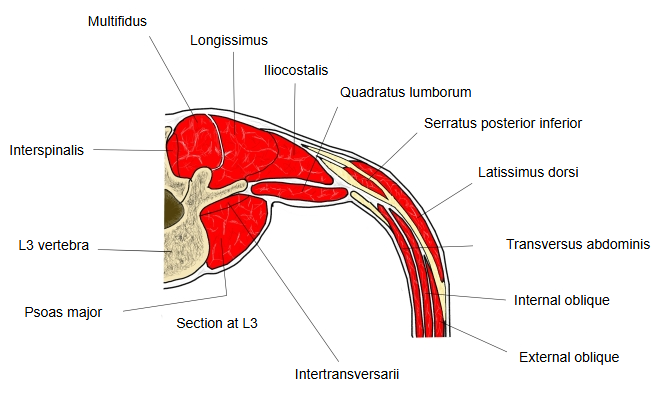
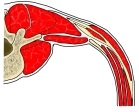 Section at L3
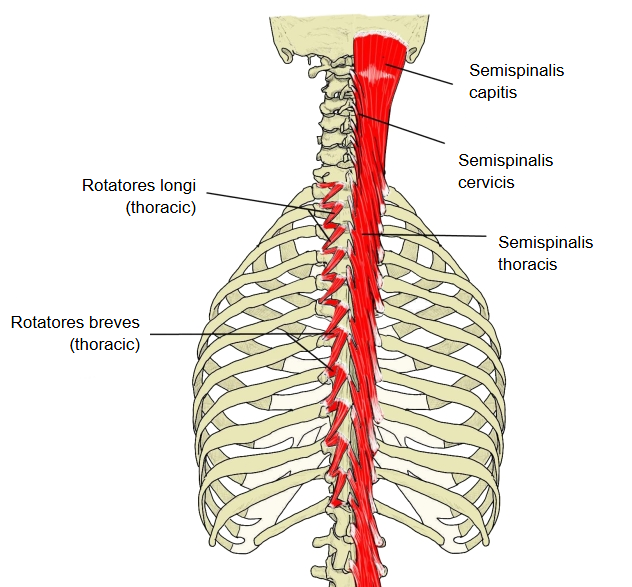
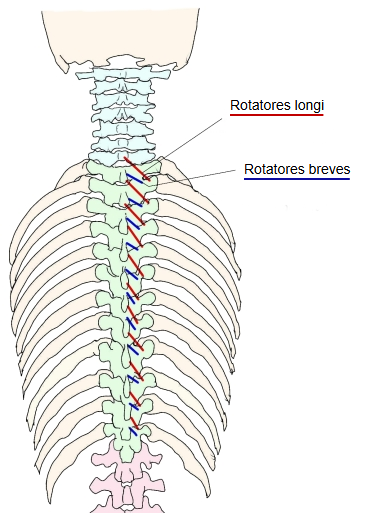
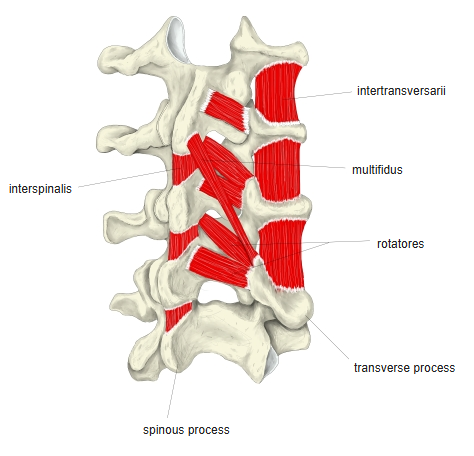
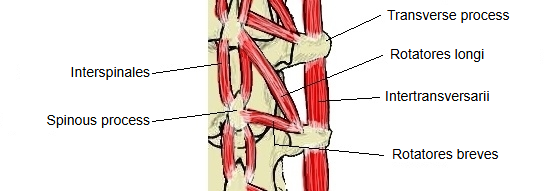
Origin / insertion
[Origin] : the upper and back part of the transverse processes of the vertebrae. In the neck and the lumbar region they are irregular: Sources differ (cervical: articular processes; lumbar: mamillary or costal processes).
Rotatores breves : from a transverse process to the vertebra directly above.
Rotatores longi : from a transverse process to the vertebra two levels above.
The fibres run upward and medially, almost horizontally in the short rotatores.
[Insertion] : the lower border and lateral surface of the lamina of the vertebra above, reaching as far as the root of the spinous process. Some texts give the spinous process itself (Sources differ).
Action
Their mechanical effect is small, because they are short and lie close to the axis of movement. Acting on one side they help to turn the vertebral column toward the opposite side; acting on both sides they help to extend it. They contain many muscle spindles and probably act mainly as position sensors that help to control each vertebra.
Nerve / blood supply
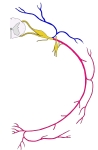
· Nerve : medial branches of the posterior (dorsal) rami of the spinal nerves at each level.
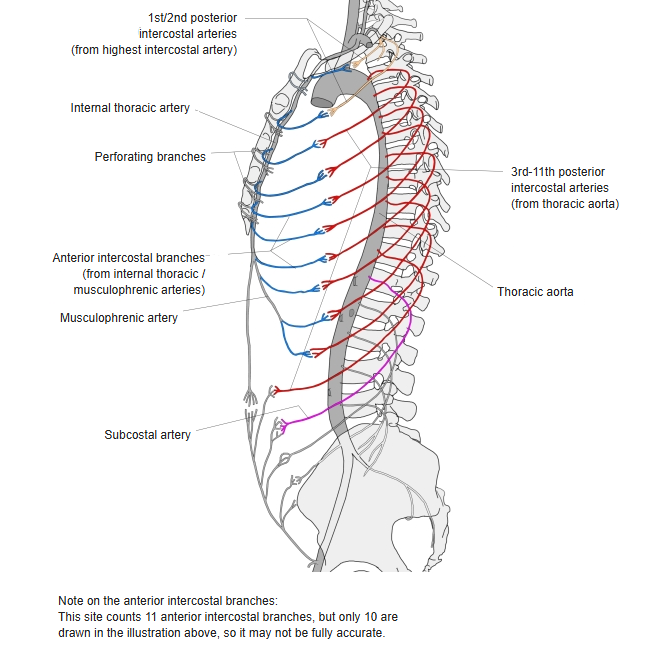
· Arteries : segmental branches: in the neck the deep cervical artery (from the costocervical trunk) and branches of the vertebral artery; in the thorax the dorsal branches of the posterior intercostal arteries; in the lumbar region the dorsal branches of the lumbar arteries.
· Veins : veins running with the arteries: the deep cervical vein, the posterior intercostal veins and the lumbar veins, and the external vertebral venous plexus.
 Thoracic nerve (schematic)
 Intercostal arteries
Reference websites
[Wikipedia]
· Rotatores muscles, Wikipedia.
[Websites with illustrations]
· Rotatores muscles (Kenhub)
Related terms
- Rotatores
- Transversospinalis muscles
- Intrinsic back muscles
- Lamina of vertebral arch
- Transverse process
- Rotatores breves
- Multifidus
- Semispinalis thoracis
- Thoracic vertebrae
- Spinal nerves
References and sources
- FIPAT. Terminologia Anatomica, 2nd ed. (TA2), 2019: musculi rotatores (cervicis, thoracis, lumborum).
- Rotatores muscles, Wikipedia.