Sphenoidal process (Latin: processus sphenoidalis ossis palatini)
Also called the sphenoidal process of palatine bone
· It is much smaller than the orbital process, which rises from the front of the same upper border.
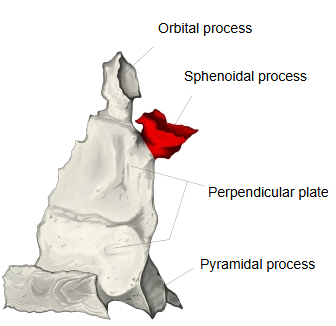
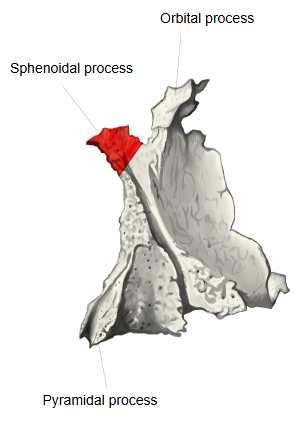
- Orbital process : projects upwards, forwards and laterally from the front of the upper border of the perpendicular plate; forms part of the back of the floor of the orbit
- Sphenoidal process : projects upwards from the back of the upper border of the perpendicular plate; forms part of the lateral wall of the nasal cavity
- Pyramidal process : projects backwards and laterally from the lower back part of the perpendicular plate; fits into the pterygoid notch of the sphenoid
The orbital and sphenoidal processes are separated by the sphenopalatine notch; the body of the sphenoid closes the notch above to form the sphenopalatine foramen. Sometimes the two processes meet above the notch, so that the palatine bone itself encloses a complete foramen, and bony spicules may divide it into two or more openings.
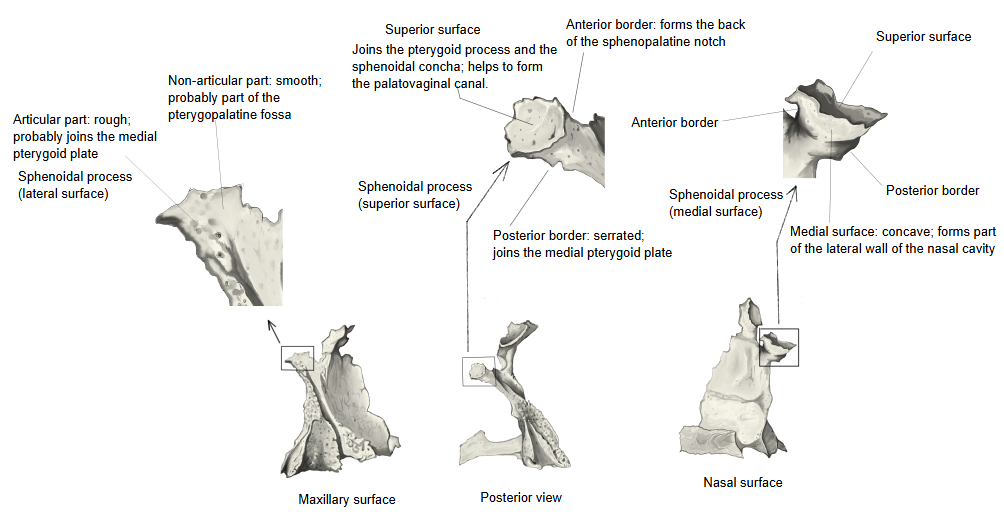
The sphenoidal process has three surfaces (superior, medial and lateral) and two borders (anterior and posterior).
- Surfaces
- Superior surface : joins the root of the pterygoid process and the underside of the sphenoidal concha of the sphenoid; its medial edge reaches the ala of the vomer, and a groove on it helps to form the palatovaginal canal
- Medial surface : concave; forms part of the lateral wall of the nasal cavity
- Lateral surface : a rough articular part joins the medial plate of the pterygoid process; a smooth non-articular part forms part of the pterygopalatine fossa
- Borders
- Anterior border : forms the posterior edge of the sphenopalatine notch
- Posterior border : serrated; joins the medial plate of the pterygoid process
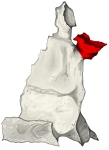 Palatine bone (nasal surface)
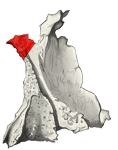 Palatine bone (maxillary surface)
 Surfaces and borders
Reference websites
[Wikipedia]
· Sphenoidal process of palatine bone, Wikipedia.
· Palatine bone, Wikipedia.
[Websites with illustrations]
· Left palatine bone, internal (nasal) view (Gray's Anatomy, fig. 168) (Wikimedia Commons)

· Left palatine bone, posterior view (Gray's Anatomy, fig. 169) (Wikimedia Commons)

Where it is found
Related terms
- Orbital process
- Pyramidal process
- Perpendicular plate
- Sphenopalatine foramen
- Pterygoid process
- Body of sphenoid
- Palatine bone
References and sources
- Further reading: Sphenoidal process of palatine bone, Wikipedia.
- Further reading: Palatine bone, Wikipedia.
- Federative International Programme for Anatomical Terminology (FIPAT). Terminologia Anatomica, 2nd ed. (TA2), 2019.