Common bile duct (Latin: ductus choledochus; ductus biliaris)
Also called the bile duct or the choledochus
· Like the rest of the bile ducts, it is lined by a simple columnar epithelium of cholangiocytes.
· It is about 6–8 cm long and normally up to about 6 mm wide.
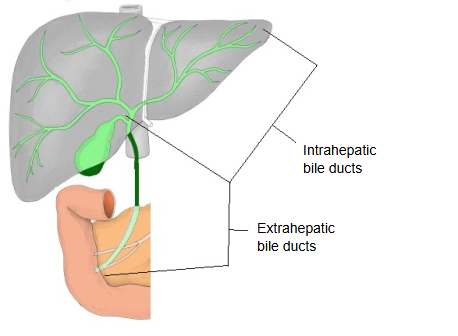
· It runs down in the free edge of the lesser omentum, behind the first part of the duodenum and through the head of the pancreas, and opens into the second (descending) part of the duodenum.
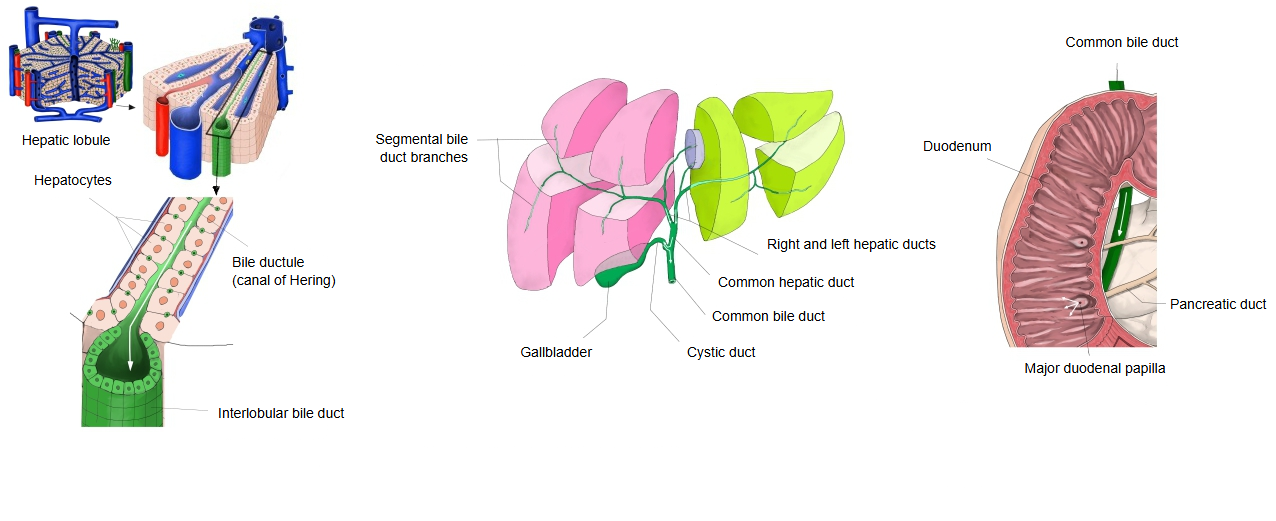
· Near its end it usually joins the main pancreatic duct to form the hepatopancreatic ampulla, which opens on the major duodenal papilla. The sphincter of Oddi surrounds the end of both ducts.
[Parts of its course]
· Supraduodenal part: in the free edge of the hepatoduodenal ligament, to the right of the proper hepatic artery and in front of the portal vein. The opening behind this free edge is the omental (epiploic) foramen.
· Retroduodenal part: behind the first part of the duodenum.
· Pancreatic part: in a groove or tunnel on the back of the head of the pancreas.
· Intraduodenal part: passes obliquely through the wall of the descending duodenum to the major duodenal papilla.
The path of bile
· Bile made by the hepatocytes enters the bile canaliculi between the liver cells, then flows through the canals of Hering and the bile ductules at the edge of the hepatic lobule into the interlobular bile ducts. Bile flows in the opposite direction to blood in the lobule.
· The ducts join into larger segmental branches and then the right and left hepatic ducts, which leave the liver at the porta hepatis and unite as the common hepatic duct.
· Between meals bile passes up the cystic duct to be stored and concentrated in the gallbladder; after a meal it returns down the cystic duct into the common bile duct and on to the duodenum.
· Sources differ on the names and order of the smallest channels (canaliculi, ductules, cholangioles).
· A gallstone that lodges in the common bile duct (choledocholithiasis) can cause obstructive jaundice; a stone at the ampulla can also cause acute pancreatitis.
Reference websites
[Wikipedia]
· Common bile duct, Wikipedia.
· Biliary tract, Wikipedia.
[Websites with illustrations]
· Common bile duct (Radiopaedia)
· Biliary tree (Radiopaedia)
· The gallbladder and biliary tree (TeachMeAnatomy)
Where it is found
Related terms
- Common hepatic duct
- Cystic duct
- Interlobular bile duct
- Sphincter of Oddi
- Pancreatic duct
- Hepatoduodenal ligament
- Porta hepatis
References and sources
- Further reading: Common bile duct, Wikipedia.
- Further reading: Biliary tract, Wikipedia.
- Federative International Programme for Anatomical Terminology (FIPAT). Terminologia Anatomica, 2nd ed. (TA2), 2019.