Transverse process (Latin: processus transversus)
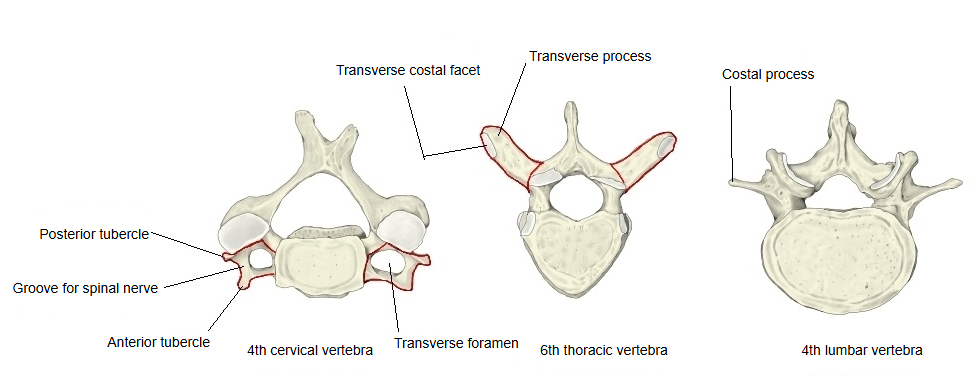
In terms of evolution and development, the "transverse process" of a lumbar vertebra corresponds to a rib, so it is more correctly called the costal process and is not the same structure as the transverse process of the other vertebrae. The true transverse process has fused with the thick costal process and is seen only as a small projection at the back of its root, the accessory process.
Many books, websites and images, however, still call the costal process of the lumbar vertebrae the transverse process, in the same way as on the cervical and thoracic vertebrae.
Each typical vertebra has a right and a left transverse process, together with one spinous process and four articular processes. The transverse processes act as levers and attachment sites for the deep back muscles (such as the transversospinalis group and the intertransversarii) and for ligaments such as the intertransverse ligament. Their shape differs from region to region, so they help to tell the vertebrae apart:
| 1 | Cervical vertebrae | · At the root of the transverse process is the transverse foramen, which carries the vertebral artery and vertebral vein (the artery usually from C6 upward). · On C3 to C7 the upper surface of the process carries the groove for spinal nerve, with a small elevation in front of it and behind it: the anterior tubercle and the posterior tubercle. · The front part of the process (around the anterior tubercle) is regarded as a rib element fused to the true transverse process. |
| 2 | Thoracic vertebrae | · The processes are strong and point backwards and outwards. · Except on T11 and T12, the tip carries a joint surface for the rib, the transverse costal facet, which articulates with the tubercle of rib. · They are longest around the middle of the thoracic region; sources differ on the exact level. |
| 3 | Lumbar vertebrae | · There is no transverse process as such. In its place, a flat process projects sideways from the vertebral arch: the costal process. · The true transverse process is represented by the small accessory process at the back of the root of the costal process. |
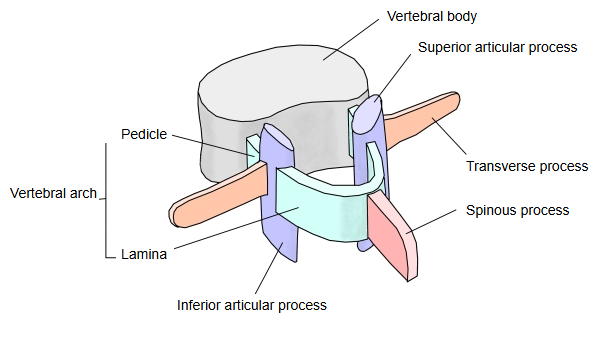
The basic parts of a vertebra are as follows.
structure
of a
vertebra
- Vertebral body : the cylindrical front part, joined to the vertebrae above and below by intervertebral discs.
- Vertebral arch
- Processes
- Spinous process : the long process pointing backwards.
- Transverse process : the processes to the left and right sides (in the lumbar vertebrae: the costal process).
- Superior and inferior articular processes : processes going up and down from the arch.
Each vertebra has two transverse processes, a small bony projection on each side. They give attachment to the muscles and ligaments of the spine and, in the thoracic region, form joints with the ribs. In posterolateral spinal fusion surgery the bone graft is laid between the transverse processes of the vertebrae to be joined.
Reference websites
[Wikipedia]
· Vertebra, Wikipedia.
[Websites with illustrations]
· A cervical vertebra (Gray's Anatomy, fig. 84) (Wikimedia Commons)

· A lumbar vertebra from above and behind (Gray's Anatomy, fig. 93) (Wikimedia Commons)

· Vertebral column: structure and regions (TeachMeAnatomy)
Related terms
- Spinous process
- Vertebral body
- Transverse foramen
- Transverse costal facet
- Costal process
- Accessory process
- Tubercle of rib
References and sources
- Further reading: Vertebra, Wikipedia.
- Federative International Programme for Anatomical Terminology (FIPAT). Terminologia Anatomica, 2nd ed. (TA2), 2019.