Posterior clinoid process (Latin: processus clinoideus posterior)
· The petroclinoid ligament (petroclinoid fold) is a fold of dura mater that runs from the posterior and anterior clinoid processes to the petrous part of the temporal bone.
- Superior surface : faces the cranial cavity and forms the central part of the cranial fossae. Joins: the ethmoid bone in front; behind, the dorsum sellae forms the clivus with the basilar part of the occipital bone.Features: sella turcica, hypophysial fossa, tuberculum sellae, dorsum sellae, middle clinoid process, posterior clinoid process, chiasmatic groove, carotid sulcus, sphenoidal lingula
- Inferior surface : forms the roof of the pharynx. Joins: the vomer (ala of vomer).
- Anterior surface : faces the nasal cavity. Joins: the ethmoid bone (and the orbital processes of the palatine bones).Features: sphenoidal crest (continuing below as the sphenoidal rostrum), sphenoidal concha (aperture of sphenoidal sinus)
- Posterior surface : a rough, four-sided surface. Joins: the occipital bone (basilar part).
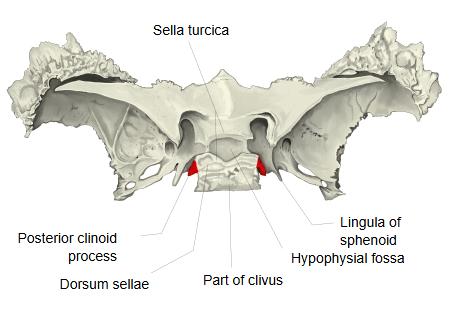
The dorsum sellae is the square plate of bone that forms the back wall of the sella turcica; its two upper corners end as the posterior clinoid processes.
With the anterior clinoid processes (and the middle clinoid processes, when present) they surround the hypophysial fossa, which holds the pituitary gland, and make it deeper.
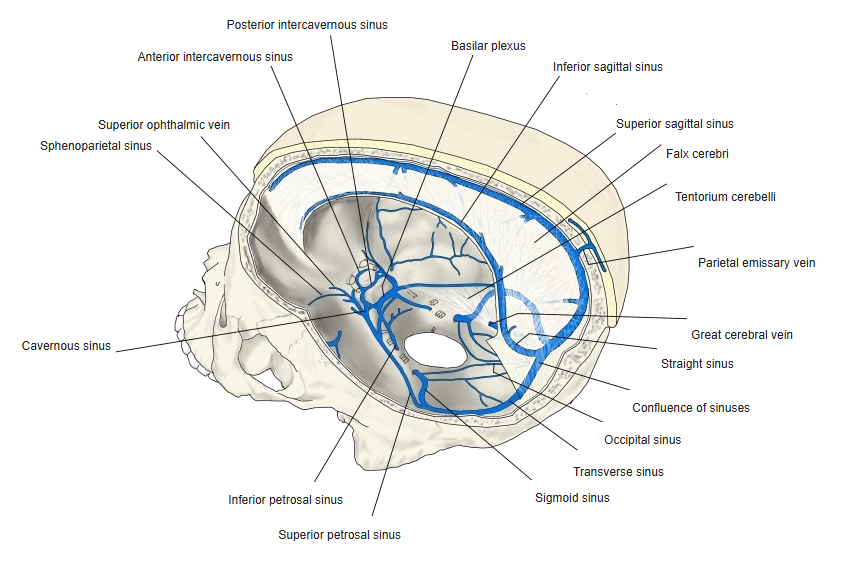
They give attachment to the tentorium cerebelli. Folds of dura (the petroclinoid folds, an anterior and a posterior band of densely packed collagen and elastic fibres) run from them and from the anterior clinoid processes back to the apex of the petrous part of the temporal bone, over the cavernous sinus.
The oculomotor nerve enters the roof of the cavernous sinus close to these folds.
Their size and shape vary widely; a posterior clinoid process may be joined to the anterior one by a bony bridge, or the petroclinoid fold may ossify.
 Sphenoid bone (superior view)
 Dural venous sinuses
Reference websites
[Wikipedia]
· Posterior clinoid processes, Wikipedia.
[Websites with illustrations]
· Posterior clinoid process (Wikimedia Commons)

· Sphenoid bone: anatomy, function and development (Kenhub)
· Sphenoid bone, upper and posterior surfaces (Gray's Anatomy, fig. 147) (Wikimedia Commons)

Related terms
- Sella turcica
- Dorsum sellae
- Hypophysial fossa
- Tuberculum sellae
- Body of sphenoid
- Sphenoid bone
- Cavernous sinus
References and sources
- Further reading: Posterior clinoid processes, Wikipedia.
- Further reading: Petroclinoid ligament, Wikipedia.
- Federative International Programme for Anatomical Terminology (FIPAT). Terminologia Anatomica, 2nd ed. (TA2), 2019.