Exocrine secretion
Also called the external secretion or the exocrine
Exocrine secretion is the kind of secretion in which the product is released through a duct onto the epithelial surface of the body or of the lumen of a hollow organ, rather than into the blood.
Secretion: the release by cells of substances they have made, to the inside or the outside of the bodyLumen: for example of the digestive tract, such as the stomach and the intestine
Secretion
(in the
narrow sense)
(in the
narrow sense)
- Exocrine secretion : secretion onto the body surface (sweat, sebum, milk) and into the digestive tract (saliva, gastric juice, pancreatic juice, bile).
- Endocrine secretion : secretion of hormones into the blood; sometimes by single cells rather than by glands.
Exocrine secretion is carried out by exocrine glands (groups of cells that secrete). Its opposite is endocrine (internal) secretion, in which endocrine glands release hormones directly into the blood.
The classification of secretory glands below should therefore be helpful (the lists of examples are not complete).
(Secretory)
glands
glands
- Exocrine glands
- Onto the body surface : sweat glands (eccrine and apocrine sweat glands), sebaceous glands, mammary gland = the skin glands.
- Into the digestive tract : salivary glands, pancreas, liver, gastric glands, duodenal glands.
- Other : nasal glands, lacrimal gland.
- Endocrine glands
- Brain : pituitary gland, pineal gland.
- Neck : thyroid gland, parathyroid glands.
- Viscera : suprarenal glands, pancreas (pancreatic islets).
- Reproductive organs : gonads (ovary with its corpus luteum, testis); placenta.
- Note : the pancreas belongs to both groups: it has exocrine and endocrine parts.
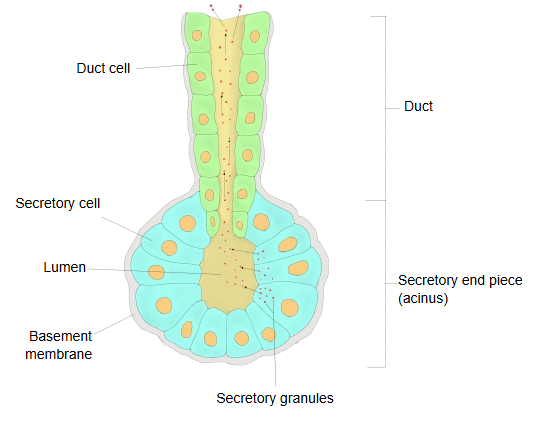
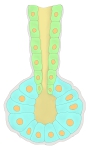 Structure of an exocrine gland
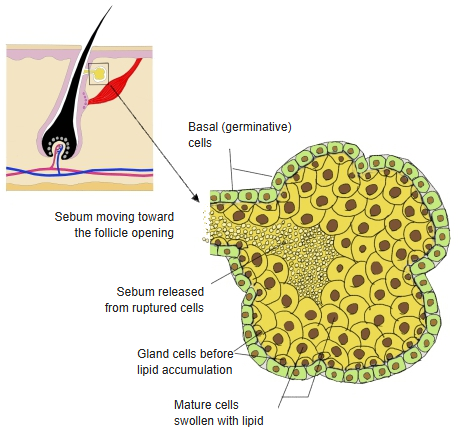
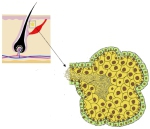 Structure of a sebaceous gland
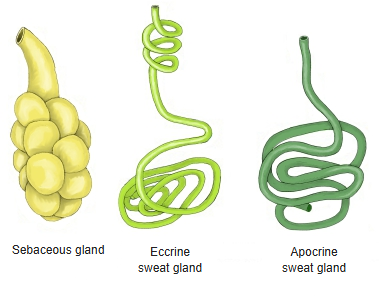
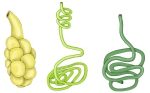 Sebaceous and sweat glands
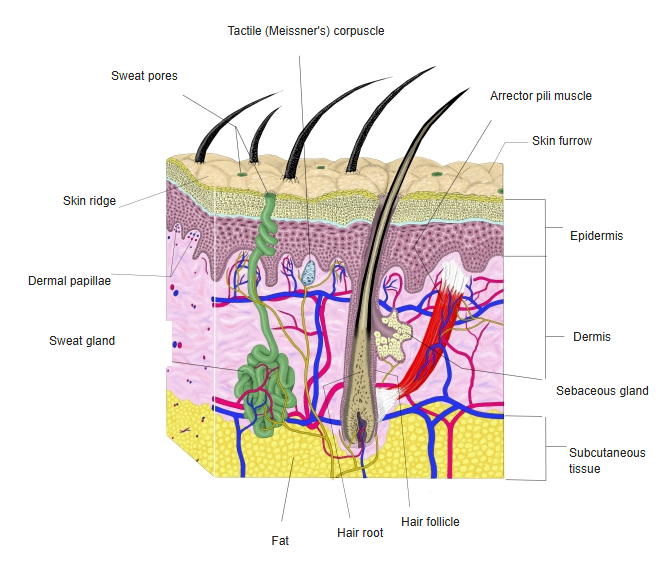
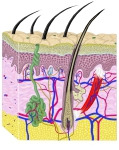 Skin and its glands
Related terms
- Gastric juice
- Secretion
- Sebum
- Exocrine gland
- Exocrine cell
- Endocrine gland
- Secretory gland
- Sweat glands
- Sebaceous glands
- Salivary glands
References and sources
- Further reading: Exocrine gland, Wikipedia.
- Further reading: Secretion, Wikipedia.
- Federative International Programme for Anatomical Terminology (FIPAT). Terminologia Anatomica, 2nd ed. (TA2), 2019.