Multifidus (Latin: musculus multifidus)
- Overview
- Illustrations
- Origin / insertion
- Action
- Nerve / blood supply
- Reference websites
- (Wikipedia, websites with illustrations)
- Related terms
Overview
- Back (21)
- Superficial back muscles (5)
- Deep back muscles (16)
- Layer 1 (2)
- Layer 2: muscles of the vertebral column (10)
- Splenius muscles (2)
- Erector spinae (3)
- Transversospinales (3) : semispinalis (thoracis, cervicis, capitis), multifidus, rotatores (breves, longi)
- Others (2) : interspinales, intertransversarii
- Suboccipital muscles (4)
- Thorax (11)
- Abdomen (6)
- Pelvis (4)
- Perineum
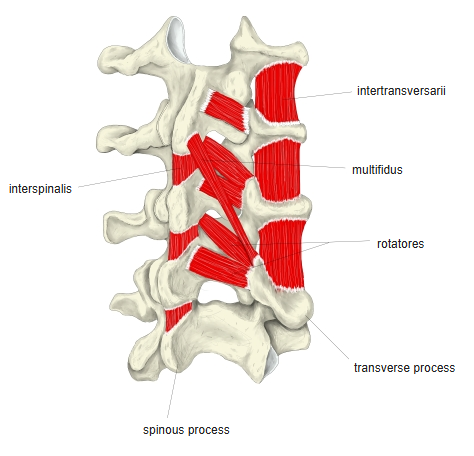
· It lies deep to the semispinalis and, in the lower back, to the erector spinae; the rotatores lie beneath it. It fills the groove between the spinous and transverse processes.
· It is thickest in the lumbar region, where it is the largest muscle next to the spinous processes; in the thorax and neck it is thinner.
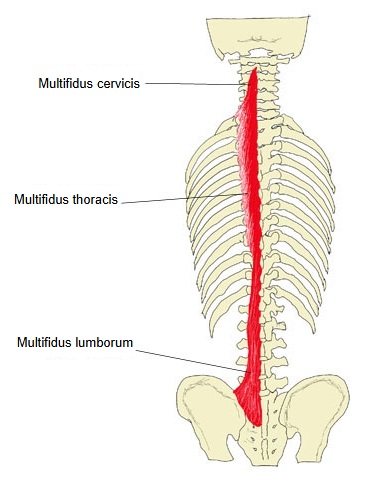
- Multifidus cervicis : the neck part (C4–C7 up to C2)
- Multifidus thoracis : the thoracic part
- Multifidus lumborum : the lumbar part, the thickest (with the sacral bundles)
· The deep bundles help to hold each lumbar vertebra steady on the next. Wasting of the lumbar multifidus is often found in people with low back pain.
Illustrations
More figures: Back, deep layer (3) · Back, deep layer (1) · Multi-muscle illustrations: Back · Muscles of the trunk (list)
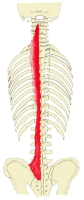 Whole muscle
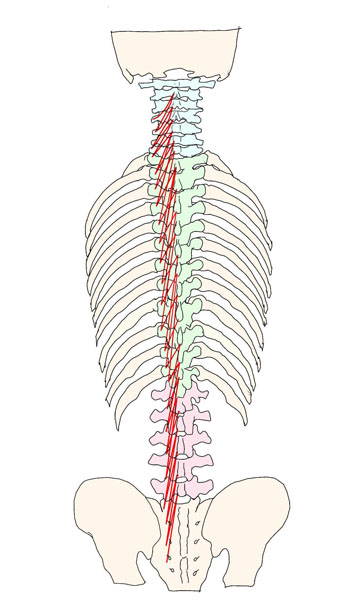
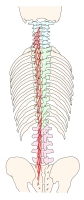 Course of the bundles (schematic)
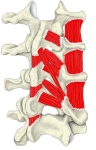 Intrinsic back muscles
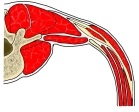 Section at L3
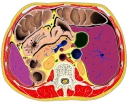 Section at L1
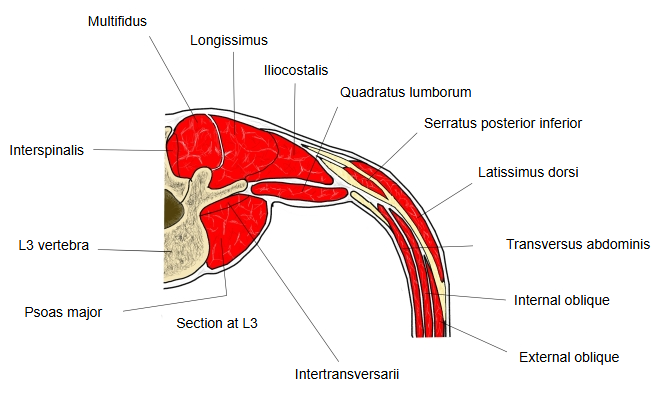
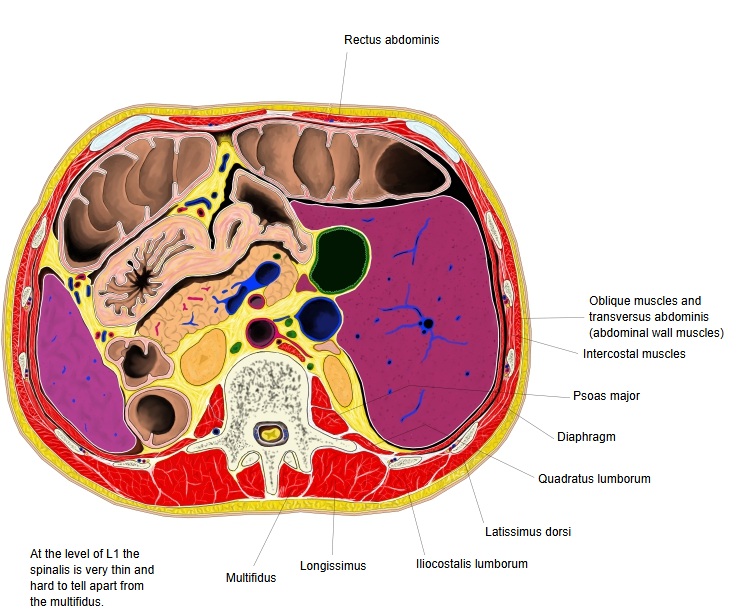
Origin / insertion
[Origin] : from four regions, from below upward:
Sacral : the back of the sacrum (down to the level of the fourth of the posterior sacral foramina), the aponeurosis of the erector spinae, the posterior superior iliac spine and the posterior sacro-iliac ligaments.
Lumbar : the mamillary processes of all lumbar vertebrae.
Thoracic : the transverse processes of all thoracic vertebrae.
Cervical : the articular processes of the lower four cervical vertebrae (C4–C7).
Each bundle runs upward and medially.
[Insertion] : the spinous processes of the vertebrae above, along the whole length of each process, from L5 up to the axis (C2).
The bundles differ in length: the deepest join neighbouring vertebrae or span two levels; the most superficial span three or four vertebrae (up to five in some descriptions). Sources differ on the exact numbers.
Action
Acting on both sides, it extends the vertebral column and holds the vertebrae steady, especially in the lumbar region. Acting on one side, it bends the column to the same side and turns it slightly toward the opposite side.
Nerve / blood supply
· Nerve : medial branches of the posterior (dorsal) rami of the spinal nerves, segment by segment (about C3 to S3). See also Spinal nerve rami (schematic).
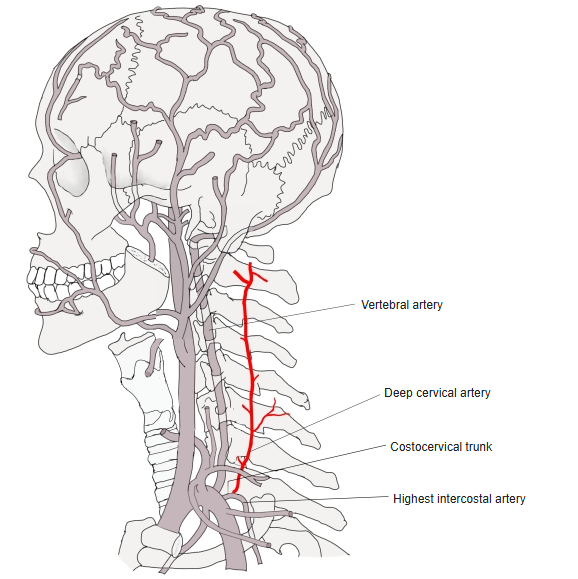
· Arteries : segmental branches: in the neck the deep cervical artery (from the costocervical trunk) and branches of the vertebral artery; in the thorax the dorsal branches of the posterior intercostal arteries; in the lumbar region the dorsal branches of the lumbar arteries; at the sacrum branches of the lateral sacral arteries.
· Veins : veins running with the arteries: the deep cervical vein, the posterior intercostal veins and the lumbar veins, and the external vertebral venous plexus.
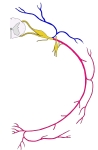 Thoracic nerve (schematic)
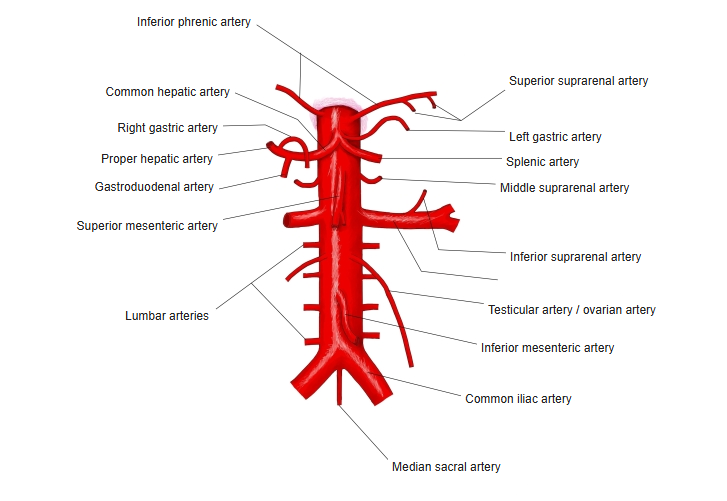
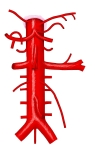 Lumbar arteries
 Deep cervical artery
Reference websites
[Wikipedia]
· Multifidus muscle, Wikipedia.
[Websites with illustrations]
· Multifidus muscle (Kenhub)
Related terms
- Multifidus
- Transversospinalis muscles
- Intrinsic back muscles
- Spinous process
- Mamillary process
- Transverse process
- Rotatores breves
- Semispinalis thoracis
- Semispinalis cervicis
- Semispinalis capitis
- Sacrum
- Spinal nerves
References and sources
- FIPAT. Terminologia Anatomica, 2nd ed. (TA2), 2019: musculus multifidus (musculus multifidus cervicis, thoracis, lumborum).
- Multifidus muscle, Wikipedia.