Extraperitoneal organs
Extraperitoneal organs is a general name for the organs of the abdomen and pelvis that lie outside the parietal peritoneum.
A descriptive term, not an official anatomical termBehind it (retroperitoneal) or below it (subperitoneal)
· These organs lie in the extraperitoneal space, not inside the peritoneal sac (peritoneal cavity); peritoneum covers at most one surface of them.
· They are the opposite of the intraperitoneal organs, which are almost completely wrapped in visceral peritoneum and usually hang from a mesentery. Most extraperitoneal organs are firmly fixed to the body wall, so they move little.
Organs
of the
abdominal
cavity
of the
abdominal
cavity
- Intraperitoneal organs : lie in the peritoneal cavity, almost completely covered by visceral peritoneum (serosa); joined to the abdominal wall by mesenteries and peritoneal folds. E.g. stomach, jejunum and ileum, transverse colon, sigmoid colon, liver, spleen, caecum (usually).
- Extraperitoneal organs
- Retroperitoneal organs
- Primary retroperitoneal organs : lie behind the peritoneum, in the retroperitoneum (the space behind the peritoneal cavity), from the start of development; very firmly fixed. E.g. kidneys, suprarenal glands, ureters, abdominal aorta, inferior vena cava.
- Secondary retroperitoneal organs : inside the peritoneal cavity, with a mesentery, early in development, then fixed to the posterior abdominal wall: duodenum (parts 2–4), pancreas (except the tail), ascending and descending colon.
- Subperitoneal organs : lie below the peritoneum of the pelvis: lower rectum, most of the urinary bladder, prostate, seminal glands, cervix of the uterus and others.
- Retroperitoneal organs
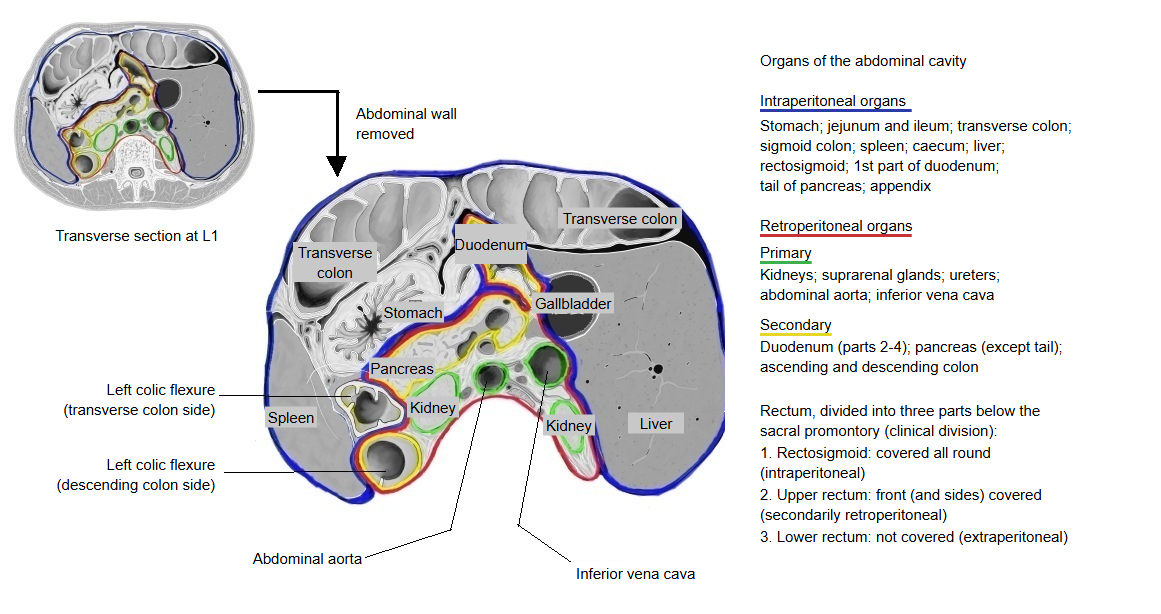
Sources differ for some organs. The caecum is usually intraperitoneal but is sometimes partly fixed to the posterior wall, and the parts of the rectum are classified differently in anatomical and clinical texts.
Related terms
References and sources
- Further reading: Retroperitoneal space, Wikipedia.
- Further reading: Peritoneum, Wikipedia.
- Federative International Programme for Anatomical Terminology (FIPAT). Terminologia Anatomica, 2nd ed. (TA2), 2019.