Orbital process (Latin: processus orbitalis ossis palatini)
Also called the orbital process of palatine bone
of the
palatine bone
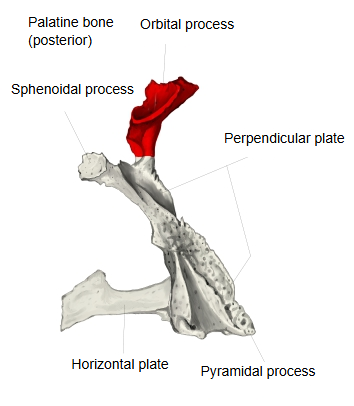
- Orbital process : projects upwards, forwards and laterally from the upper end of the perpendicular plate and forms part of the back of the floor of the orbit.
- Sphenoidal process : projects upwards and medially from the back of the upper border of the perpendicular plate and forms part of the roof and lateral wall of the nasal cavity.
- Pyramidal process : projects backwards and laterally from the lower back part of the bone and fits into the pterygoid notch of the sphenoid bone.
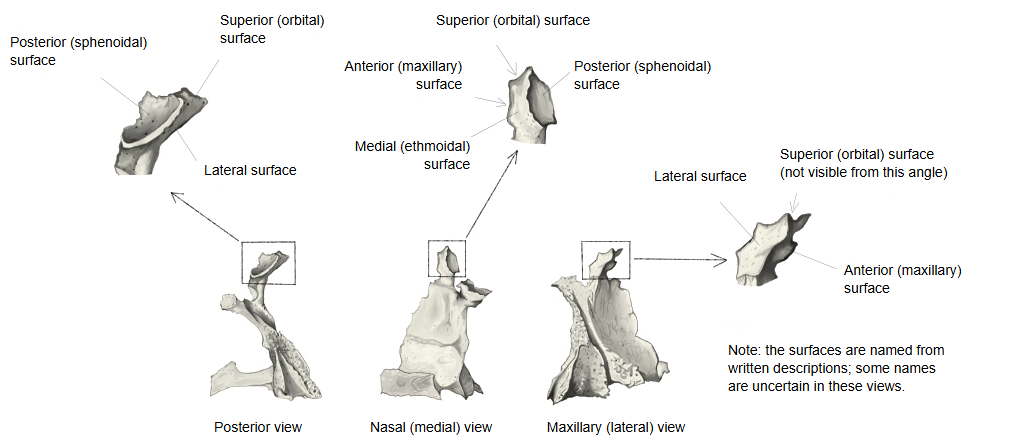
The orbital process has five surfaces; three of them join other bones.
of the
orbital process
- Anterior (maxillary) surface : oblong and rough; joins the maxilla.
- Posterior (sphenoidal) surface : carries the opening of the air cell, which usually opens into the sphenoidal sinus; it also joins the sphenoidal concha.
- Medial (ethmoidal) surface : joins the ethmoidal labyrinth of the ethmoid bone.
- Superior (orbital) surface : triangular; forms a small part of the back of the floor of the orbit.
- Lateral surface : oblong; faces the pterygopalatine fossa.
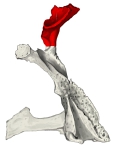 Palatine bone (posterior)
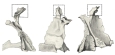 Surfaces of the orbital process
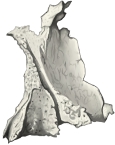 Palatine bone (maxillary surface)
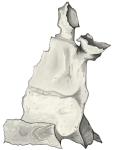 Palatine bone (nasal surface)
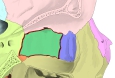 Right orbit (medial wall)
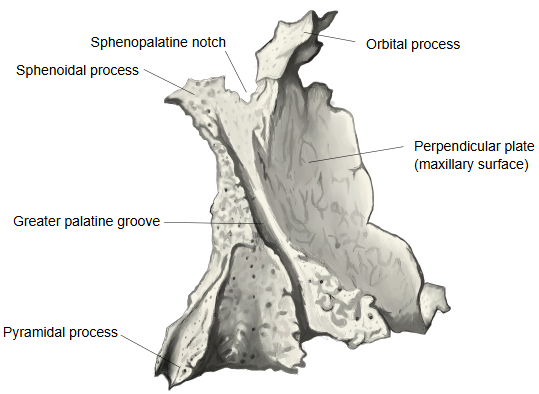
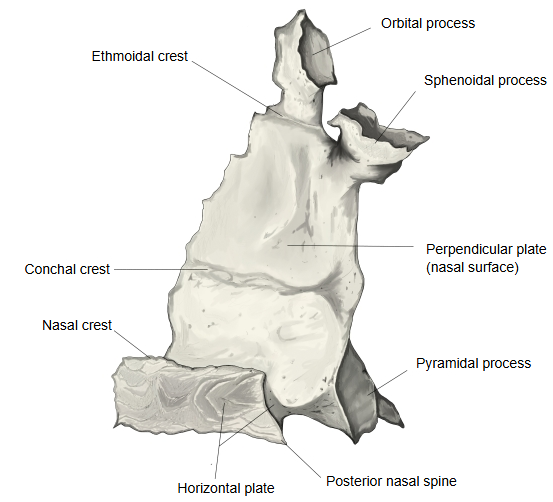
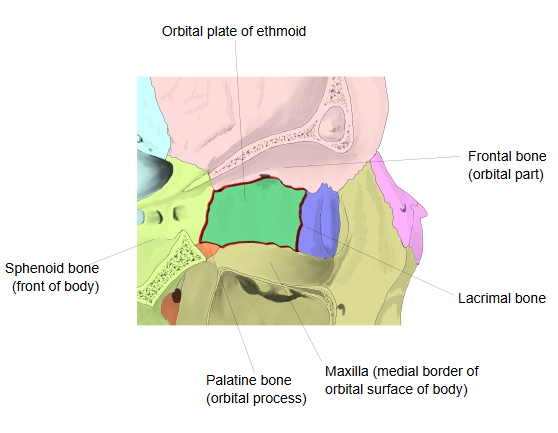
The orbital process is the larger of the two processes on the upper border of the perpendicular plate. It sits at the front of the border and is joined to the plate by a narrow neck; the sphenoidal process lies behind it, separated by the sphenopalatine notch.
It is hollow: its surfaces enclose an air cell, which usually opens into the sphenoidal sinus and sometimes into the posterior ethmoidal cells. A rounded border between the orbital and lateral surfaces helps to bound the inferior orbital fissure.
Reference websites
[Wikipedia]
· Orbital process of palatine bone, Wikipedia.
· Palatine bone, Wikipedia.
[Websites with illustrations]
· Left palatine bone, nasal aspect (Gray's Anatomy, fig. 168) (Wikimedia Commons)

· Left palatine bone, posterior aspect (Gray's Anatomy, fig. 169) (Wikimedia Commons)

Where it is found
Related terms
- Perpendicular plate
- Sphenoidal process
- Pyramidal process
- Sphenopalatine foramen
- Orbit
- Orbital plate
- Palatine bone
References and sources
- Further reading: Orbital process of palatine bone, Wikipedia.
- Further reading: Palatine bone, Wikipedia.
- Federative International Programme for Anatomical Terminology (FIPAT). Terminologia Anatomica, 2nd ed. (TA2), 2019.