Irregular bone (Latin: os irregulare)
An irregular bone is a bone with an irregular, complex shape that does not fit any of the other shape groups: long bones, short bones, flat bones, pneumatic bones or sesamoid bones.
They usually have several processes for muscles, ligaments and joints, and consist of spongy bone covered by a thin layer of compact bone.
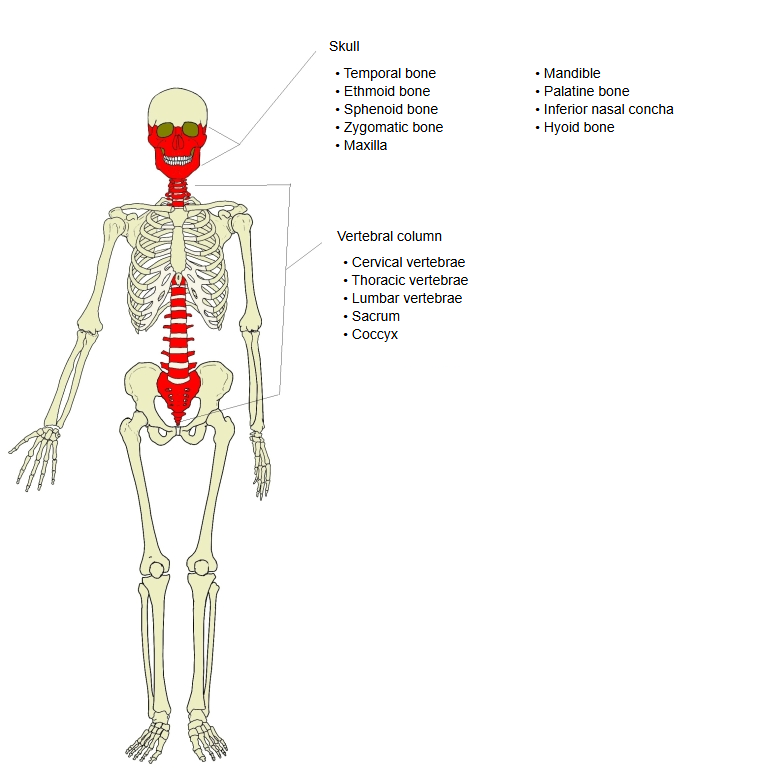
- Skull: the zygomatic bone, mandible, palatine bone and inferior nasal concha; and the hyoid bone in the neck.
- Vertebral column: the cervical, thoracic and lumbar vertebrae, the sacrum and the coccyx.
Note: when bones are sorted into only five groups, without pneumatic bones, the irregular bones also include the bones around the paranasal sinuses (the sphenoid bone, ethmoid bone and maxilla) and the temporal bone; the frontal bone is then counted as a flat bone.
Note: some sources also count the scapula (and sometimes the hip bone) as irregular; this site counts the scapula as a flat bone.
Irregular bones do many jobs: the vertebrae protect the spinal cord, the sacrum gives anchor points for muscles, and the hyoid supports the tongue and larynx.
Bones
grouped
by shape
grouped
by shape
- Long bone : a long bone of any size with a tubular shaft, such as the femur or humerus; also called a tubular bone.
- Short bone : about as long as it is wide, such as the carpal bones and tarsal bones.
- Flat bone : a thin, plate-like bone, such as the bones of the skull vault and the sternum.
- Irregular bone : a bone of irregular shape, such as the vertebrae and many bones of the facial skeleton.
- Pneumatic bone : a bone with air-filled spaces, such as the frontal bone and sphenoid bone.
- Sesamoid bone : a small bone that develops in a tendon of the hand or foot, or in a tendon where it runs over a joint and is fused with the joint capsule; the patella is the largest.
Reference websites
[Wikipedia]
· Irregular bone, Wikipedia.
· Bone, Wikipedia.
[Websites with illustrations]
· Irregular bones, anterior view (with legend) (Wikimedia Commons)

Related terms
References and sources
- Further reading: Irregular bone, Wikipedia.
- Further reading: Bone, Wikipedia.
- Federative International Programme for Anatomical Terminology (FIPAT). Terminologia Anatomica, 2nd ed. (TA2), 2019.