Abdominal cavity (Latin: cavitas abdominis)
- Overview (abdominal cavity and peritoneal cavity)
- Boundaries
- Organs only partly covered by peritoneum
- Reference websites
- (Wikipedia, websites with illustrations)
- Related terms
Overview
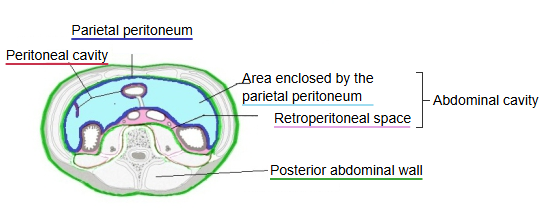
· The organs inside the abdominal cavity include:
the stomach, liver, gallbladder, spleen, pancreas, small intestine, kidneys, large intestine and adrenal glands.
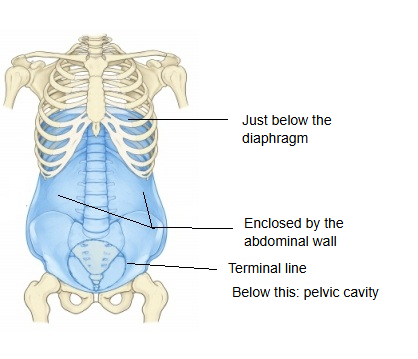
· It is the largest body cavity. Sources differ in naming: many texts treat the abdominal and pelvic cavities together as the abdominopelvic cavity.
[Abdominal cavity and peritoneal cavity]
The abdominal cavity is often treated as if it were the same as the peritoneal cavity, but the two terms refer to different spaces.
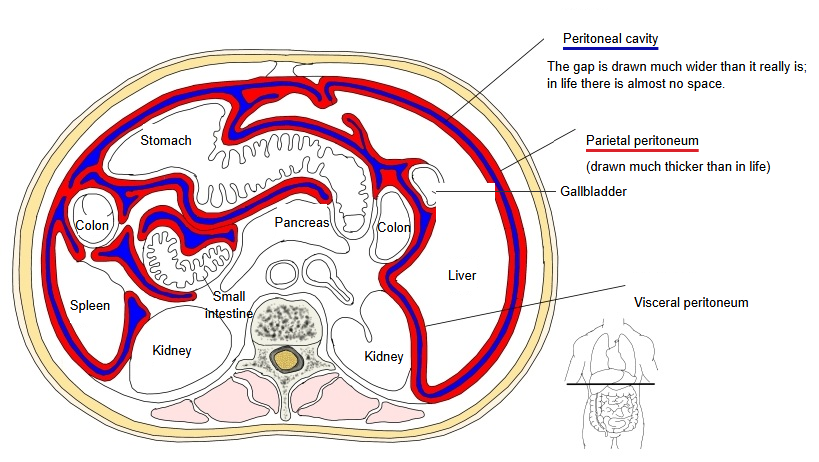
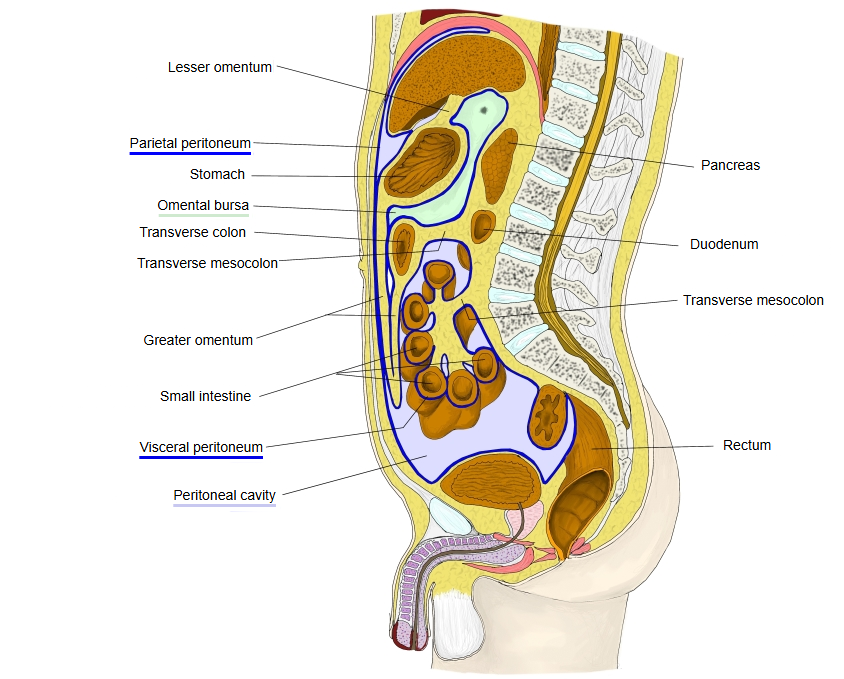
The peritoneal cavity is only the very thin space between the layers of the peritoneum (the parietal peritoneum and the visceral peritoneum). It normally holds just a little fluid and no organs. The relationship can be pictured like this:
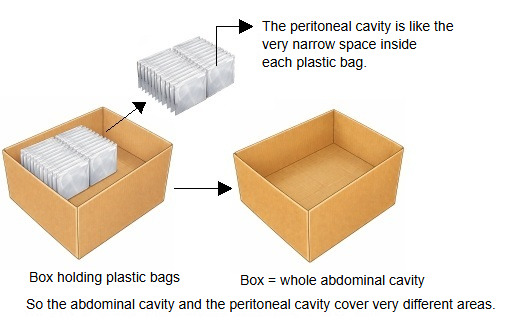
The abdominal cavity, in contrast, is the whole space inside the abdominal walls. So organs inside the peritoneum (such as the stomach) and organs behind it, in the retroperitoneal space (such as the pancreas and kidneys), are all organs of the abdominal cavity, but none of them lies in the peritoneal cavity.
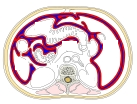 Abdomen (transverse section)
 Abdomen and pelvis (median section)
Boundaries
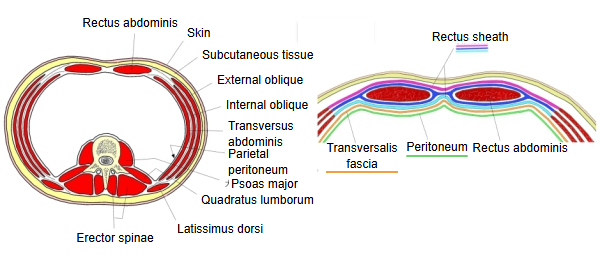
The upper part of the abdominal cavity lies under the lower part of the thorax (the lower ribs), and its lower part is held in shape by the pelvis; elsewhere it is enclosed mainly by muscles. Its boundaries, mainly the muscles, are:
| Above | Diaphragm | |
| Sides (abdominal wall) | Front | Rectus abdominis |
| Side | Transversus abdominis, internal oblique, external oblique | |
| Back | The vertebral column with the deep (intrinsic) back muscles (such as the erector spinae), psoas major, quadratus lumborum and others | |
| Floor | Psoas major, iliacus; then the opening into the pelvis | |
Organs only partly covered by peritoneum
The main organs covered by peritoneum on only part of their surface are:
| Organ | Peritoneal covering | Notes | |
|---|---|---|---|
| 1 | Liver | Almost everywhere | Except the bare area |
| 2 | Gallbladder | Usually only the lower surface | The upper surface lies against the liver |
| 3 | Duodenum (parts 2 to 4) | Front only | Secondarily retroperitoneal |
| 4 | Pancreas | Front only | Secondarily retroperitoneal |
| 5 | Ascending colon | Front only | Secondarily retroperitoneal |
| 6 | Descending colon | Front only | Secondarily retroperitoneal |
| 7 | Rectum (upper part) | Upper third: front and sides | Middle third: front only; lower third: no peritoneum |
Reference websites
[Wikipedia]
· Abdominal cavity, Wikipedia.
· Retroperitoneal space, Wikipedia.
[Websites with illustrations]
· Body cavities (scheme) (Wikimedia Commons)

· Abdominal cavity (Encyclopaedia Britannica)
· The peritoneum (TeachMeAnatomy)
Related terms
- Peritoneal cavity
- Parietal peritoneum
- Visceral peritoneum
- Peritoneum
- Diaphragm
- Transversus abdominis
- Pelvis
References and sources
- Further reading: Abdominal cavity, Wikipedia.
- Further reading: Retroperitoneal space, Wikipedia.
- Federative International Programme for Anatomical Terminology (FIPAT). Terminologia Anatomica, 2nd ed. (TA2), 2019.