Terms used to describe the parts and features of bones in general. Click a figure to open the enlarged figure or the page of the bone shown.
| No. | Term | Description | Figure |
|---|---|---|---|
| 1 | Nutrient canal |
The canal that leads from a nutrient foramen into the bone. It carries the nutrient artery to the medullary cavity. It is not the same as the perforating (Volkmann's) canals, the small channels that link the Haversian canals. |
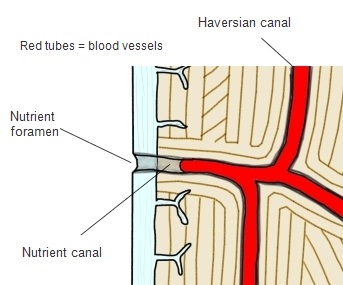 |
| 2 | Nutrient foramen |
A sharply outlined opening, about 1–2 mm across, on the surface of a bone, through which blood vessels and nerves pass into the bone. The number and position of these foramina follow a general pattern for each bone but vary considerably between individuals. |
|
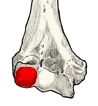
| 3 | Condyle |
A rounded, projecting end of a bone that takes part in a joint, such as the medial and lateral condyles of the femur and tibia, and the condyle of the humerus. |
 |
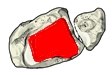
| 4 | Articular surface |
The surface of a bone that forms a joint with another bone. It is covered with articular (hyaline) cartilage. Examples: the inferior articular surface of the tibia and the articular facets of the vertebrae. |
 |
| 5 | Tubercle |
A small, blunt, thickened projection that stands out clearly from the surrounding bone. Examples: the lateral intercondylar tubercle of the tibia, the mental tubercle of the mandible, and the greater and lesser tubercles of the humerus. |
 |
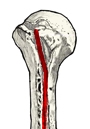
| 6 | Groove |
A long, narrow depression in a bone, often holding a tendon, vessel or nerve. Examples: the intertubercular groove of the humerus and the groove for the tendon of flexor hallucis longus on the calcaneus. |
 |
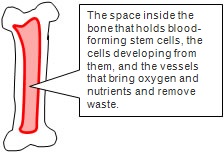
| 7 | Medullary cavity |
The space inside a bone. It holds the bone marrow: blood-forming stem cells, the cells developing from them, and the blood vessels that bring them oxygen and nutrients and carry away waste. |
 |
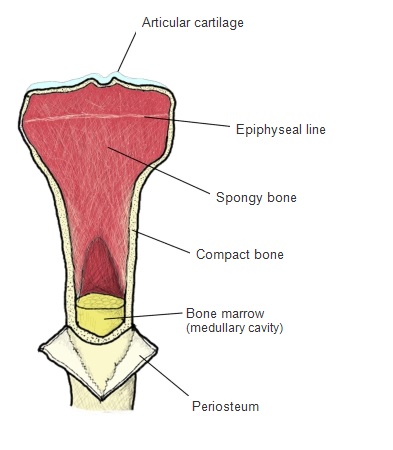
| 8 | Epiphyseal plate(epiphyseal cartilage, growth plate) |
The layer of cartilage between the epiphysis and the shaft of a growing bone, where the bone grows in length. When growth ends it is replaced by bone, and its position remains visible as the epiphyseal line. |
 |
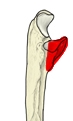
| 9 | Apophysis |
An older term with several meanings. In the broadest sense it means any outgrowth of a bone. More narrowly it is used either for a projection that grows out of the bone itself without a separate centre of ossification, or, on the contrary, for one that forms from its own centre of ossification. It is little used in English, and Terminologia Anatomica does not say which meaning it intends. |
 |
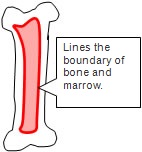
| 10 | Endosteum |
A very thin layer of connective tissue lining the inner surfaces of bone: (1) the boundary between the bone tissue and the marrow, and (2) the walls of the Haversian canals. Osteoclasts and osteoblasts are especially numerous in it while the bone is growing. |
 |
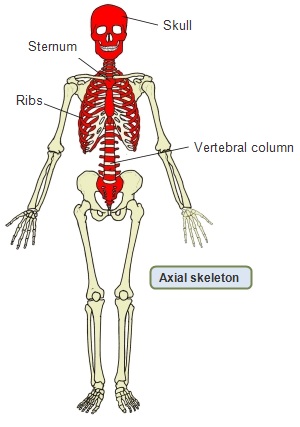
| 11 | Axial skeleton |
The bones along the axis of the body: the skull, the vertebral column, the ribs and the sternum. |
 |
| 12 | Epicondyle |
A projection just above a condyle, where muscles or ligaments attach. Examples: the medial and lateral epicondyles of the femur and humerus. |
 |
| 13 | Growth plate | |
|
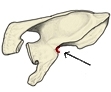
| 14 | Notch |
An indentation in the edge of a bone, as if cut out with a knife. Examples: the acetabular notch and lesser sciatic notch of the hip bone, and the suprascapular notch of the scapula. |
 |
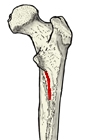
| 15 | Line |
A low, narrow ridge on a bone. Examples: the pectineal line and the intercondylar line of the femur. |
 |
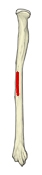
| 16 | Tuberosity |
A rough, raised area where a tendon attaches. Examples: the pronator tuberosity of the radius and the gluteal tuberosity of the femur. |
 |
| 17 | Cortical bone |
The outer layer of a bone, made of compact bone. In the shaft of a long bone it is thick; over the ends it becomes a thin shell around the spongy bone. |
|
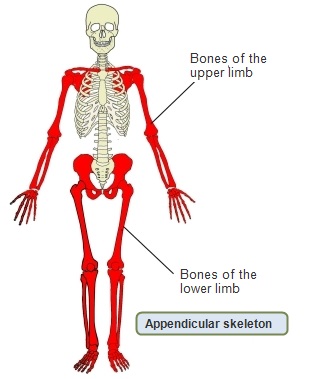
| 18 | Appendicular skeleton |
The bones of the upper and lower limbs, including the bones that attach them to the trunk. It is regarded as hanging from the axial skeleton. |
 |
| 19 | Tuber |
A large, rounded projection of bone; smaller ones are called tubercles. Examples: the calcaneal tuber of the calcaneus. The intercondylar eminence of the tibia is a raised area of the same kind. |
 |
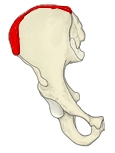
| 20 | Crest |
A prominent ridge, like the ridge line of a mountain. Examples: the iliac crest of the hip bone and the median sacral crest of the sacrum. |
 |
Bones: List of bones (A–Z) | Bones by region | Bones by shape