Septum of musculotubal canal (Latin: septum canalis musculotubarii)
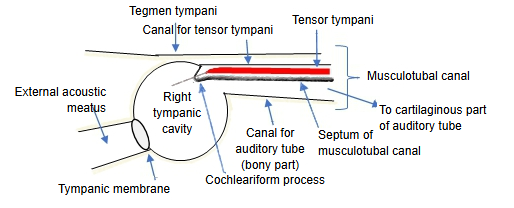
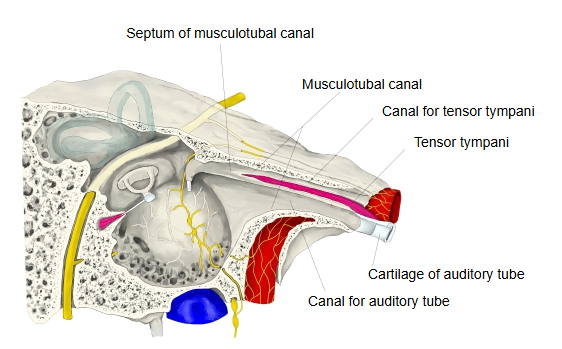
- Canal for tensor tympani : the upper of the two half-canals into which the septum divides the musculotubal canal; it holds the tensor tympani.
- Septum of musculotubal canal : a thin, incomplete plate of bone that divides the musculotubal canal into upper and lower halves; at its back end, in the tympanic cavity, it curves laterally as the cochleariform process.
- Canal for auditory tube : the lower half-canal; it forms the bony part of the auditory tube.
Features
1. A very thin, incomplete, gutter-shaped plate of bone that covers the canal for tensor tympani from below.
It is usually incomplete, but it is sometimes complete.
2. Behind, it continues as a curved ridge from the upper front corner of the medial (labyrinthine) wall of the tympanic cavity backwards, just below the prominence of the facial canal.
3. It ends as the cochleariform process, a curved lip around which the tendon of tensor tympani turns laterally.
- Squamous part : the part that takes up the middle and the whole upper part of the bone; it has a temporal surface and a cerebral surface.
- Petrous part
- Mastoid part : below the squamous part (from the mastoid process to the parietal notch).
- Pyramid : a three-sided pyramid running forwards and medially from the boundary of the squamous and mastoid parts; it has an apex, surfaces and borders.
- Apex : points towards the foramen lacerum; the internal opening of the carotid canal opens here.
- Anterior surface : = cerebral surface: trigeminal impression, arcuate eminence, grooves for the greater and lesser petrosal nerves.
- Posterior surface : = cerebellar surface: internal acoustic opening, subarcuate fossa, external aperture of the vestibular aqueduct.
- Inferior surface : = basal surface: styloid process, jugular fossa, groove for the mastoid canaliculus, external aperture of the cochlear canaliculus, external opening of the carotid canal, petrous fossula, inferior opening of the tympanic canaliculus.
- Tympanic part : the smallest part: a thin, half-tube-shaped plate of bone that forms the front and lower walls of the external acoustic meatus.
The septum is a very thin, half-tube-shaped plate of bone between the two parts of the musculotubal canal of the petrous part: above it lies the canal for tensor tympani, below it the canal for the auditory tube. Its back part projects a little into the tympanic cavity along the prominence of the facial canal and ends as the cochleariform process, a small hook-shaped lip around which the tendon of tensor tympani turns laterally to reach the malleus.
Reference websites
[Wikipedia]
· Tensor tympani muscle, Wikipedia.
· Eustachian tube, Wikipedia.
[Websites with illustrations]
· The middle ear (TeachMeAnatomy)
· Middle ear and auditory tube (Sobotta, 1911) (Wikimedia Commons)

· Section through the ear (Gray's Anatomy) (Wikimedia Commons)

Related terms
References and sources
- Further reading: Tensor tympani muscle and Eustachian tube, Wikipedia.
- Federative International Programme for Anatomical Terminology (FIPAT). Terminologia Anatomica, 2nd ed. (TA2), 2019.