Internal acoustic opening (Latin: Porus acusticus internus)
Also called the internal acoustic pore or the internal auditory opening
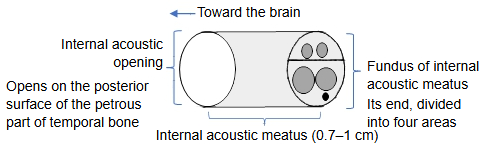
· It is a large oval opening near the middle of the posterior surface of the petrous part (the pyramid), facing the posterior cranial fossa. Its size varies a good deal, and its rim is smooth and rounded.
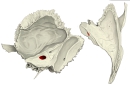 Right temporal bone (medial and superior views)
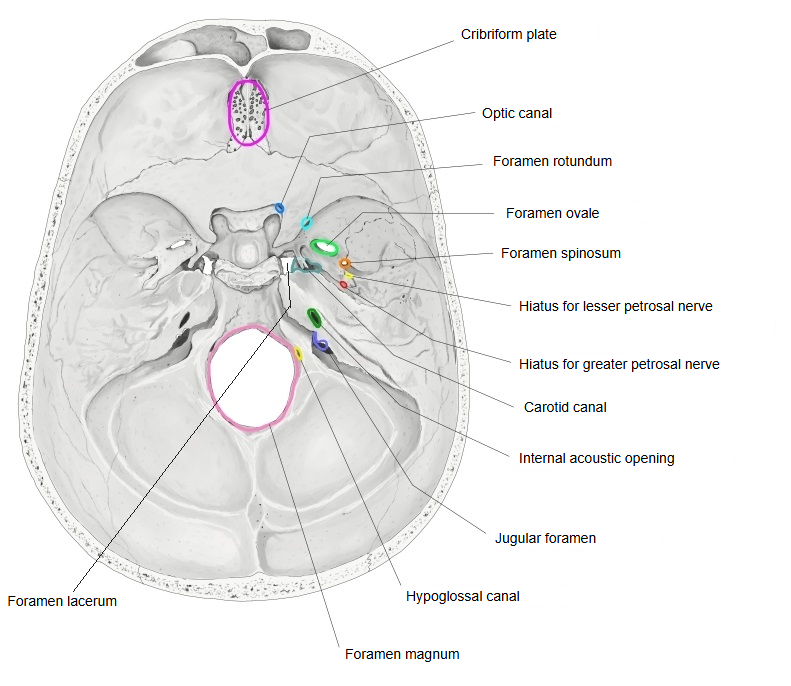
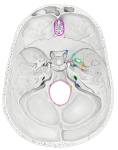 Openings of the internal cranial base
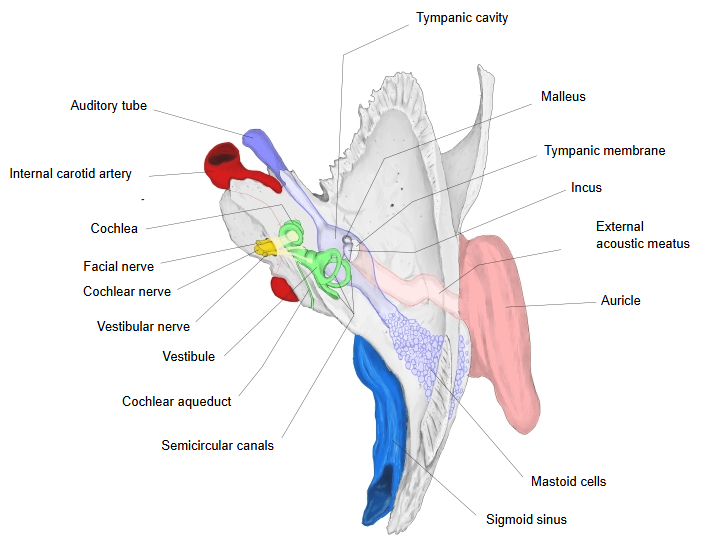
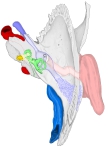 Right temporal bone (superior view)
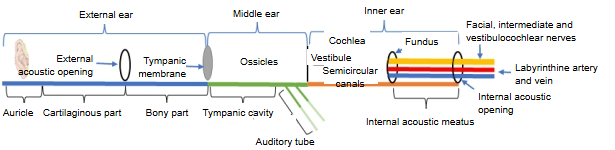
 Hearing: model diagram
- Squamous part : the thin, flat upper part of the bone, forming part of the side wall of the skull; it has a temporal surface and a cerebral surface.
- Petrous part
- Mastoid part : below the squamous part (from the mastoid process to the parietal notch).
- Pyramid : a three-sided pyramid running forwards and medially from the boundary of the squamous and mastoid parts; it has an apex, surfaces and borders.
- Apex : points towards the foramen lacerum; the internal opening of the carotid canal opens here.
- Anterior surface : = cerebral surface: trigeminal impression, arcuate eminence, grooves for the greater and lesser petrosal nerves.
- Posterior surface : = cerebellar surface: internal acoustic opening, subarcuate fossa, external aperture of the vestibular aqueduct.
- Inferior surface : = basal surface: styloid process, jugular fossa, groove for the mastoid canaliculus, external aperture of the cochlear canaliculus, external opening of the carotid canal, petrous fossula, inferior opening of the tympanic canaliculus.
- Tympanic part : the smallest part: a thin, half-tube-shaped plate of bone that forms the front and lower walls of the external acoustic meatus.
The internal acoustic opening leads laterally into the internal acoustic meatus, a short canal about 0.7–1 cm long that ends blindly at the fundus, which is divided into four areas. Through the opening pass the facial nerve, the intermediate nerve and the vestibulocochlear nerve, with the labyrinthine artery (usually from the anterior inferior cerebellar artery, sometimes from the basilar artery) and the labyrinthine veins. Nearby on the same surface lie the subarcuate fossa above and behind it and the external opening of the vestibular aqueduct further back. On the outer surface of the skull the corresponding opening of the ear is the external acoustic opening.
Reference websites
[Wikipedia]
· Internal auditory meatus, Wikipedia.
· Temporal bone, Wikipedia.
[Websites with illustrations]
· Internal acoustic meatus: anatomy and function (Kenhub)
· The inner ear (TeachMeAnatomy)
Related terms
- Fundus of internal acoustic meatus
- Internal acoustic meatus
- Petrous part
- Vestibulocochlear nerve
- Facial nerve
- Labyrinthine veins
- External acoustic opening
- Ear (vestibulocochlear organ)
References and sources
- Further reading: Internal auditory meatus, Wikipedia.
- Further reading: Temporal bone, Wikipedia.
- Federative International Programme for Anatomical Terminology (FIPAT). Terminologia Anatomica, 2nd ed. (TA2), 2019.