Intestinal tract (Latin: intestinum)
Also called the intestine, bowel
Overview
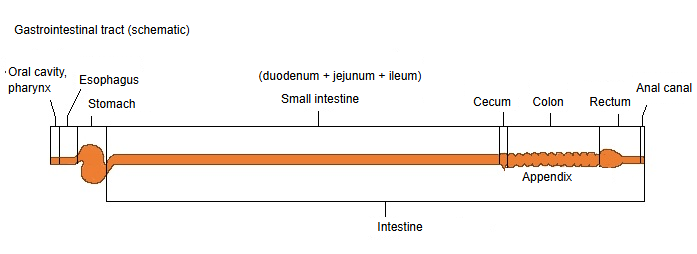
The intestinal tract is one of the parts of the gastrointestinal tract: the small intestine and the large intestine together, which make up most of its length.
Gastrointestinal tract: the part that digests and absorbs food and forms feces, from the mouth to the anusRoughly 85–90%
The intestinal tract is the main part of the gastrointestinal tract that carries out the absorption of digested food and the forming of feces.
The main absorber is the small intestine, especially the jejunum
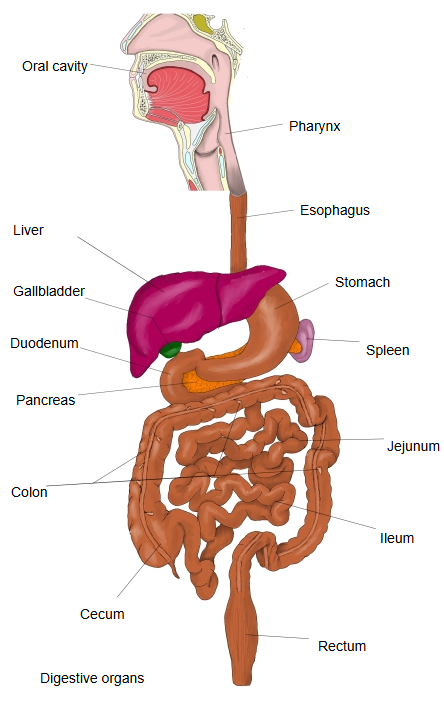
Below is a short overview of the parts of the gastrointestinal tract.
Gastro-
intestinal
tract
intestinal
tract
- Oral cavity : the entrance of the tract; function: chewing the food and mixing it with saliva to prepare it for swallowing.
- Pharynx : the food passage behind the oral cavity, shared with the respiratory system; leads the food into the oesophagus.
- Esophagus : the start of the typical tubular part; a muscular organ that moves the food on by peristalsis.
- Stomach : the widest part; stores the contents, digests them mechanically by churning and chemically with gastric juice.
- Small intestine : part of the intestinal tract.
- Duodenum : neutralizes the contents with pancreatic juice and bile; full digestion begins.
- Jejunum : well-developed circular folds; the main part of the small intestine and the centre of nutrient absorption.
- Ileum : absorbs bile acids and vitamin B12; rich in lymphoid tissue.
- Large intestine : part of the intestinal tract.
- Cecum : receives the contents from the ileum; rich in immune tissue; carries the vermiform appendix.
- Colon : absorbs water and electrolytes and forms feces; three teniae coli and the haustra.
- Rectum : stores the formed feces for a time.
- Anal canal : the last part of the tract; the internal (involuntary) and external (voluntary) anal sphincters control defecation.
Comparison table
A simple table to show how the parts differ. Lengths and widths vary greatly between people and between living and post-mortem measurements; the figures are typical adult values.
| Part | Length (cm) | Inner diameter (cm) | Wall thickness (mm) | Features of the layers | Function | |
|---|---|---|---|---|---|---|
| 1 | Duodenum | 25–30 | 3–4 | 2.0–3.0 | Duodenal glands in the submucosa | Neutralizes stomach acid; mixes the contents with pancreatic juice and bile |
| 2 | Jejunum | 200–250 | 3 | 2.0–2.5 | Best-developed circular folds | Main site of nutrient absorption |
| 3 | Ileum | 300–400 | 2.5 | 1.5–2.0 | Peyer's patches (aggregated lymphoid nodules) | Absorbs bile acids and vitamin B12 |
| 4 | Cecum | 6–8 | 7–8 | 1.5–2.0 | Start of the teniae coli; a blind pouch | Receives the contents |
| 5 | Ascending colon | 15–20 | 6–7 | 2.0–2.5 | Teniae coli and haustra | Absorbs water; feces begin to form |
| 6 | Transverse colon | 40–50 | 5–6 | – | Highly mobile (has a mesentery) | Absorbs water and electrolytes |
| 7 | Descending colon | 25–30 | 4–5 | 2.5–3.0 | Fixed to the posterior abdominal wall (retroperitoneal) | Concentrates and moves the feces |
| 8 | Sigmoid colon | 40 | 4 | 3.0–4.0 | Strongly curved; holds contents | Stores feces for a time |
| 9 | Rectum | 12–15 | 5–6 | 4.0–6.0 | Teniae coli spread out into a continuous layer; has an ampulla | Stores feces; prepares for defecation |
| 10 | Anal canal | 3–4 | variable | 2–3 | Lining changes from columnar to stratified squamous epithelium | Controls defecation (sphincters) |
In all, the small intestine is about 6 m long in the living body (longer after death) and long and narrow; the large intestine is about 1.5 m long, shorter and wider. The ileum ends at the ileocaecal valve, where the contents pass into the caecum.
Related terms
- Orifice of vermiform appendix
- Gastrointestinal tract
- Small intestine
- Large intestine
- Duodenum
- Jejunum
- Ileum
- Colon
References and sources
- Further reading: Intestine, Wikipedia.
- Further reading: Small intestine, Wikipedia.
- Further reading: Large intestine, Wikipedia.
- Federative International Programme for Anatomical Terminology (FIPAT). Terminologia Anatomica, 2nd ed. (TA2), 2019.