Endocrine secretion
Also called the internal secretion or the endocrine
Endocrine (internal) secretion is the kind of secretion (the release by cells of substances they have made, to the inside or the outside of the body) in which cells release hormones directly into the tissue fluid and blood, without a duct.
Hormones: physiologically active substances that are carried by the blood and act on target cells in particular places
Unlike exocrine secretion, endocrine secretion is carried out not only by glands but also by hormone-producing cells scattered in many tissues.
Secretion
(in the
narrow sense)
(in the
narrow sense)
- Exocrine secretion : secretion onto the body surface (sweat, sebum, milk) and into the digestive tract (saliva, gastric juice, bile, etc.).
- Endocrine secretion : secretion of hormones; sometimes by single cells rather than by glands.
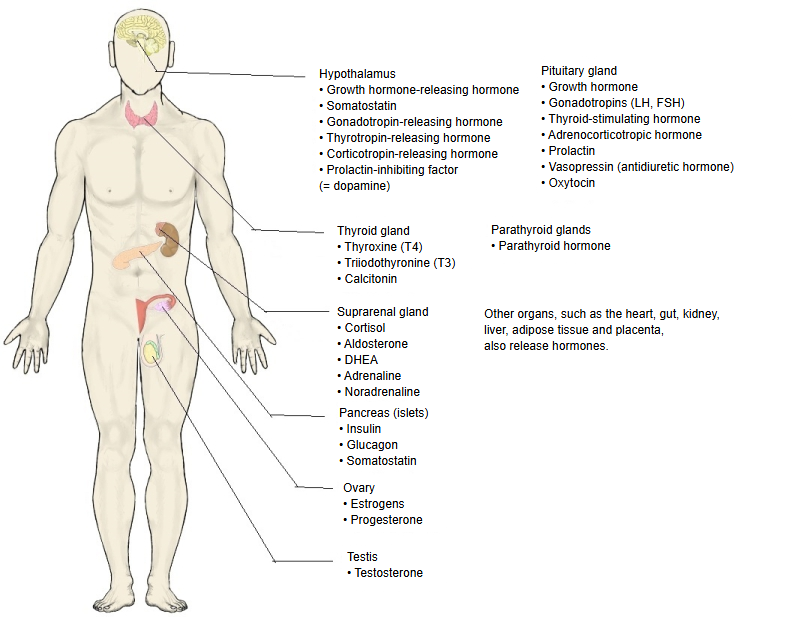
The figure below divides the secretory glands into endocrine and exocrine glands. Endocrine secretion is carried out by the endocrine glands in this figure,
and in addition by hormone-producing cells scattered in various tissues, such as the enteroendocrine cells of the gut and cells of the heart, kidney, liver and adipose tissue, and during pregnancy by the placenta. Nerve cells that release hormones into the blood (for example in the hypothalamus) carry out neurosecretion.
(Secretory)
glands
glands
- Exocrine glands
- Onto the body surface : sweat glands (eccrine and apocrine sweat glands), sebaceous glands, mammary gland = the skin glands.
- Into the digestive tract : salivary glands, pancreas, liver, gastric glands, duodenal glands.
- Other : nasal glands.
- Endocrine glands
- In the brain : pituitary gland, pineal gland.
- In the neck : thyroid gland, parathyroid glands.
- In the abdomen : suprarenal glands, pancreas (pancreatic islets).
- Reproductive organs : gonads (ovary with its corpus luteum, testis); during pregnancy also the placenta.
- Note : the lists try to name as many glands as possible but may not be complete. The pancreas belongs to both groups.
Related terms
- Hormone
- Endocrine gland
- Exocrine secretion
- Secretion
- Neurosecretion
- Enteroendocrine cell
- Endocrine glands
References and sources
- Further reading: Endocrine system, Wikipedia.
- Further reading: Endocrine gland, Wikipedia.
- Federative International Programme for Anatomical Terminology (FIPAT). Terminologia Anatomica, 2nd ed. (TA2), 2019.