Infraperitoneal organs
Also called Subperitoneal organs
Infraperitoneal organs is a general name for the organs that lie below the parietal peritoneum of the pelvis, in the subperitoneal space.
Classification
of the
abdominal
organs
of the
abdominal
organs
- Intraperitoneal organs : lie in the peritoneal cavity and are almost completely covered by visceral peritoneum (a serous membrane); joined to the wall by mesenteries and peritoneal folds. E.g. the stomach, the small intestine, the transverse and sigmoid colon, the liver, the spleen.
- Retroperitoneal organs
- Primarily retroperitoneal : develop from the start in the retroperitoneum (the space behind the peritoneal cavity) and are firmly fixed. E.g. the kidneys, suprarenal glands, ureters, abdominal aorta, inferior vena cava.
- Secondarily retroperitoneal : lie in the peritoneal cavity at first, but become fixed to the posterior wall during development. E.g. the duodenum (parts 2–4), the pancreas (except the tail), the ascending and descending colon, the cecum (sometimes).
- Infraperitoneal organs : lie below the peritoneum. E.g. the lower part of the rectum, the lower part of the urinary bladder, the prostate, the cervix of the uterus.
- Retroperitoneal + infraperitoneal : together make up the extraperitoneal organs.
· It is a descriptive term, not an official anatomical term. Peritoneum covers at most the upper surface of these organs; the rest of each organ is embedded in pelvic connective tissue. Other examples are the seminal glands in men and the vagina in women.
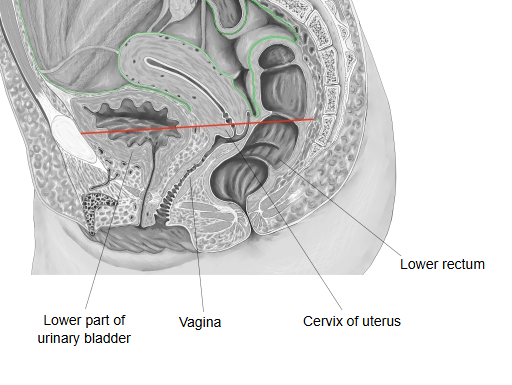 Female pelvis (sagittal section)
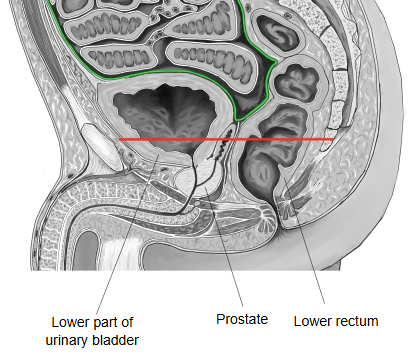 Male pelvis (sagittal section)
Related terms
- Extraperitoneal organs
- Retroperitoneal organs
- Intraperitoneal organs
- Subperitoneal space
- Parietal peritoneum
- Urinary bladder
- Rectum
References and sources
- Further reading: Peritoneum, Wikipedia.
- Federative International Programme for Anatomical Terminology (FIPAT). Terminologia Anatomica, 2nd ed. (TA2), 2019.