Oropharynx (Latin: pars oralis pharyngis)
Also called Oral part of pharynx or the mesopharynx
One of the three parts of the pharynx (cavity of pharynx): the middle part, between the epipharynx above and the hypopharynx below, lying behind and opening into the oral cavity. Also called the oral part of the pharynx (mesopharynx).
of
pharynx
- Epipharynx : = nasal part of pharynx
- Oropharynx : = oral part of pharynx
- Hypopharynx : = laryngeal part of pharynx
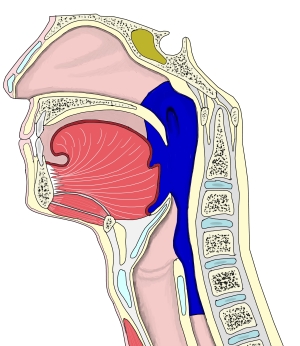
More detail
In front, the oropharynx continues into the oral cavity at the fauces (through the isthmus of fauces); above, it reaches the soft palate, and below, the upper border of the epiglottis, where the laryngopharynx begins. Below the isthmus its front wall is the back (pharyngeal part) of the tongue, with the lingual tonsil and the epiglottic valleculae. On each lateral wall, the palatine tonsil lies between the palatoglossal arch and the palatopharyngeal arch.
The palatine tonsil, together with the pharyngeal tonsil, the lingual tonsil and the tubal tonsil, surrounds the upper pharynx and forms the pharyngeal lymphoid ring (Waldeyer's ring). Behind the oropharynx lie the second and third cervical vertebrae, separated from it by the pharyngeal constrictors and the prevertebral fascia. It carries both air and food and is lined by non-keratinised stratified squamous epithelium.
of the
pharynx
- Epipharynx : = nasal part of pharynx (nasopharynx). Connects with the nasal cavity through the choanae, and with the middle ear through the pharyngeal opening of the auditory tube. Related terms: torus levatorius, salpingopharyngeal fold, pharyngeal recess, torus tubarius, pharyngeal fornix, pharyngeal tonsil.
- Oropharynx : = oral part of pharynx. Connects with the oral cavity through the fauces (isthmus of fauces); below, it continues into the laryngopharynx.
- Hypopharynx : = laryngeal part of pharynx. Connects with the larynx through the laryngeal inlet, and with the esophagus through the opening of the esophagus at about C6. Related terms: piriform recess (on each side of the laryngeal inlet), fold of superior laryngeal nerve.
[A question]
The textbook used as the main source for this site shows the three parts of the pharynx in three colours, as in the figure above, and labels them the "nasal part" and "laryngeal part" of the pharynx. The range it colours as the oropharynx, however, does not seem to match the textbook's own description ("in front it continues into the oral cavity at the fauces; it reaches the soft palate above and the larynx below"). This may only reflect the author's limited knowledge, but images found on the internet also differ in the range they give to the pharynx, so there may be several views. Many sources also make no clear distinction between the pharynx and the cavity of the pharynx.
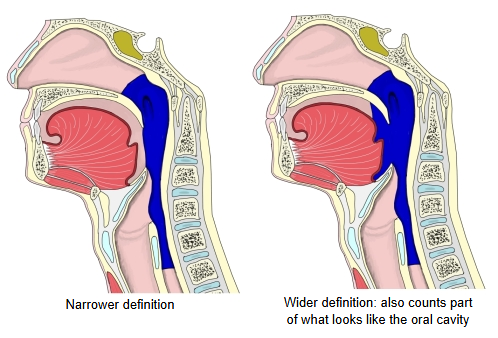
Most sources place the oropharynx between the soft palate and the tip of the epiglottis (about the level of the hyoid bone), but diagrams vary in how much of the space behind the tongue they include.
Reference websites
[Wikipedia]
· Pharynx (oropharynx), Wikipedia.
· Pharynx, Wikipedia.
[Websites with illustrations]
· The pharynx (TeachMeAnatomy)
· Oropharynx (Radiopaedia)
Where it is found
Related terms
- Nasopharynx
- Isthmus of fauces
- Palatine tonsil
- Palatoglossal arch
- Palatopharyngeal arch
- Epiglottic vallecula
- Pharynx
References and sources
- Further reading: Oropharynx, Wikipedia.
- Further reading: Pharynx, Wikipedia.
- Federative International Programme for Anatomical Terminology (FIPAT). Terminologia Anatomica, 2nd ed. (TA2), 2019.