Transversalis fascia (Latin: fascia transversalis)
Also called the transverse fascia
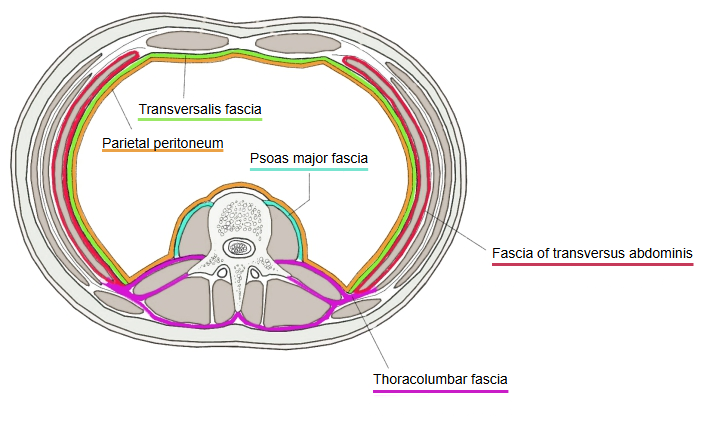
The transversalis fascia also extends from top to bottom, and its connections differ from part to part, as follows.
Upper part
Front
· Near the xiphoid process and the costal cartilages it is continuous with the aponeurosis of transversus abdominis and is attached to the inner surfaces of the sternum and the ribs.
· Higher up, near the diaphragm, it passes on to the underside of the diaphragm as the diaphragmatic fascia.
Sides
· The muscle fibres of transversus abdominis interdigitate with those of the diaphragm at the costal margin, and the transversalis fascia passes on with them into the fascia lining the diaphragm.
Back
· It joins the renal fascia and the fascia over the crura of the diaphragm, and takes part in the supporting framework of the retroperitoneum; behind the kidneys it thins out in the perirenal fat.
Lower part
Front
· Inguinal ligament: it is attached to the back of the inguinal ligament and strengthens it from behind; medial to the femoral vessels it is attached to the pubis, and in front of the femoral vessels it extends down as the anterior wall of the femoral sheath.
· Deep inguinal ring: an opening in the transversalis fascia, through which the spermatic cord (in males) or the round ligament of the uterus (in females) passes into the inguinal canal.
· Pelvic cavity: below, it passes into the pelvic fascia of the pelvic cavity; around the bladder it is continuous with the prevesical fascia.
Sides
· Iliac fascia: it is attached to the iliac crest and joins the iliac fascia that covers the iliac fossa (over iliacus), forming part of the iliopsoas fascia.
· At the lateral part of the inguinal ligament it joins the iliac fascia along the back of the ligament; the fascia lata of the thigh is attached to the same ligament from below.
Back
· It is continuous with the iliopsoas fascia.
· It joins the fasciae that wrap psoas major and iliacus, and so forms part of the wall of the retroperitoneal space.
In front of the lumbar vertebrae it is continuous with the fascia there (the iliopsoas fascia) and with the renal fascia.
At the inlet of the pelvis it joins the pelvic fascia and passes into the membranes that support the pelvic organs, such as the rectum, bladder and uterus.
Note: Sources use the names differently. Some texts use 'transversalis fascia' for the whole fascial lining of the abdominal cavity, others only for the part on transversus abdominis, also called the fascia of transversus abdominis; the information is still being checked and the page will be corrected as needed.
Some sources give different names to its parts, by region:
- Diaphragmatic fascia : the upper part, covering the underside of the diaphragm.
- Lumbar part : the back part, which reaches the inner surface of quadratus lumborum and covers psoas major and psoas minor.
- Umbilical fascia : a slightly thicker part behind the umbilical ring.
- Interfoveolar ligament : a vertical thickening of the transversalis fascia on the medial side of the deep inguinal ring, just in front of the inferior epigastric vessels.
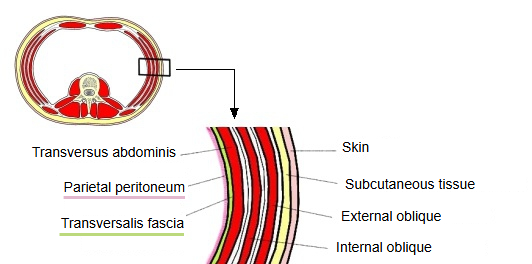
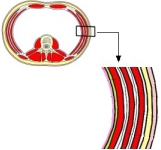 Layers of the lateral abdominal wall
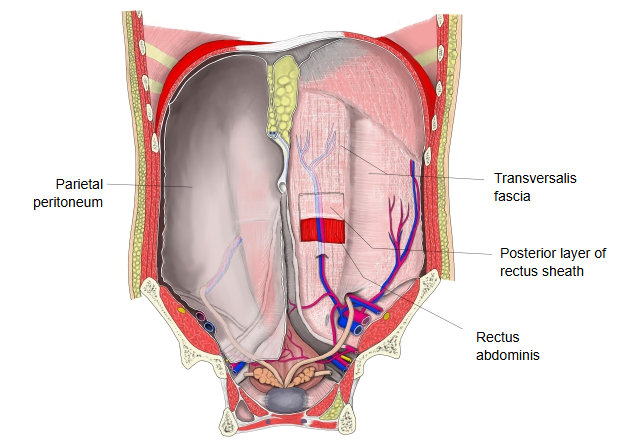
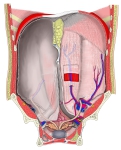 Abdominal cavity seen from behind
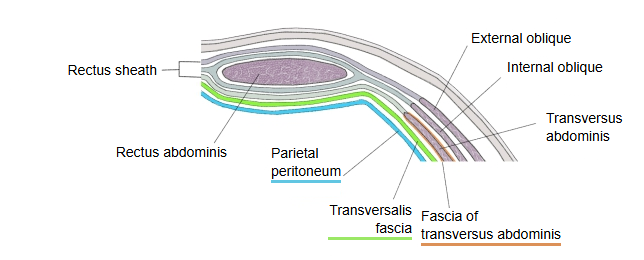
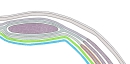 Anterior abdominal wall (cross-section)
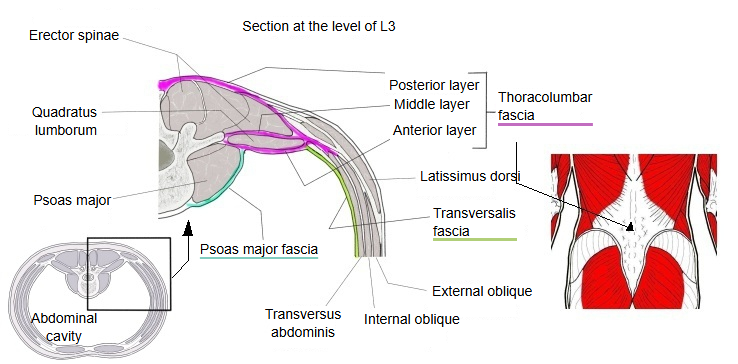
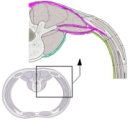 Posterior abdominal wall (cross-section at L3)
Confusing names: transversalis fascia / fascia of transversus abdominis / transverse abdominal fascia.
· 'Fascia of transversus abdominis' (transverse abdominal fascia) means the deep fascia that covers the whole of transversus abdominis.
· On this page, the transversalis fascia is the fascia inside it, running parallel to the parietal peritoneum; behind, each side ends at the thoracolumbar fascia, so it does not continue across the back around the vertebral column.
· Other sources treat the transversalis fascia as the same as the fascia of transversus abdominis, or use all three names for one layer.
Note: pages written earlier may still use these names in the older way; they are being corrected.
The transversalis fascia is the thin membrane between the inner surface of transversus abdominis and the peritoneum. Together with the iliac fascia over iliacus and the fascia on the underside of the diaphragm, it forms a continuous fascial sheet that lines the inner surface of the abdominal wall muscles. The upper part, covering the underside of the diaphragm, is the diaphragmatic fascia. Behind, it covers quadratus lumborum and psoas major and minor, and over iliacus it becomes the iliac fascia. In front, above the arcuate line, it covers the back of the rectus sheath and reaches the linea alba; below the arcuate line, where the posterior layer of the rectus sheath is missing, it lies directly on the back of rectus abdominis, and its lower end is attached to the pubis. Behind the umbilical ring it is a little thicker; this part is called the umbilical fascia.
It is a thin, aponeurosis-like membrane between transversus abdominis and the parietal peritoneum, and part of the general fascial lining of the abdominal walls; it is directly continuous with the iliac fascia, the internal spermatic fascia and the pelvic fasciae. In the groin it is thick and dense and receives fibres from the aponeurosis of transversus abdominis; it becomes thinner as it rises to the diaphragm, where it blends with the fascia on the underside of that muscle.
Borders
Behind, it is lost in the fat behind the kidneys. Below, it is attached along the whole length of the iliac crest, between the attachments of transversus abdominis and iliacus; between the anterior superior iliac spine and the femoral vessels it is attached to the back of the inguinal ligament, where it is continuous with the iliac fascia. Medial to the femoral vessels it is thin and attached to the pubis and the pectineal line, behind the inguinal falx, with which it is united; it descends in front of the femoral vessels as the anterior wall of the femoral sheath. Along the lower border of the inguinal ligament, on its deep (posterior) side, it is strengthened by a band of fibrous tissue, the iliopubic tract, which runs parallel to the ligament and is only loosely connected to it.
Opening
The spermatic cord (in males) and the round ligament of the uterus (in females) pass through the transversalis fascia at the deep inguinal ring, the entrance to the inguinal canal; the opening cannot be seen from the outside. In males the fascia continues down around the cord as the internal spermatic fascia.
Reference websites
[Wikipedia]
· Transversalis fascia, Wikipedia.
· Deep inguinal ring, Wikipedia.
[Websites with illustrations]
· Transversalis fascia and the deep inguinal ring in the groin (figure) (Surgical Clinics (Elsevier))

Related terms
- Transversus abdominis
- Parietal peritoneum
- Inguinal ligament
- Femoral sheath
- Rectus abdominis
- Iliacus
- Peritoneal cavity
References and sources
- Further reading: Transversalis fascia, Wikipedia.
- Further reading: Deep inguinal ring, Wikipedia.
- Federative International Programme for Anatomical Terminology (FIPAT). Terminologia Anatomica, 2nd ed. (TA2), 2019.