Joint (Latin: junctura; articulatio)
Also called the articulation
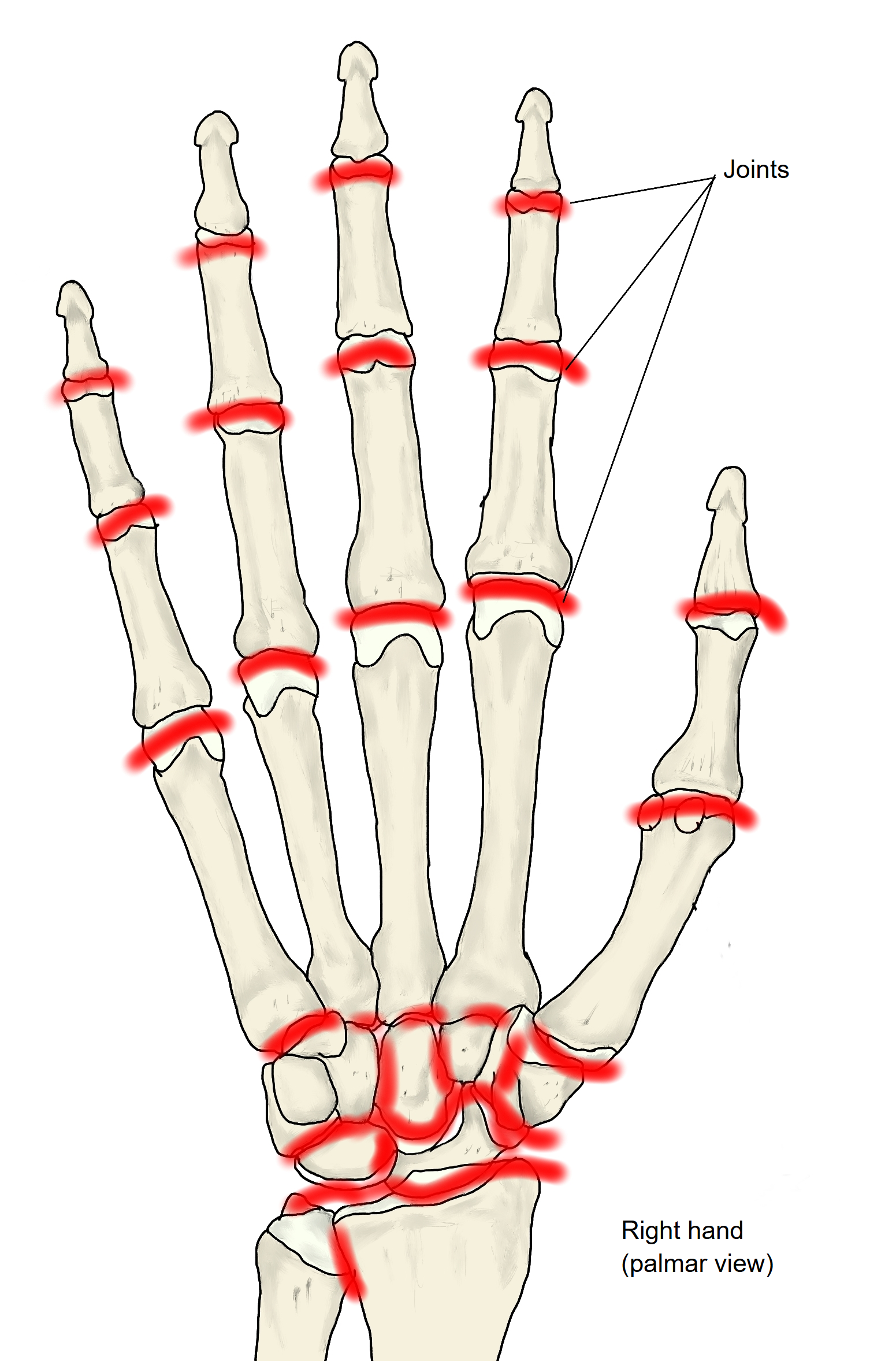
Overview
A joint is a part that connects bone to bone; according to how much they move, joints are divided into immovable joints (with no joint cavity; some of them, such as the symphyses, allow slight movement) and movable joints.
Movable joints: joints in the narrow sense
Joints
- Immovable joints (no joint cavity; some slightly movable)
- Fibrous joints
- Syndesmosis : bones joined by fibrous connective tissue in the form of ligaments or membranes (e.g. the tibiofibular syndesmosis, the interosseous membranes of the forearm and leg)
- Suture : mainly between the bones of the skull: serrate, squamous and plane sutures
- Gomphosis : between the root of a tooth and its socket (alveolus)
- Cartilaginous joints : the pubic symphysis between the right and left pubic bones; in the young, the spheno-occipital synchondrosis
- Bony union (synostosis) : usually a cartilaginous joint that has turned to bone, e.g. the fused sacral vertebrae in the adult sacrum
- Fibrous joints
- Movable joints : (joints in the narrow sense) a gap separates the two bones completely, and the joint has special structures; also called synovial joints (diarthroses)
More details
Joints let our bodies move smoothly. They are found all over the body, and many of them are in the hands and feet; most joints of the limbs are synovial joints. Counts of the total number of joints vary widely between sources, depending on what is counted.
Joint
- Definition : where bones meet and move against each other
- Number : counts of the total differ between sources
- Where : many are in the hands and feet
Structure
The parts of a (synovial) joint are as follows.
| Name | Notes | Illustration | |
|---|---|---|---|
| 1 | Periosteum | The tough fibrous membrane that covers the bone. | 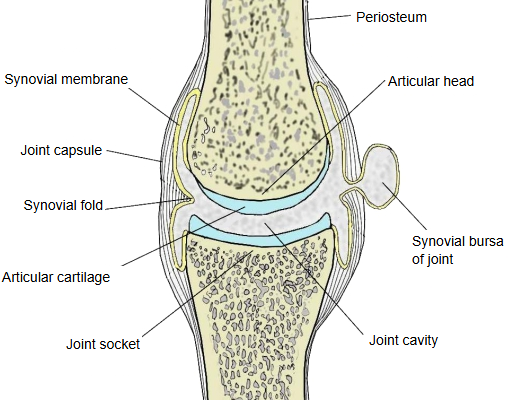 |
| 2 | Joint cavity | The narrow space between the bones of the joint; it contains synovial fluid (synovia). | |
| 3 | Synovial bursa | In large joints the synovial membrane, with synovial fluid inside, may bulge out through the joint capsule; this is called a synovial bursa. | |
| 4 | Articular cartilage | A layer of hyaline cartilage covering the articular surface of each bone; it gives a smooth surface and acts as a cushion. | |
| 5 | Joint socket | The concave end of one of the two bones. | |
| 6 | Joint capsule | Connective tissue that continues from the periosteum and encloses the joint; it has two layers, an outer fibrous membrane and an inner synovial membrane. | |
| 7 | Synovial fold | A fold of the synovial membrane projecting into the joint cavity. | |
| 8 | Synovial membrane | The soft inner lining of the joint capsule, rich in blood vessels; it secretes the synovial fluid. | |
| 9 | Articular head | The convex end of the other bone. |
Types
The main types of joints are listed below.
| By axes of movement | By shape | Examples | |
|---|---|---|---|
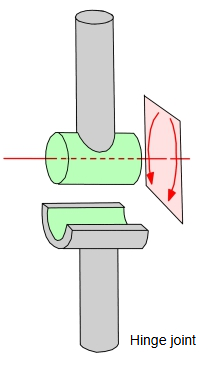
| Uniaxial joints | 1 | Hinge joint | Interphalangeal joints, elbow joint |
| 2 | Spiral joint (a variant of the hinge joint) | Humero-ulnar joint, talocrural joint, knee joint | |
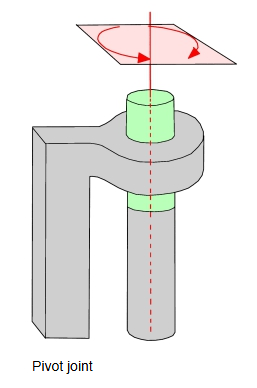
| 3 | Pivot joint | Proximal and distal radio-ulnar joints, median atlanto-axial joint | |
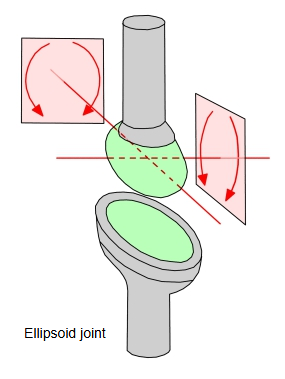
| Biaxial joints | 4 | Ellipsoid joint | Radiocarpal joint |
| 5 | Condylar joint | Atlanto-occipital joint, temporomandibular joint, subtalar joint | |
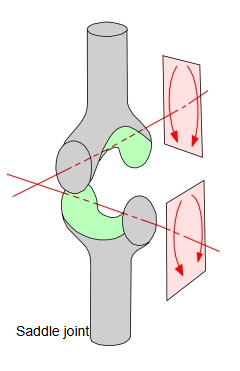
| 6 | Saddle joint | First carpometacarpal joint (thumb), sternoclavicular joint | |
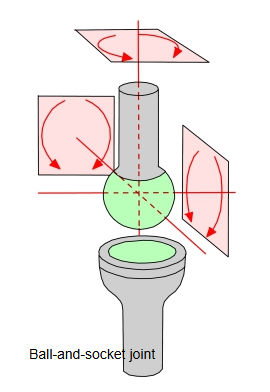
| Multiaxial joints | 7 | Ball-and-socket joint | Shoulder joint (glenohumeral joint), humeroradial joint |
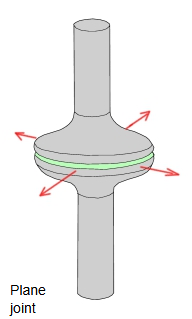
| 8 | Plane joint | Zygapophysial (facet) joints, acromioclavicular joint, intercarpal joints, intertarsal joints | |
| 9 | Amphiarthrosis (tight joints with very little movement; not really classed by axes) | Sacroiliac joint | |
| 10 | Enarthrosis (cup-shaped joint) | Hip joint | |
Sources differ in how some joints are classed (for example the humeroradial, temporomandibular, subtalar and knee joints).
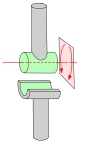 Hinge joint (model)
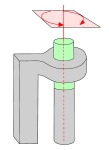 Pivot joint (model)
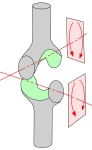 Saddle joint (model)
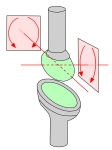 Ellipsoid joint (model)
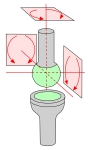 Ball-and-socket joint (model)
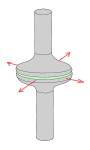 Plane joint (model)
Related terms
- Synovial joint
- Cartilaginous joint
- Joint capsule
- Articular cartilage
- Articular cavity
- Hinge joint
- Ball-and-socket joint
References and sources
- Further reading: Joint, Wikipedia.
- Further reading: Synovial joint, Wikipedia.
- Federative International Programme for Anatomical Terminology (FIPAT). Terminologia Anatomica, 2nd ed. (TA2), 2019.