Lateral plate of pterygoid process (Latin: lamina lateralis processus pterygoidei)
Also called Lateral pterygoid plate or the lateral lamina
bone
- Body : the central part of the sphenoid; it contains the sphenoidal sinus and has several surfaces.
- Processes
- Greater wing : the largest process; part of the middle cranial fossa and of the side wall of the skull. It has 3 surfaces and 3 margins.
- Lesser wing : projects to each side from the front of the body; part of the anterior cranial fossa.
- Pterygoid process : projects downwards from the body and the greater wing; made of two plates, the medial plate and the lateral plate.
- Medial plate : long and narrow; its lateral surface forms the medial wall of the pterygoid fossa.
Related terms: pterygoid hamulus, groove of the pterygoid hamulus, scaphoid fossa, vaginal process, palatovaginal groove / canal, vomerovaginal groove / canal. - Lateral plate : shorter and wider than the medial plate; the lower head of the lateral pterygoid arises from its lateral surface, and the deep head of the medial pterygoid from its medial surface.
Related term: pterygospinous process.
- Medial plate : long and narrow; its lateral surface forms the medial wall of the pterygoid fossa.
- Terms shared by both plates : pterygoid notch, pterygoid fossa, pterygoid canal.
Other features of the lateral plate
· The medial and lateral plates are joined above but separate below; the gap between them is the pterygoid notch, into which the pyramidal process of the palatine bone fits.
· Behind, the medial and lateral plates enclose a deep hollow, the pterygoid fossa, where the medial pterygoid arises.
· The back edge of the lateral plate is sharp, and near its upper end it often carries a small spine, the pterygospinous process.
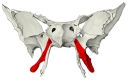 Sphenoid bone (anterior view)
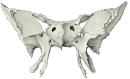 Sphenoid bone (anterior view)
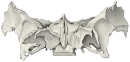 Sphenoid bone (inferior view)
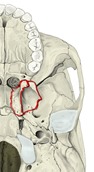 External cranial base
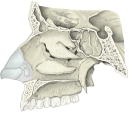 Right nasal cavity (lateral wall)
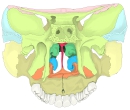 Nasal cavity (from behind)
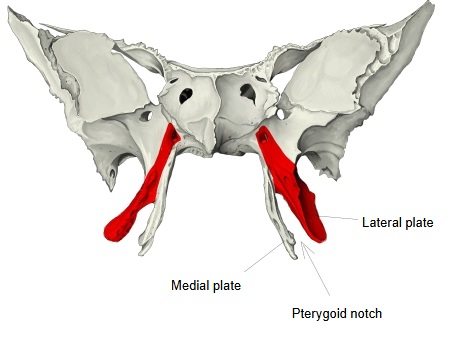
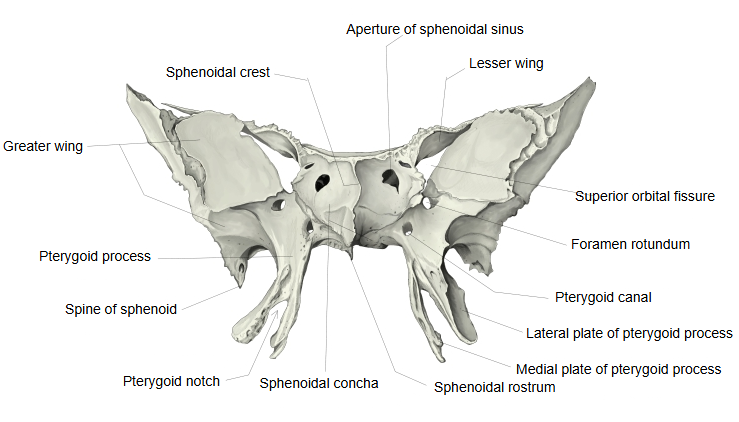
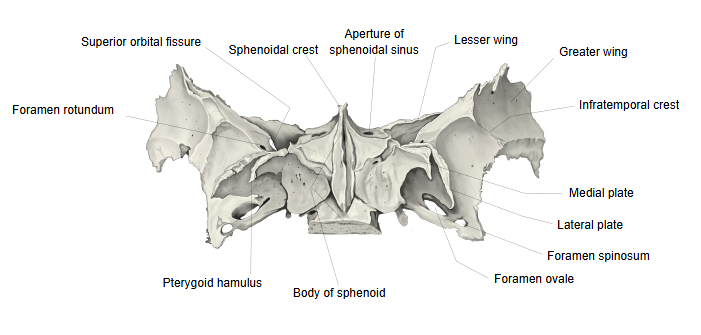
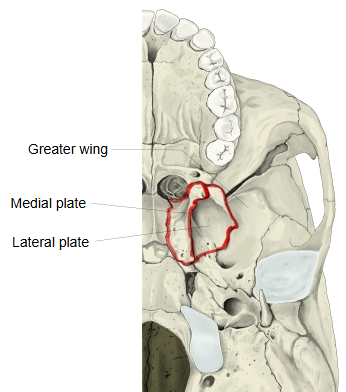
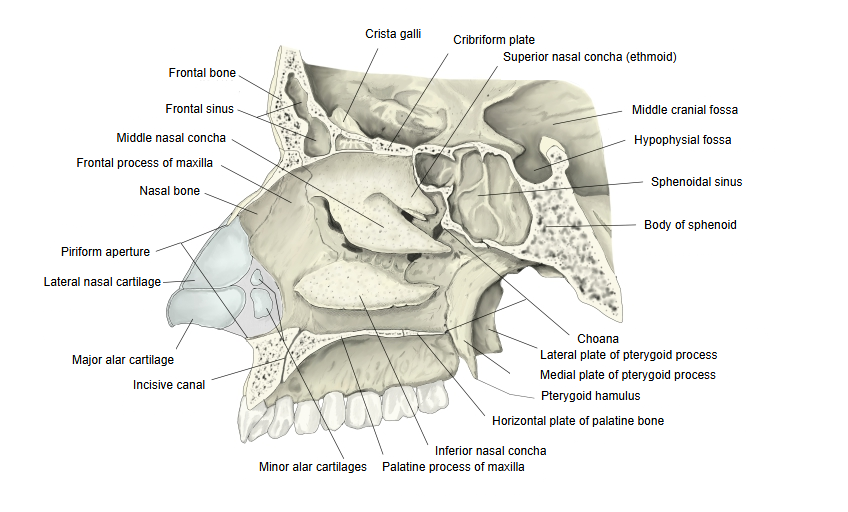
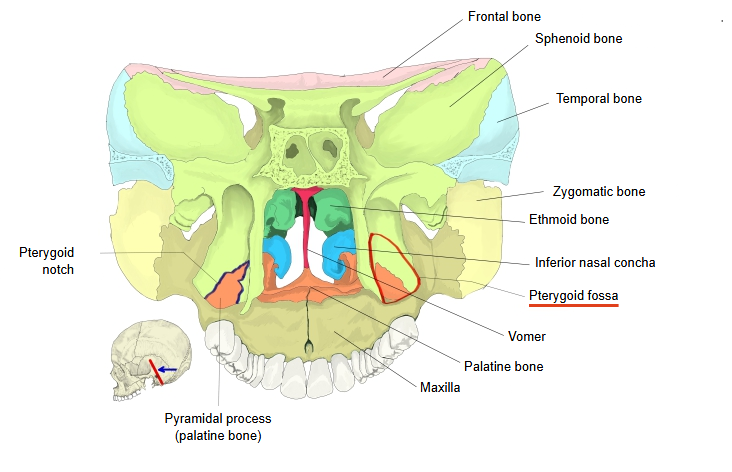
In more detail: the lateral plate of the pterygoid process is broader and a little shorter than the medial plate and is set obliquely to the sagittal plane; the lower head of the lateral pterygoid arises from its outer surface. The two plates are joined along their front edges. A shallow vertical groove on the front of the process, the pterygopalatine groove, forms the back wall of the pterygopalatine fossa, which the pterygoid process completes together with the body of the maxilla and the perpendicular plate of the palatine bone. Behind, the two plates enclose the pterygoid fossa, which opens backwards and gives origin to the medial pterygoid. Below, the plates part to enclose the pterygoid notch, filled in by the pyramidal process of the palatine bone. The sharp back edge of the lateral plate often bears a small pterygospinous process near its upper end.
The lateral plate is broad, thin and turned outwards, forming the outer part of the horseshoe-shaped pterygoid process on the under side of the sphenoid. Its lateral surface forms part of the medial wall of the infratemporal fossa and gives origin to the lateral pterygoid, which moves the mandible forwards and from side to side; its medial surface forms part of the pterygoid fossa and gives origin to the medial pterygoid.
Reference websites
[Wikipedia]
· Lateral pterygoid plate, Wikipedia.
· Sphenoid bone, Wikipedia.
[Websites with illustrations]
· Sphenoid bone, anterior and inferior surfaces (Gray's Anatomy, fig. 146) (Wikimedia Commons)

· Sphenoid bone, upper and posterior surfaces (Gray's Anatomy, fig. 147) (Wikimedia Commons)

Related terms
- Pterygoid process
- Medial plate of pterygoid process
- Pterygoid fossa
- Pterygoid notch
- Sphenoid bone
- Palatine bone
- Infratemporal fossa
References and sources
- Further reading: Lateral pterygoid plate, Wikipedia.
- Federative International Programme for Anatomical Terminology (FIPAT). Terminologia Anatomica, 2nd ed. (TA2), 2019.