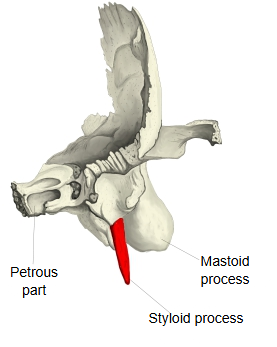
Styloid process (Latin: processus styloideus)
Also called the styloid process of temporal bone
- Squamous part : the part that takes up the middle and the whole upper part of the bone; it has a temporal surface and a cerebral surface.
- Petrous part
- Mastoid part : below the squamous part (from the mastoid process to the parietal notch).
- Pyramid : a three-sided pyramid running forwards and medially from the boundary of the squamous and mastoid parts; it has an apex, surfaces and borders.
- Apex : points towards the foramen lacerum; the internal opening of the carotid canal opens here.
- Anterior surface : = cerebral surface: trigeminal impression, arcuate eminence, grooves for the greater and lesser petrosal nerves.
- Posterior surface : = cerebellar surface: internal acoustic opening, subarcuate fossa, external aperture of the vestibular aqueduct.
- Inferior surface : = basal surface: styloid process, jugular fossa, groove for the mastoid canaliculus, external aperture of the cochlear canaliculus, external opening of the carotid canal, petrous fossula, inferior opening of the tympanic canaliculus.
- Tympanic part : the smallest part: a thin, half-tube-shaped plate of bone that forms the front and lower walls of the external acoustic meatus.
· The ulna, the radius (styloid process of radius) and the third metacarpal (styloid process of third metacarpal) also have processes of the same name.
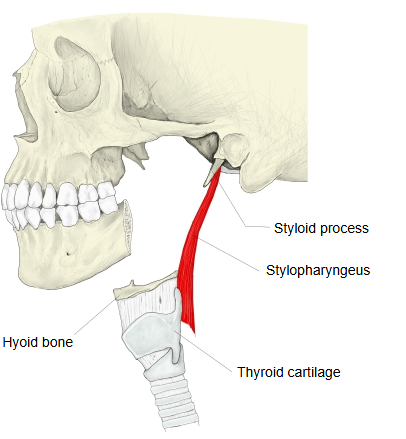
· In development it is part of the cartilage of the second pharyngeal arch (Reichert's cartilage), which is related to the hyoid bone; this part ossifies and fuses with the pyramid. The same cartilage also forms the stylohyoid ligament and the lesser horn of the hyoid bone.
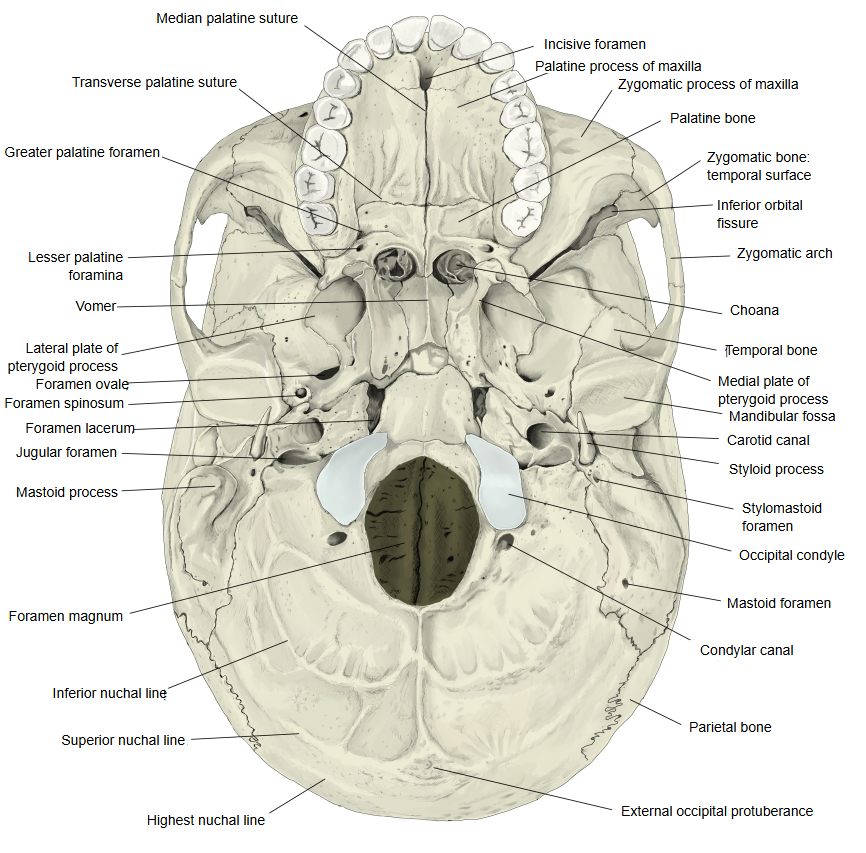
The stylomastoid foramen, through which the facial nerve leaves the skull, lies between its root and the mastoid process.
An abnormally long styloid process or a calcified stylohyoid ligament can cause throat and neck pain on swallowing or turning the head (Eagle syndrome).
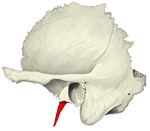 Left temporal bone (lateral view)
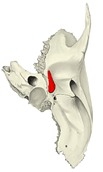 Left temporal bone (inferior view)
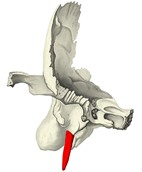 Left temporal bone (front view)
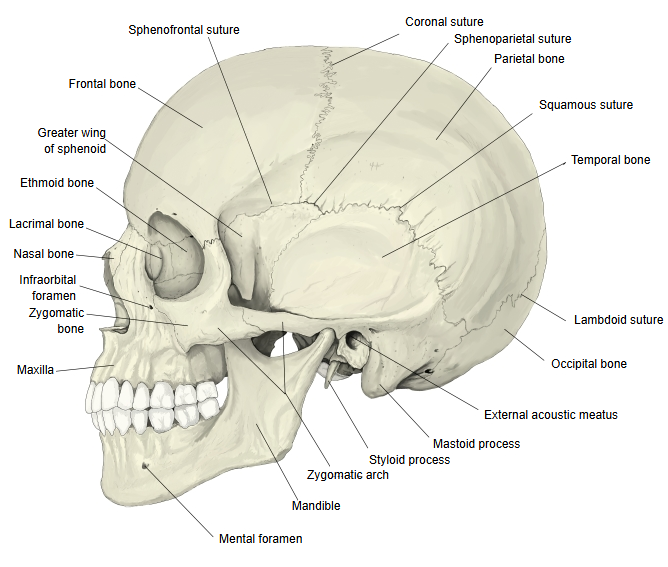
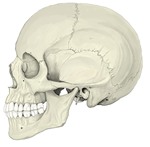 Skull (left lateral view)
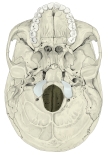 External cranial base
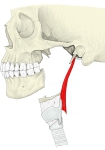 Stylopharyngeus
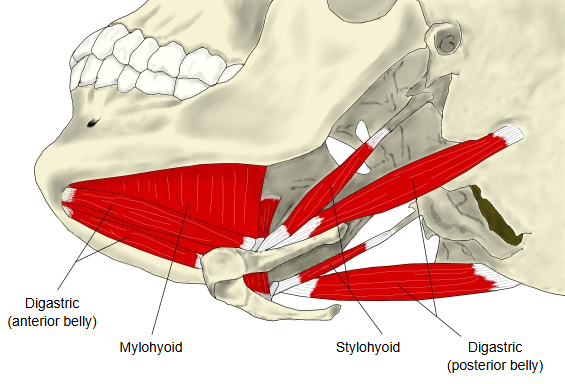
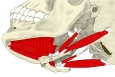 Stylohyoid
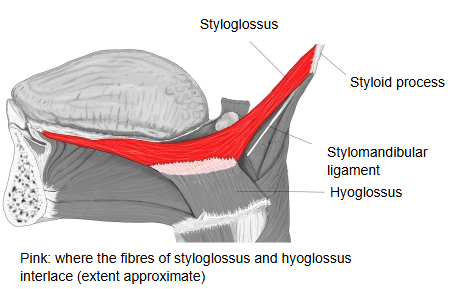
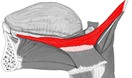 Styloglossus
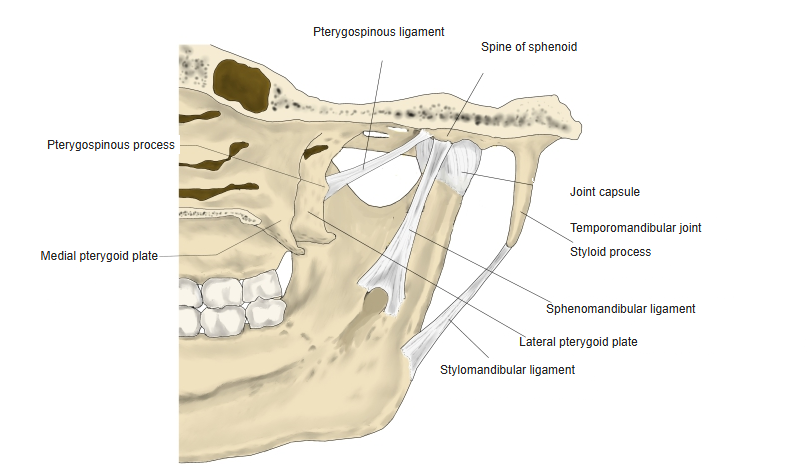
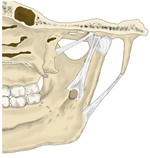 Stylomandibular ligament
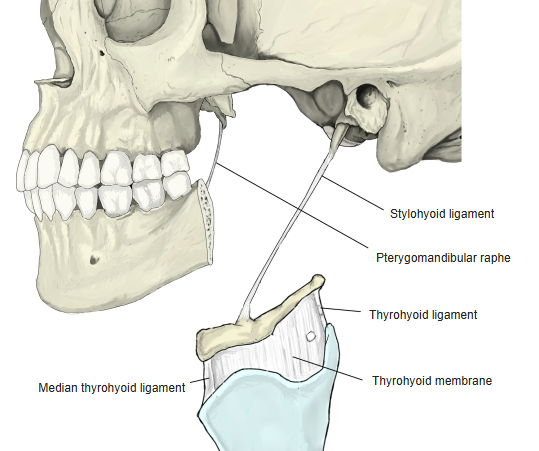
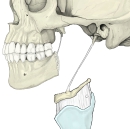 Stylohyoid ligament
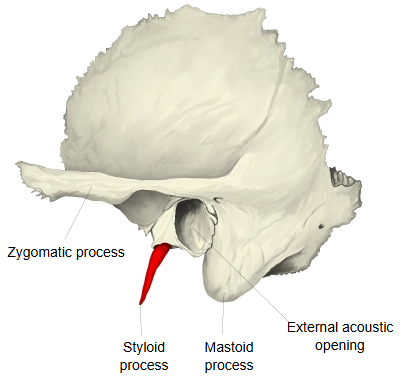
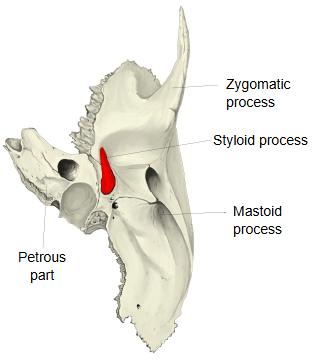
Reference websites
[Wikipedia]
· Temporal styloid process, Wikipedia.
· Eagle syndrome, Wikipedia.
[Websites with illustrations]
· Left temporal bone, outer surface (Gray's Anatomy, fig. 137) (Wikimedia Commons)

· Base of the skull, external surface (Gray's Anatomy, fig. 187) (Wikimedia Commons)

· The temporal bone (TeachMeAnatomy)
Where it is found
Related terms
References and sources
- Further reading: Temporal styloid process, Wikipedia.
- Further reading: Eagle syndrome, Wikipedia.
- Federative International Programme for Anatomical Terminology (FIPAT). Terminologia Anatomica, 2nd ed. (TA2), 2019.