Secretory cell
Overview
cells
- Exocrine cells
- Definition : cells forming part of an exocrine gland; they release their product outside the body or into a body cavity (such as the digestive tract).
- Structure : most form acini and send their product out through a duct; exception: the goblet cell.
- Secretion : serous (pancreas, parotid gland), mucous (sublingual gland, goblet cells of the airway) or a mixture of both (submandibular gland).
- Examples : onto the body surface: sweat glands, sebaceous glands, mammary gland, lacrimal gland; into a cavity: salivary glands, gastric glands, the acinar cells of the pancreas, the goblet cells of the intestine.
- Endocrine cells
- Definition : they have no duct and release their product directly into nearby blood capillaries (and lymphatic vessels).
- Secretion : mostly hormones (insulin, adrenaline and others); some release hormone-like substances.
- Solitary endocrine cells : scattered in the digestive tract, e.g. G cells and I cells.
- Grouped endocrine cells : form glands: the suprarenal cortex, the pituitary gland, the thyroid gland.
Exocrine cells
cells
- Forming a gland : a group of exocrine cells + a duct.
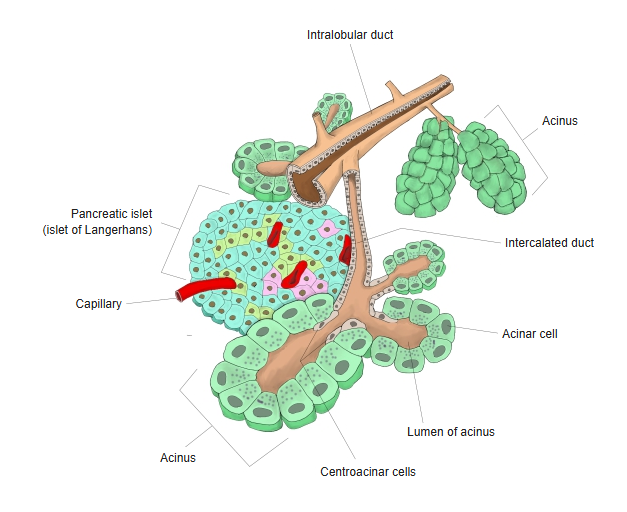
- Acinar : end pieces shaped like a bunch of grapes; e.g. the pancreas, the parotid gland. The most common form.
- Tubular : long, narrow tubes; e.g. the intestinal glands of the large intestine, the gastric glands, the eccrine sweat glands. Fewer in number.
- Tubuloacinar : both tubes and acini; e.g. the submandibular gland, the sublingual gland.
- Alveolar (saccular) : rounder, sac-like end pieces, similar to acini; e.g. the mammary gland, the sebaceous glands.
- Not forming a gland : no duct: goblet cells, the Paneth cells of the intestine, the club (Clara) cells of the airway epithelium.
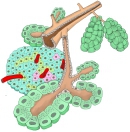 Acini and islet of the pancreas
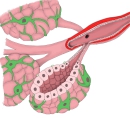 Acini of the mammary gland
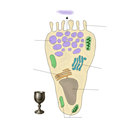 Goblet cell
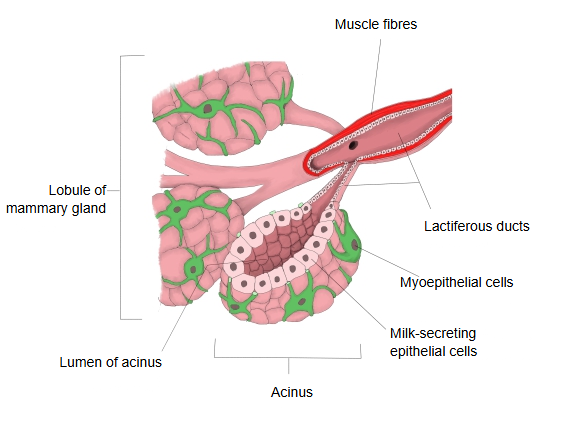
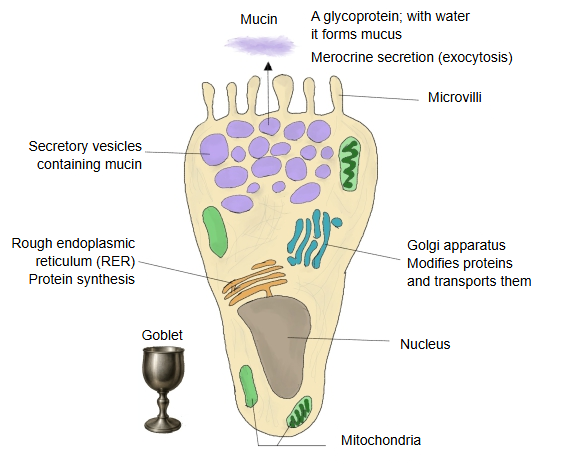
Examples of exocrine cells are listed below.
| Cell | Main location | Example of secretion | |
|---|---|---|---|
| 1 | Pancreatic acinar cells | Pancreas | Digestive enzymes (amylase, lipase and others) |
| 2 | Goblet cells | Intestine, airway epithelium and others | Mucus |
| 3 | Acinar cells of the parotid gland | Parotid gland | Serous saliva (contains amylase) |
| 4 | Acinar cells of the submandibular and sublingual glands | Submandibular and sublingual glands | Mixed saliva (serous fluid + mucus) |
| 5 | Chief cells of the stomach | Fundic (gastric) glands | Pepsinogen |
| 6 | Parietal cells of the stomach | Fundic (gastric) glands | Gastric acid (HCl) and intrinsic factor |
| 7 | Gland cells of the sebaceous glands | Skin | Sebum |
| 8 | Gland cells of the sweat glands (eccrine / apocrine) | Skin | Sweat (temperature control, body odour) |
| 9 | Mammary gland cells | Mammary gland | Milk (fat, sugar, protein) |
| 10 | Lacrimal gland cells | Lacrimal gland | Tears (contain lysozyme and other substances) |
| 11 | Prostatic acinar cells | Prostate | Part of the seminal fluid |
Classification
1. By the mode of secretion
| Mode | Description | Examples | |
|---|---|---|---|
| 1 | Merocrine secretion (= exocytosis) | Only the product is released, in vesicles; the cell itself is not damaged. | Pancreatic acinar cells, salivary glands (e.g. the parotid gland), goblet cells |
| 2 | Apocrine secretion | Part of the cell (some cytoplasm with its membrane) is pinched off with the product. | Mammary gland, axillary sweat glands |
| 3 | Holocrine secretion | The whole cell breaks down and becomes the secretion. | Sebaceous glands |
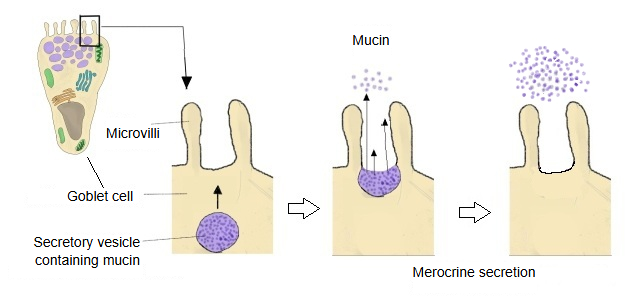
2. By the nature of the secretion
| Kind of secretion | Description | Examples | |
|---|---|---|---|
| 1 | Serous | Watery and rich in enzymes | Pancreas, parotid gland |
| 2 | Mucous | Viscous; contains mucin | Sublingual gland (mainly mucous), goblet cells of the airway |
| 3 | Mixed | Contains both serous and mucous parts | Submandibular gland |
3. By the structure of the gland (histological classification)
| Type | Description | Examples | |
|---|---|---|---|
| 1 | Simple gland | The duct is not branched | Gastric glands, intestinal glands (crypts of Lieberkühn) |
| 2 | Compound gland | The duct is branched | Pancreas, salivary glands |
4. By the form and distribution of the cells
| Type | Description | Examples | |
|---|---|---|---|
| 1 | Solitary | Single cells | Goblet cells |
| 2 | Forming a gland | Many cells together make up a gland | Pancreas, salivary glands |
Endocrine cells
Other features
· Their products enter the capillaries and are carried all over the body.
· In most cases they lie close to capillaries.
· The products are often stored in the cell as granules (secretory granules).
· Endocrine cells are sometimes divided into solitary (scattered) endocrine cells and grouped endocrine cells (which form gland structures).
Solitary endocrine cells: G cells, I cells and other enteroendocrine cells scattered in the digestive tract (the DNES, diffuse neuroendocrine system).
Grouped endocrine cells: the suprarenal cortex, the pituitary gland, the thyroid gland and others.
· Most endocrine cells release their products by exocytosis, like merocrine exocrine cells; steroid-producing cells, such as those of the suprarenal cortex, release their hormones by diffusion without storing them.
The main products of endocrine cells are listed in the simple table below.
| Site | Endocrine cells | Secretion | |
|---|---|---|---|
| 1 | Pancreas (pancreatic islets) | Alpha cells, beta cells and others | Glucagon, insulin |
| 2 | Thyroid gland | Follicular epithelial cells, parafollicular cells | Thyroxine, calcitonin |
| 3 | Parathyroid glands | Chief cells | Parathyroid hormone (parathormone) |
| 4 | Suprarenal gland (cortex and medulla) | Cells of the zona glomerulosa, zona fasciculata and zona reticularis; chromaffin cells | Aldosterone, cortisol, adrenaline |
| 5 | Pituitary gland | Various hormone-producing cells | GH, TSH, ACTH and many others |
| 6 | Mucosa of the stomach and intestine | G cells, S cells and others | Gastrin, secretin and others |