Pneumatic bone (Latin: os pneumaticum)
What is a pneumatic bone?
One of the six bone shapes: a bone that has air-filled spaces inside, such as the bones that form the paranasal sinuses and the ethmoidal air cells, or the temporal bone.
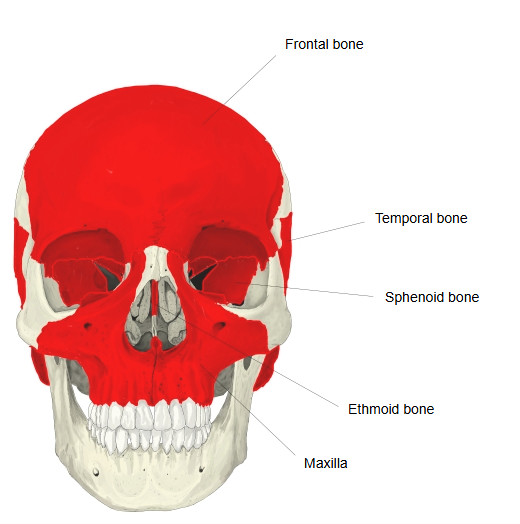
Bones that form the paranasal sinuses: the frontal bone, sphenoid bone, ethmoid bone and maxillaNote: some sources use only five shapes and leave out the pneumatic bone. The frontal bone is then classed as a flat bone, but it is still a pneumatic bone.
Bones by
shape
shape
- Long bone : a long, tube-shaped bone, whatever its size, such as the femur and humerus; also called a tubular bone.
- Short bone : about as long as it is wide, such as the carpal bones and tarsal bones.
- Flat bone : a flat, plate-like bone, such as the bones of the skull vault and the sternum.
- Irregular bone : a bone of irregular shape, such as the vertebrae and many bones of the facial skeleton.
- Pneumatic bone : a bone with air-filled spaces inside, such as the frontal and sphenoid bones.
- Sesamoid bone : a bone that develops within a tendon of the hand or foot, or in an articular capsule where a tendon blends with it.
In medical dictionaries a pneumatic bone is a bone that is hollow or contains many air cells; the mastoid process of the temporal bone is a typical example.
The temporal bone holds the mastoid air cells and the tympanic cavity; these air spaces connect with the middle ear. The paranasal sinuses open into the nasal cavity. The spaces are lined with mucous membrane.
The air spaces make the skull lighter and add resonance to the voice. They are small at birth and enlarge mainly during childhood and adolescence.
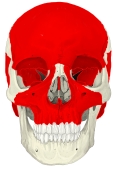 Pneumatic bones of the skull
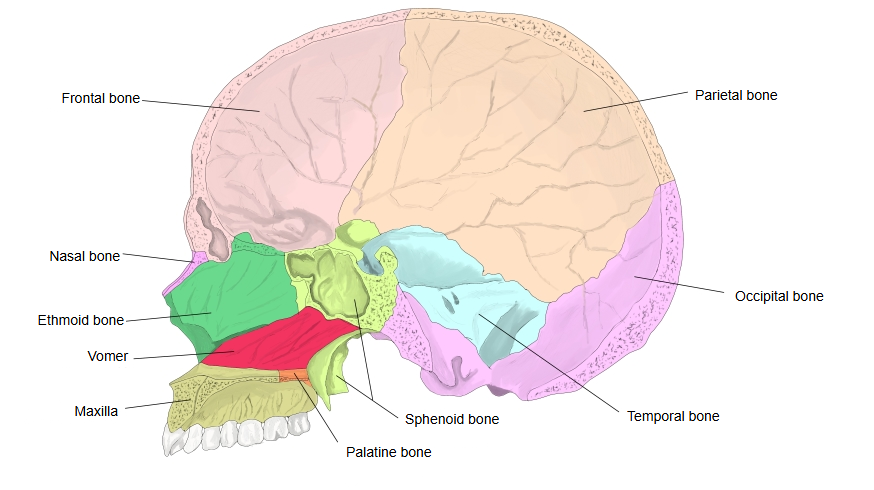
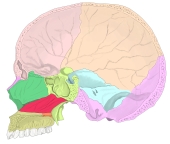 Skull (sagittal section)
Related terms
- Paranasal sinuses
- Frontal sinus
- Maxillary sinus
- Sphenoidal sinus
- Ethmoidal air cells
- Mastoid process
- Flat bone
References and sources
- Further reading: Skeletal pneumaticity, Wikipedia.
- Further reading: Paranasal sinuses, Wikipedia.
- Federative International Programme for Anatomical Terminology (FIPAT). Terminologia Anatomica, 2nd ed. (TA2), 2019.