Soft palate (Latin: palatum molle)
Also called Velum or the velum palatinum
- Overview
- Features of the soft palate
- Muscles of the soft palate
- Reference websites
- (Wikipedia, websites with illustrations)
- Where it is found
- Related terms
Overview
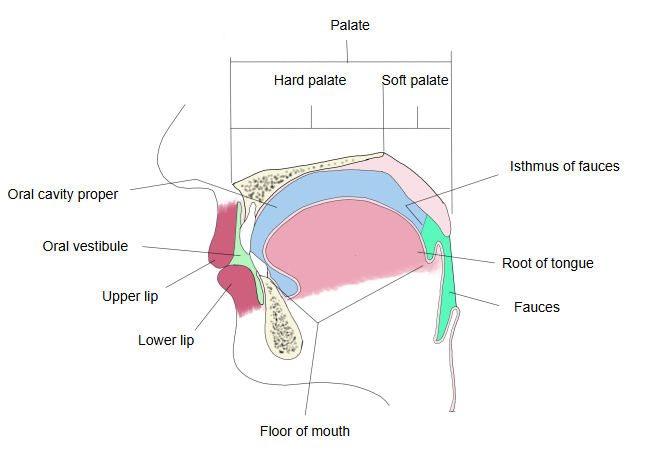
cavity
- Lips : the front wall of the mouth: the upper lip and lower lip, joined at each corner (the labial commissure).
- Oral cavity : the space inside the lips and cheeks, in two parts: the oral vestibule in front (narrow) and the oral cavity proper behind.
- Palate : the upper wall (roof) of the mouth, in two parts: the hard palate in front (the larger part) and the soft palate behind.
- Floor of mouth : the bottom of the mouth, covered by soft mucous membrane with much loose connective tissue beneath.
- Cheeks : the side walls of the mouth; they form the oral vestibule with the lips and are made of skin, muscle (buccinator) and mucous membrane.
of the
palate
- Hard palate : the front part, with bone as its base (palatine processes and horizontal plates), covered by mucous membrane. Seen on its surface: the palatine raphe, the transverse palatine folds, the incisive papilla and others.
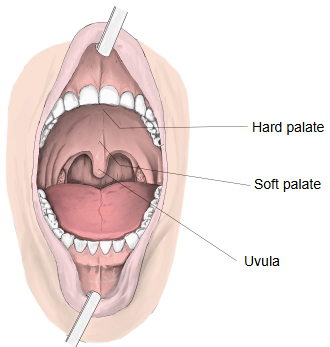
- Soft palate : the back part, with muscle as its base, covered by mucous membrane; the part hanging down from it is the uvula. Its muscles: palatopharyngeus, musculus uvulae, palatoglossus, levator veli palatini and tensor veli palatini.
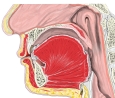 Mouth and pharynx (section)
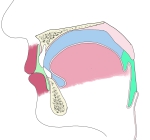 Oral cavity (diagram, section)
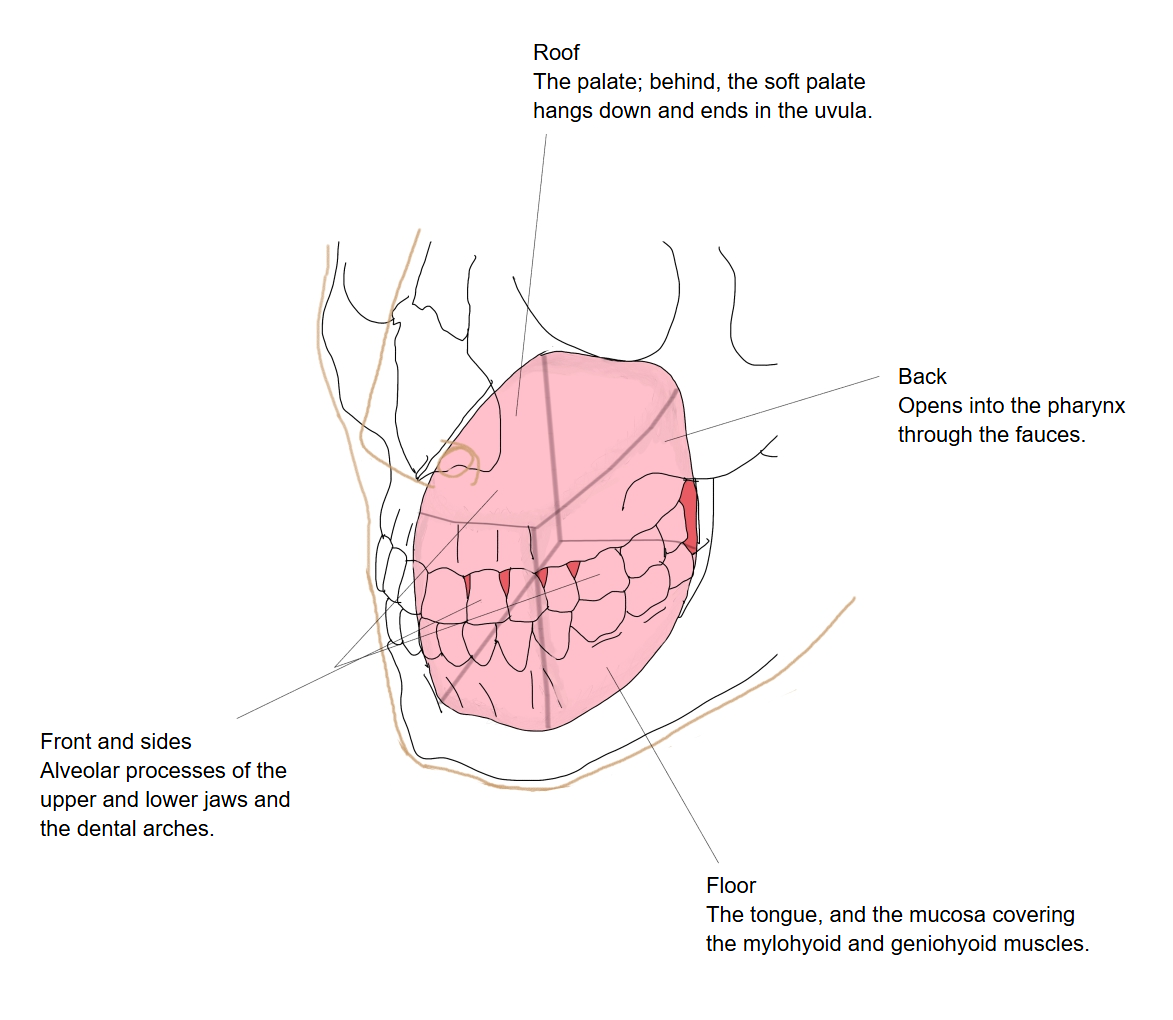
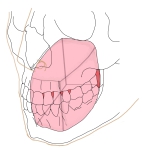 Walls of the oral cavity proper
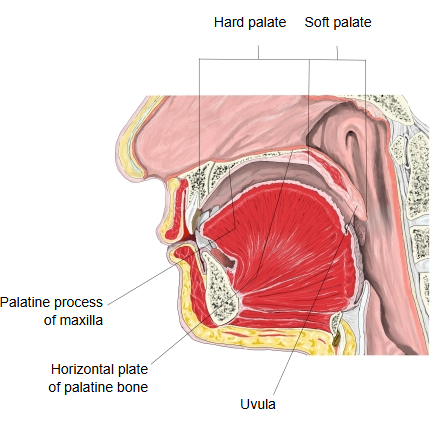
Features of the soft palate
· In the middle of its free edge hangs the long, drooping uvula.
- Mouth and pharynx (section)
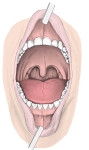 Open mouth, front view
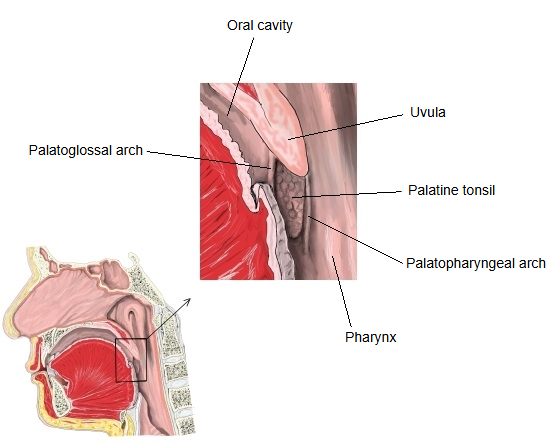
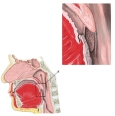 Around the uvula (section)
Muscles of the soft palate
muscles
- Palatopharyngeus : origin: the hard palate and the palatine aponeurosis; insertion: the back edge of the thyroid cartilage and the wall of the pharynx. It forms the palatopharyngeal arch.
- Musculus uvulae : origin: the posterior nasal spine of the horizontal plate of the palatine bone and the palatine aponeurosis; insertion: the tip of the uvula. It shortens and lifts the uvula.
- Palatoglossus : arises from the side of the tongue and runs up into the soft palate, where it meets the muscle of the other side. It forms the palatoglossal arch.
- Levator veli palatini : arises from the petrous part of the temporal bone, in front of the external opening of the carotid canal, and from the cartilage of the auditory tube; it spreads out in the soft palate. It raises the soft palate.
- Tensor veli palatini : arises from the scaphoid fossa of the sphenoid bone and the side of the auditory tube; its tendon turns around the pterygoid hamulus and spreads into the palatine aponeurosis. It tightens the soft palate and opens the tube.
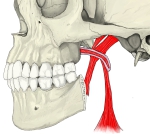 Muscles of the soft palate (side view)
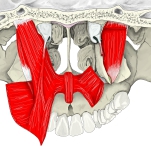 Muscles of the soft palate (back view)
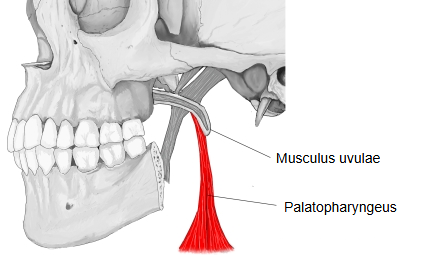
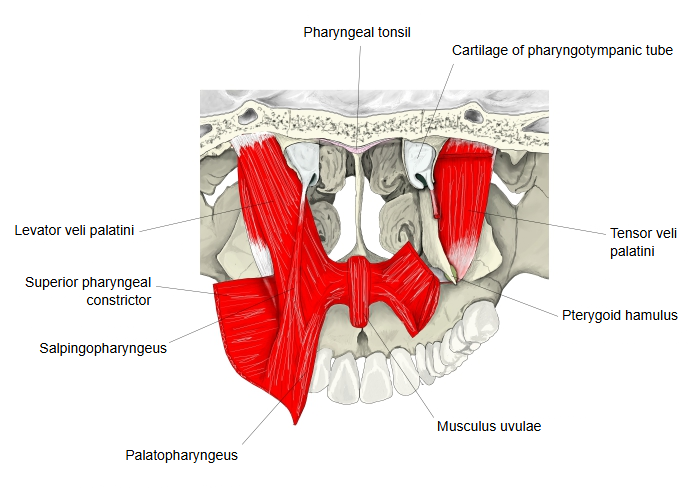
Nerve supply: all these muscles are supplied by the vagus nerve through the pharyngeal plexus, except the tensor veli palatini, which is supplied by the mandibular nerve.
The soft palate is a large fold of mucous membrane with muscles inside, forming an incomplete partition between the mouth and the cavity of the pharynx. It is attached to the back edge of the hard palate by the palatine aponeurosis and slopes down and back from it; from the middle of its free edge the uvula hangs down. On each side two arch-shaped folds run down from it.
These folds are the palatine arches. The front one, the palatoglossal arch, forms a gentle curve and reaches the margin of the tongue, where it ends in a small triangular fold of mucosa. The back one, the palatopharyngeal arch, is steeper and narrower and reaches the side wall of the pharynx. The palatine tonsil lies between the two.
In swallowing the soft palate is raised and tightened against the back wall of the pharynx, closing off the nasal part of the pharynx so that food does not pass into the nose; it also helps to direct air through the mouth or nose in speech. Touching the soft palate or uvula causes a strong gag reflex in most people.
Reference websites
[Wikipedia]
· Soft palate, Wikipedia.
· Palatine uvula, Wikipedia.
[Websites with illustrations]
· The palate (TeachMeAnatomy)
· Palate (Kenhub)
Where it is found
Related terms
- Hard palate
- Palatoglossal arch
- Palatopharyngeal arch
- Palatine tonsil
- Isthmus of fauces
- Pharynx
- Tongue
References and sources
- Further reading: Soft palate, Wikipedia.
- Further reading: Palatine uvula, Wikipedia.
- Federative International Programme for Anatomical Terminology (FIPAT). Terminologia Anatomica, 2nd ed. (TA2), 2019.