Cells, Tissues, Organs and Organ Systems
Contents: Introduction · Cells · Tissues · Organs · Organ systems
Introduction
The basic unit of the human body is the cell. There are about 200 kinds of cells (some sources count more than 250), and an adult body is made of roughly 37 trillion of them, according to recent estimates (an older, often quoted figure is 60 trillion). Cells of the same form and function gather to make a tissue. Different tissues combine to form an organ, and organs that work together for the same purpose form an organ system. The whole body is, in the end, a set of organ systems.
Cells
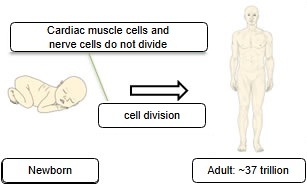
The number of cells in the body is the result of repeated cell division. A newborn has far fewer cells than an adult, and the number grows as the cells divide and multiply. The total also differs from person to person with body size. Some cells, such as cardiac muscle cells and most nerve cells of the central nervous system, do not divide after birth. The cells that make up each organ vary in shape and lifespan, but their basic components are much the same.
| No. | Feature | Examples | |
|---|---|---|---|
| 1 | Shape |
|
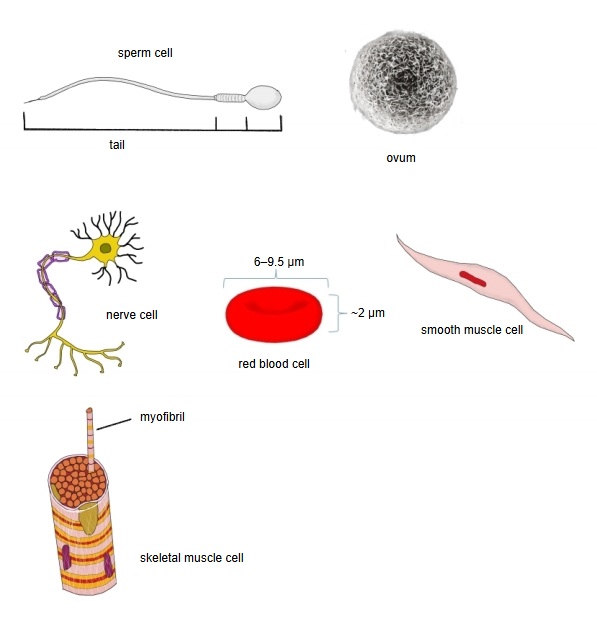 |
| 2 | Size | Most cells are about 6–25 µm across (1 µm = 0.001 mm), but some are larger or smaller. Large:
| |
| 3 | Lifespan |
| |
Basic structure of a cell
- cell
- protoplasm
- cell membrane The cell membrane (plasma membrane) encloses the protoplasm.
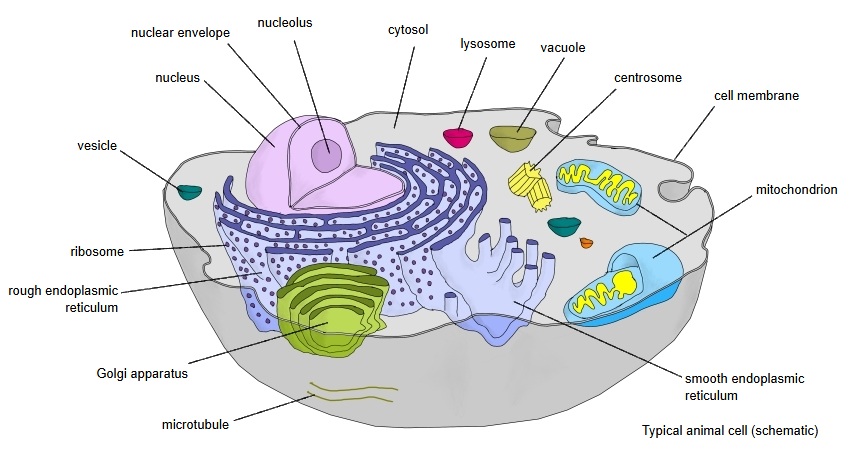
The structures found in almost every cell:
| No. | Structure | Main role |
|---|---|---|
| 1 | nucleus | Contains the genetic material (DNA). Cells without a nucleus: red blood cells, platelets. Cells with many nuclei: skeletal muscle cells. |
| 2 | centrioles (centrosome) | A pair of short cylinders made of microtubules, near the nucleus. They organize the microtubules and the spindle during cell division. |
| 3 | mitochondria | Supply energy to the cell (ATP production). |
| 4 | Golgi apparatus | Modifies proteins, for example by adding sugar chains or cutting them (processing), and sorts and packs them. |
| 5 | ribosomes | Make proteins. |
| 6 | rough / smooth endoplasmic reticulum | Rough: makes proteins with the ribosomes on its surface. Smooth: makes lipids. |
| 7 | lysosomes | Break down proteins, nucleic acids and lipids. |
| 8 | cytoskeleton | Maintains the shape of the cell (includes the microtubules). |
Tissues
Cells with the same function gather to form a tissue. Tissues are broadly divided into four types:
Organs
Tissues with related functions gather to form an organ.
Organ systems
Organs that work together form an organ system. The grouping below is one common way to divide them. Textbooks group the organs in different ways, so there is no single fixed classification:
- The biggest difference is whether the skin and its appendages are counted with the sensory organs or treated as a separate system (the integumentary system).
- One organ can belong to more than one system. For example, the testis belongs to both the reproductive system and the endocrine system.
- organ systems
- locomotor system 1. skeletal system 2. muscular system
- circulatory system 1. heart 2. blood vessels 3. lymphatic system
- respiratory system 1. nose 2. pharynx 3. bronchi 4. lungs
- digestive system 1. oesophagus 2. stomach 3. small intestine 4. liver
- urinary system 1. kidneys 2. urinary bladder 3. urethra
- reproductive system 1. testis 2. ovary 3. uterus
- endocrine system 1. thyroid gland 2. suprarenal (adrenal) gland 3. testis
- nervous system 1. central nervous system 2. peripheral nervous system
- sensory system 1. eye 2. ear 3. skin