Mesenteries
Overview
· In development, mesenteries are divided into ventral and dorsal mesenteries.
· Each has its own name according to its site: for example, the mesentery of the small intestine and the transverse mesocolon.
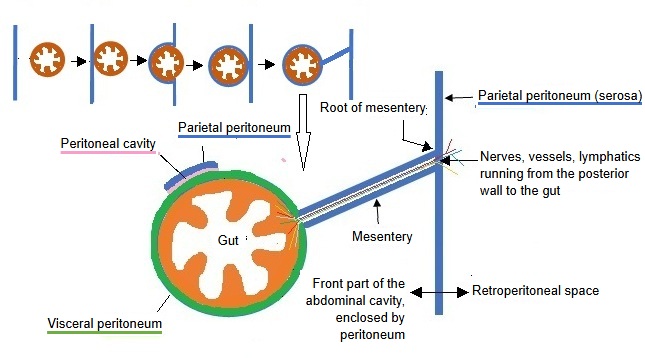
The structures formed where the peritoneum extends inward can be summarized as follows.
| Structure | What it is | Examples |
|---|---|---|
| Mesentery | A double layer connecting an organ to the body wall | Mesentery, transverse mesocolon, sigmoid mesocolon |
| Peritoneal fold | A raised ridge of peritoneum over an underlying structure | Median, medial and lateral umbilical folds |
| Omentum | A double layer passing from the stomach to a neighboring organ | Lesser omentum, greater omentum |
| Peritoneal ligament | A double layer connecting an organ to another organ or to the wall; not a true ligament | Falciform ligament, gastrosplenic ligament |
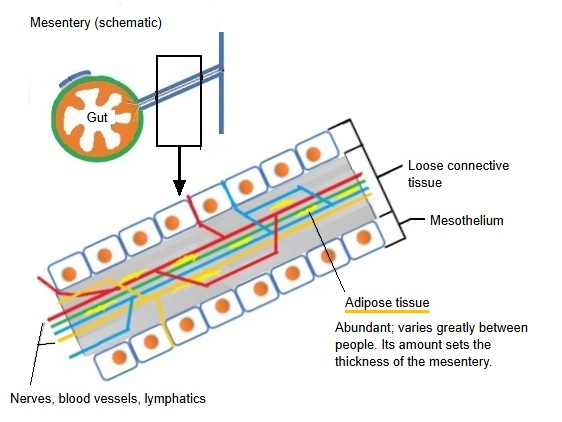
Summary
- A membrane "between" : lies between an organ and the posterior parietal peritoneum, or between two organs: keeps organs in position
- A passage : carries blood vessels, nerves and lymphatics: keeps organs working
- A double layer : of peritoneum, a serous membrane
Relation to organs
Mesenteries relate to organs in two ways.
Wrapping the organ
| Organ | Mesentery | Mobility | Notes |
|---|---|---|---|
| Jejunum | Mesentery | Very high | The most typical organ with a mesentery |
| Ileum | Mesentery | High | Slightly restricted at its end |
| Transverse colon | Transverse mesocolon | Moderate | Closely related to the stomach through the greater omentum (gastrocolic ligament) |
| Sigmoid colon | Sigmoid mesocolon | High | Prone to twisting (clinically important) |
| Appendix | Mesoappendix | Low to moderate | Its position varies greatly between people |
Attached to only part of the organ, or joining organs
The organs below are not simply wrapped and slung from the posterior wall.
| Organ | Fold | Mobility | Notes |
|---|---|---|---|
| Liver | Falciform ligament, lesser omentum | Low | The bare area against the diaphragm has no peritoneum |
| Stomach | Lesser omentum, greater omentum | High | Basically wrapped, but held by the two omenta |
| Pancreas | None of its own; the tail lies in the splenorenal ligament | Almost none | The head, neck and body are attached to the posterior wall |
The folds around the stomach and spleen mainly join organs to one another: the stomach to the transverse colon through the greater omentum, and the stomach to the spleen through the gastrosplenic ligament. They arise from the mesentery of the stomach and are rearranged during development.
Kinds
The main mesenteries are listed below.
| Region | Name | What it connects |
|---|---|---|
| Digestive tract | Mesentery (of the small intestine) | Jejunum and ileum to the posterior abdominal wall |
| Transverse mesocolon | Transverse colon to the posterior abdominal wall | |
| Sigmoid mesocolon | Sigmoid colon to the posterior abdominal wall | |
| Mesoappendix | Appendix to the mesentery at the end of the ileum | |
| Stomach | Gastrocolic ligament | Part of the greater omentum: the greater curvature of the stomach to the transverse colon |
| Gastrosplenic ligament | Part of the greater omentum: stomach to spleen | |
| Gastrophrenic ligament | Stomach to diaphragm | |
| Hepatogastric ligament | Part of the lesser omentum: liver to stomach | |
| Hepatoduodenal ligament | Part of the lesser omentum: liver to duodenum | |
| Liver | Falciform ligament | Liver to the anterior abdominal wall and diaphragm |
| Coronary ligament | Upper surface of the liver to the diaphragm | |
| Triangular ligaments (right and left) | The two ends of the coronary ligament | |
| Reproductive organs | Broad ligament | Uterus to the pelvic wall |
| Mesovarium | Ovary to the broad ligament | |
| Mesosalpinx | Uterine tube to the broad ligament | |
| Other | Splenorenal ligament | Spleen to the left kidney |
· In the fetus, an ascending mesocolon and a descending mesocolon are also seen.
Reference websites
[Wikipedia]
· Mesentery, Wikipedia.
· Peritoneum, Wikipedia.
Related terms
- General organization of the abdomen
- Peritoneal cavity
- Parietal peritoneum
- Visceral peritoneum
- Transverse mesocolon
- Sigmoid mesocolon
- Mesoappendix
- Peritoneal ligaments
- Peritoneal folds
References and sources
- Further reading: Mesentery, Wikipedia.
- Further reading: Peritoneum, Wikipedia.
- Federative International Programme for Anatomical Terminology (FIPAT). Terminologia Anatomica, 2nd ed. (TA2), 2019.