Synergistic muscle
Also called: synergist
A muscle that works together with another muscle to produce the same movement, as the members of a flexor group or an extensor group do.
More detail
For example, in flexion of the elbow joint the prime movers (agonists) are the biceps brachii, the brachialis and the brachioradialis. These three muscles are therefore synergists of one another, as follows.
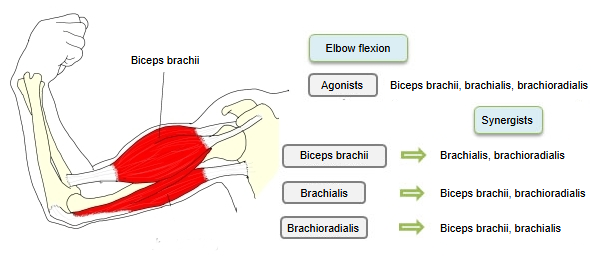
Note that a muscle often has more than one action, and for a different action other muscles become its synergists. For example, the biceps brachii also supinates the forearm together with the supinator; in this movement the synergist of the biceps brachii is the supinator.
The table below shows the prime movers (agonists) and their antagonists for each movement. The muscles in each group of prime movers, and in each group of antagonists, are synergists of one another.
For example, the prime movers in flexion of the neck are the sternocleidomastoid and the prevertebral muscles, so the synergists of the sternocleidomastoid are the prevertebral muscles, and the synergist of the prevertebral muscles is the sternocleidomastoid. The same holds for the antagonists.
Other pairs: the infraspinatus and teres minor in lateral rotation of the shoulder, and the tensor fasciae latae and gluteus medius in abduction of the hip. Muscles grouped by a shared action, such as the forearm flexor muscles or the forearm extensor muscles, act as synergists of one another. Sources differ: many textbooks use synergist in a narrower sense, for a muscle that assists the prime mover or steadies a joint so that the prime mover can work efficiently, rather than for the prime movers themselves.
| Region | Movement | Prime movers | Antagonists |
| Neck | Flexion (bending forwards); the reverse is extension (bending backwards) | · Sternocleidomastoid · Prevertebral muscles | · Splenius muscles · Erector spinae · Suboccipital muscles · Short back muscles |
| Lower back | Flexion (bending forwards); the reverse is extension (bending backwards) | · Rectus abdominis · External oblique · Internal oblique | · Long back muscles · Short back muscles |
| Pectoral girdle | Elevation; the reverse is depression | · Trapezius (upper part) · Levator scapulae · Rhomboids (major, minor) | · Subclavius · Pectoralis minor · Trapezius (lower part) |
| Abduction (protraction) | · Serratus anterior · Pectoralis minor | · Trapezius (middle part) · Rhomboids | |
| Upward rotation; the reverse is downward rotation | · Trapezius (upper and lower parts) · Serratus anterior | · Rhomboids · Pectoralis minor | |
| Shoulder | Flexion (raising the arm forwards); the reverse is extension (moving it backwards) | · Deltoid (anterior part) · Pectoralis major (clavicular part) | · Deltoid (posterior part) · Teres major · Latissimus dorsi |
| Abduction (raising the arm sideways); the reverse is adduction | · Deltoid (middle part) · Supraspinatus | · Pectoralis major (abdominal part) · Teres major · Latissimus dorsi | |
| Lateral rotation; the reverse is medial rotation | · Infraspinatus · Teres minor | · Subscapularis · Teres major | |
| Horizontal flexion (horizontal adduction); the reverse is horizontal extension (horizontal abduction) | Up to 90° of adduction: · Deltoid (anterior part) · Pectoralis major · Coracobrachialis | · Deltoid (middle and posterior parts) · Infraspinatus · Teres minor | |
| Forearm | Supination; the reverse is pronation | · Supinator · Biceps brachii | · Pronator quadratus · Pronator teres |
| Hand | Flexion (palmar flexion); the reverse is extension (dorsiflexion) | · Flexor carpi radialis · Palmaris longus · Flexor carpi ulnaris | · Extensor carpi radialis longus · Extensor carpi radialis brevis · Extensor carpi ulnaris |
| Radial deviation; the reverse is ulnar deviation | · Extensor carpi radialis longus · Extensor carpi radialis brevis | · Flexor carpi ulnaris · Extensor carpi ulnaris | |
| Hip | Flexion; the reverse is extension | · Iliopsoas · Tensor fasciae latae · Rectus femoris · Pectineus | · Gluteus maximus · Biceps femoris (long head) · Semitendinosus · Semimembranosus |
| Abduction; the reverse is adduction | · Tensor fasciae latae · Gluteus medius | · Adductor magnus · Adductor longus · Adductor brevis · Gracilis · Pectineus | |
| Lateral rotation; the reverse is medial rotation | · Gluteus maximus · Obturator externus · Obturator internus · Gemellus superior · Gemellus inferior · Quadratus femoris · Piriformis | · Gluteus minimus | |
| Knee | Extension; the reverse is flexion | · Quadriceps femoris · Tensor fasciae latae | · Biceps femoris · Semitendinosus · Semimembranosus |
| Lateral rotation; the reverse is medial rotation | · Biceps femoris | · Semitendinosus · Semimembranosus | |
| Ankle (foot) | Dorsiflexion; the reverse is plantar flexion | · Tibialis anterior · Extensor digitorum longus · Fibularis tertius | · Fibularis longus · Gastrocnemius · Soleus · Plantaris |
| Inversion (supination + adduction + plantar flexion); the reverse is eversion (pronation + abduction + dorsiflexion) | · Tibialis posterior · Flexor digitorum longus | · Fibularis longus · Fibularis brevis | |
| Toes | Flexion; the reverse is extension | · Flexor digitorum longus · Flexor hallucis longus | · Extensor digitorum longus · Extensor hallucis longus |
Reference websites
[Wikipedia]
· Synergist (muscle), Wikipedia.
Related terms
References and sources
- Further reading: Synergist (muscle), Wikipedia.
- Federative International Programme for Anatomical Terminology (FIPAT). Terminologia Anatomica, 2nd ed. (TA2), 2019.